
AI Search in NextGen CDE: How Thinkproject AI turns governed construction data into confirmed answers
 About the author: Max Fritze is Director of Product Management at Thinkproject.
Construction has the data. It doesn’t have the context.
Construction generates more project data than any previous generation of people building and operating assets. Most teams cannot contextualise all of it.
The commissioning engineer navigating duplicate specifications. The document controller managing approval submissions. The infrastructure owner whose asset depends on the documentation produced during construction. Each faces the same condition: information that is present but unconfirmed, and not always findable when it matters.
Not because the data is wrong. Because they cannot confirm it is current. The drawing may have been superseded last week. The approval may still be pending. The revision on the shared drive may be two steps behind the one in the master register. The information exists. The context that would make it actionable does not.
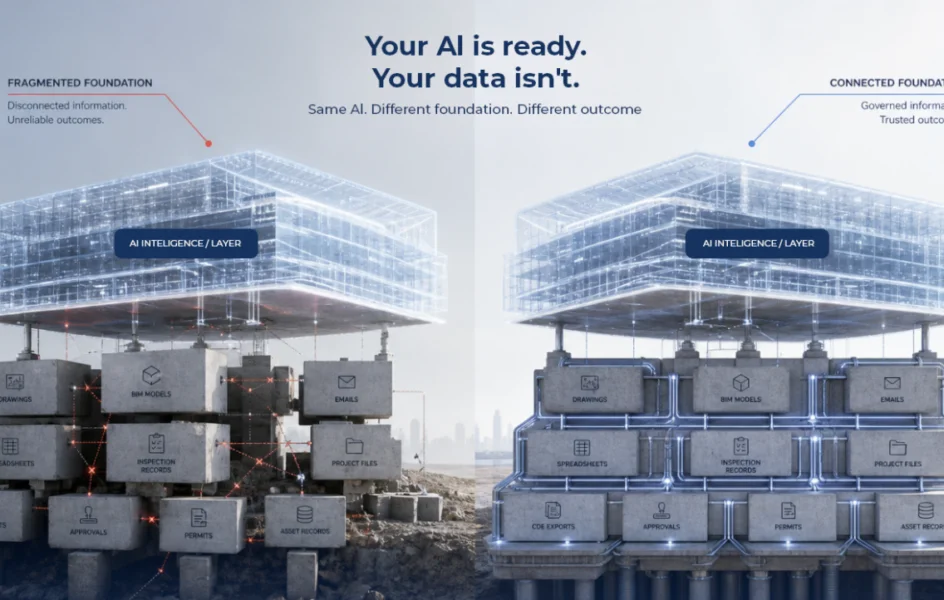
This is the condition in which AI is being deployed across construction. The AI is ready. The data isn’t. The question is what it is searching, and whether it can access the full context.
Andre Friedel, digital twin and data governance specialist: “AI will explain plausible nonsense to you, and it will sound convincing. The only way to prevent it is to have quality data at the base. A clean data foundation is a fundamental part of governance.” Listen to our German Podcast to learn more.
A 2024 study found that at least 30% of GenAI projects do not survive proof of concept. Three structural conditions explain why construction project data is especially exposed:
- Absent validation state. A file folder has no record of which version was approved, by whom, when, and whether a superseding version exists. Without that record, AI ingests all versions with equal confidence. This is not an AI limitation. It is a data architecture limitation.
- Fragmentation. Construction documents do not live in one place. The approved drawing is in the CDE. An older revision sits on the shared drive from last month’s coordination meeting. A subcontractor sent a working copy by email. Each has a plausible file name. None is flagged as superseded. The AI cannot know.
- Misplaced trust. When AI returns a confident answer from a fragmented, unvalidated environment, the engineer has no way to verify it without retrieving the original document. At that point the AI has saved nothing.
One query. Two environments. Two different answers.
Let’s take the query: “AHU-L3-01, commissioning specification, current approved revision.”
In an unvalidated file environment, the search returns four documents:
- Three are working drafts from different stages of the coordination process.
- One is the current approved specification.
- All four have plausible names.
- None is labelled superseded.
The commissioning engineer calls the project engineer to confirm which is current. That call takes twenty minutes. The commissioning team has already started work.
For the infrastructure owner, the cost is different. Every document that cannot be confirmed as current extends the risk window: not just for the commissioning decision, but for the regulatory record. An owner operating a critical facility for decades after construction cannot reconstruct what was approved and when, if the project archive does not carry a machine-readable governance record. The twenty-minute call is a project cost. The absent governance record is an operational risk.
Only one of those four documents carries the governance record: the approval date, the revision number, the status confirmation that says whether it is safe to commission from. That record is not a document property added after the fact. It is the output of the approval workflow. Without a system that reads it, the AI cannot use it.
When AI searches without access to that record, it returns documents. It does not return information the engineer can base a decision on. The engineer who needs to commission from an approved specification gets candidates, not a confirmed answer.
This gap is structural, not accidental. Fixing it requires a structural change: not a better search algorithm, and not more data discipline from the project team. It requires a data environment where the validation record is machine-readable, and an AI that reads it.
Thinkproject AI closes that gap by doing two things simultaneously: reading the content of every document in the environment, and using governance metadata to determine which results carry the authority to act on. That combination is what separates a search that returns results from a search that contextualises and explains them.
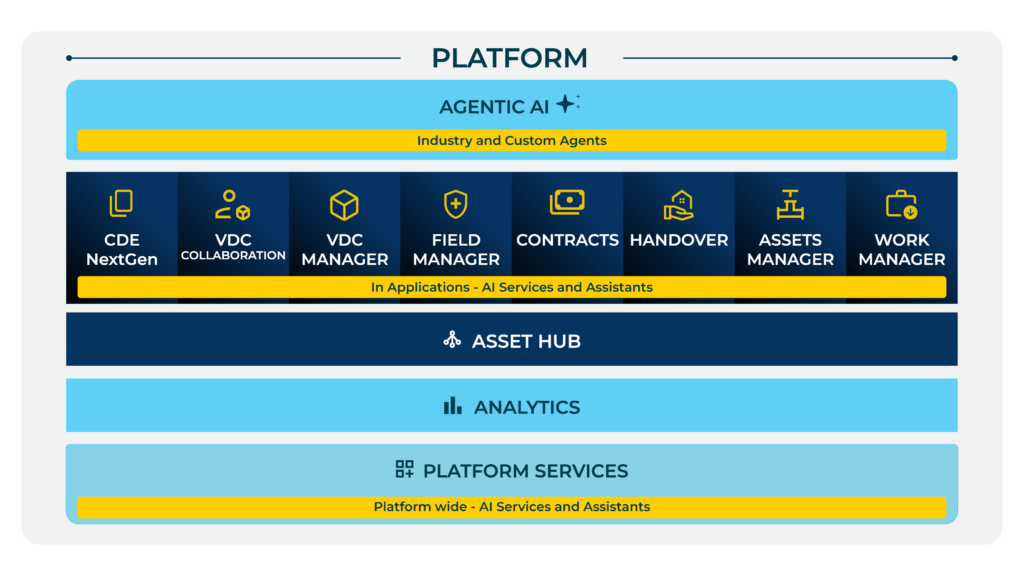
Two things simultaneously. Most systems do one.
The four-document problem in Section 2 is not a search volume problem. It is a search architecture problem. A standard search returns everything with a plausible name. It does not read inside the document. It does not know which version carries the approval that makes it safe to commission from. Thinkproject AI does both simultaneously in a governed CDE. Most systems do only one.
It reads.
Thinkproject AI extracts and indexes the content of every document in the environment: PDFs, Office documents, scanned drawings, and image attachments. When you ask a question, it searches the text inside the document, not just the filename or folder path, and only within documents the user has permission to access. If the AHU-L3-01 commissioning specification states an operating temperature range of 18 to 26 degrees Celsius, a query about temperature specifications for Level 3 equipment finds that sentence. If a commissioning record references a deviation from design intent, a query about outstanding deviations on AHU-L3-01 surfaces it.
It contextualises.
Every result is anchored to the governance state of the document it came from: the approval status, the revision history, and the permissions of the person asking. Only results from approved documents are surfaced for action.
The CDE’s structured approval record carries the full history for every document. Thinkproject AI reads that record. Currency is confirmed, not assumed.
The same commissioning engineer queries: “What are the approved performance specifications for the Air Handling Unit on Level 3, and has the installation been signed off?”
Thinkproject AI finds the performance specification documents for AHU-L3-01, drawing on document content. It returns a synthesised answer with the source document, its approval state, and the revision history. Earlier revisions remain accessible in the document history. The active specification is always the current approved revision. Results are scoped to each user’s access permissions. Follow-up queries continue within the same session.
The governance structure Thinkproject AI needs (approval workflows, metadata classification, permission management) is the same structure a well-run CDE already maintains.
The question is whether governance travels with the asset.
The approved record that answers the commissioning engineer’s query exists because it was governed from the moment it was created. The question is whether that governance travels with it.
- During construction. AHU-L3-01’s specification is issued in the NextGen CDE: approved, status-confirmed, permission-controlled. Inspection findings are logged against it in the field. When the responsible engineer raises a document revision, it goes through the same approval workflow. Every decision is recorded against the asset record from the first submission.
- At handover. The current approved specification, with every inspection finding and every sign-off recorded against it, is packaged and transferred to asset management as a verified record. The operations team is not starting from a handover folder. They are starting from a chain of governed decisions: each one traceable to source, each one approval-stamped.
- In operations. When a critical system requires maintenance, or when a decision needs to be justified against the original design specification, the question is not “where is the document?” It is “can this document prove what was approved, by whom, and when?” Governance that travels with the asset from construction through to operations is the only governance that answers that question.
An infrastructure owner managing assets across a portfolio of construction projects faces the same governance question repeated across every project: at handover, can each asset’s documentation prove what was approved, when, and by whom? The same approval structure, the same governance record, the same machine-readable validation state applies across every project. That is the foundation a portfolio-level project manager needs to manage delivery risk at scale.
Thinkproject AI in NextGen CDE is the first access point to that chain. The governed foundation that makes a search result traceable during construction is the same foundation that makes asset records defensible after handover.
The record enables the search. The search enables the decision.
In NextGen CDE, the architecture is clear: the CDE holds the governed record, Thinkproject AI contextualises it, and the engineer decides.
Search tools have always been fast. The commissioning engineer in Section 2 got four results in seconds. Speed was not the problem. Context was.
Thinkproject AI contextualises access to governed information: every result carries the approval state, the revision history, and the access scope of the person asking. For a contractor, that means fewer coordination errors. For a commissioning engineer, a confirmed answer in minutes instead of a 20-minute call. For an asset owner, a verified record across the operational life of the asset.
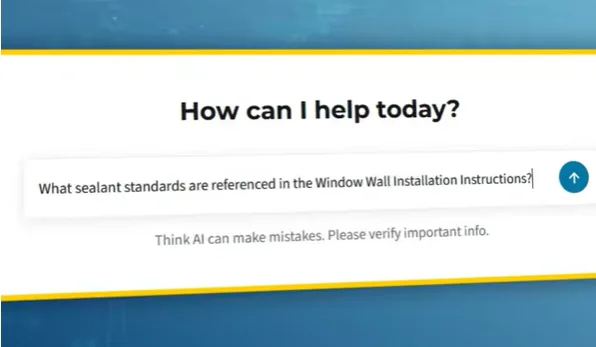
Thinkproject AI on NextGen CDE increases productivity because information arrives contextualised: approval state confirmed, revision history visible, access scope enforced. The commissioning engineer works from a confirmed answer. The project manager sees consistent governance state across all project packages. Decisions are faster because the context that grounds them is already in place. Where governance is absent, AI returns faster noise. Where governance is in place, Thinkproject AI delivers confirmed context the engineer can build decisions on.
Governed data is the precondition. Thinkproject AI is the access layer. The decision belongs to the engineer.
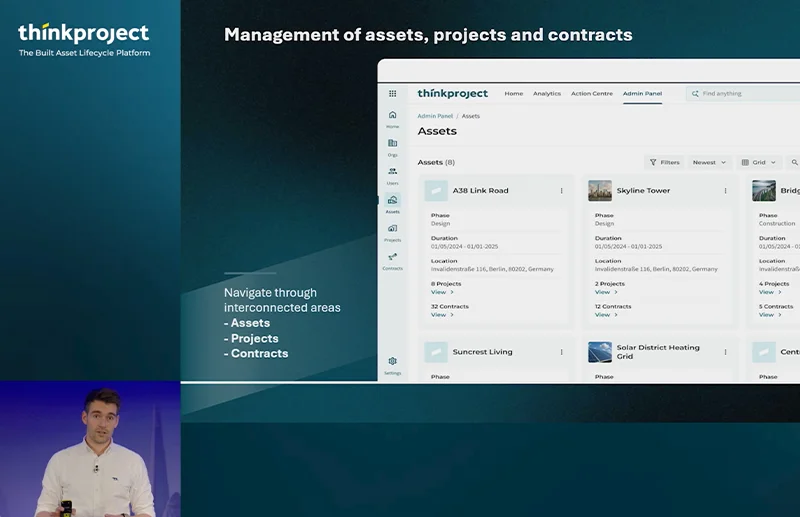
From fragmented systems to one connected, AI-enabled platform for the built asset lifecycle
See how organisations planning, building and operating complex assets reduce cost and risk with lifecycle-wide traceability, governed workflows and audit-ready information.
More resources
-
Blog

Digitalization
Construction business intelligence: Turning data into better decisions
Read moreLearn how construction business intelligence connects project data, improves reporting and supports better decisions across the asset lifecycle.
-
Blog

Contracts
Best construction contract management software: 11 features to look for
Read moreCompare the key features to look for in construction contract management software, from NEC, JCT and FIDIC workflows to audit trails and risk control.
-
Event

Built Asset Lifecycle Platform
Thinkproject Live London 2026
Register nowDiscover how AI and connected data are helping teams reduce risk, improve control, and make faster, smarter decisions across the project lifecycle.
-
Event

Built Asset Lifecycle Platform
Thinkproject Live Events 2026
Read moreJoin construction, infrastructure, and asset management leaders for a day focused on the future of project and asset delivery.
-
Blog
Contracts
JCT contract types: Choosing and managing the right contract
Read moreCompare the main JCT contract types, understand construction management contracts and learn how to choose and administer the right form.
-
Blog

Built Asset Lifecycle Platform
AI in construction: Uses, benefits and real-world examples
Read moreExplore how AI in construction improves planning, safety, project controls, handover and asset performance across the built asset lifecycle.
-
Blog
Health & Safety
Construction risk management: How to identify, assess and control project risks
Read moreLearn how to identify, assess and control construction risks across cost, safety, contracts, programmes and project information.
-
Blog
Digitalization
Your AI is ready. Your data isn’t.
Read moreAI is exposing a deeper problem in construction: fragmented project data. See why connected, governed information is the foundation for reliable AI.
-
Blog

Information Security
7 Construction cybersecurity risks that can disrupt project delivery
Read moreLearn how construction cybersecurity risks can disrupt project delivery and how secure CDEs, access controls and supplier governance reduce exposure.