
BIM collaboration: How connected project teams work better together
Building information modelling (BIM) enhances collaboration in construction by giving project teams a shared, visual and information-rich understanding of a built asset. Architects, engineers, contractors, BIM teams and owners can review models together, identify issues earlier and make decisions with clearercontext.
But effective BIM collaboration depends on more than sharing a model. The real challenge is keeping the context around models, issues and decisions connected as information moves between BIM specialists and the wider project team. Without that continuity, teams can end up collaborating through screenshots, spreadsheets, emails and disconnected applications instead of around the information itself.
What is BIM collaboration?
BIM collaboration is the process of using shared building information models and associated data to help multiple project participants review designs, exchange information, manage issues and make coordinated decisions. It gives different disciplines a common visual context while supporting structured communication around the model throughout design and construction.
BIM collaboration is vital in construction projects, because construction information rarely belongs to one discipline:
- An architect’s design affects structural requirements.
- Structural decisions affect building services.
- Building services influence spatial coordination and installation.
Changes in any of these areas can have consequences for contractors, specialist trades, schedules and asset owners. A shared model makes these relationships easier to see.
Instead of relying entirely on separate drawings, spreadsheets, emails and specialist applications, teams can review relevant information in a common visual context. They can see where an issue is located, understand which model elements are affected and discuss what needs to happen next. The model becomes a shared point of reference for conversations that might otherwise take place across disconnected systems.
However, simply putting several models in the same viewer does not guarantee effective collaboration. Teams also need processes for managing issues, responsibilities, revisions and approved information. That distinction becomes clearer when comparing BIM collaboration with BIM coordination.
BIM collaboration vs BIM coordination: What is the difference?
BIM collaboration and BIM coordination are closely connected, but they are not interchangeable:
- Coordination is typically concerned with aligning models, information and designs across disciplines.
- Collaboration is broader and describes how the people involved use that coordinated information to communicate, review issues and make decisions together.
This table illustrates the main differences:
| BIM collaboration | BIM coordination | |
|---|---|---|
Primary focus | Helping people and disciplines work together around shared BIM information | Aligning models and identifying inconsistencies between disciplines |
Typical activities | Model review, comments, issue assignment, discussion and decision-making | Model federation, model checking, validation and clash detection |
Participants | A broad range of project stakeholders, including people who may not use BIM authoring software | Often BIM managers, BIM coordinators, designers and specialist disciplines |
Main outcome | Shared understanding and clearer communication | Better coordinated and more reliable models |
Relationship | Uses coordinated information to support multidisciplinary teamwork | Provides reliable model information that supports collaboration |
However, the two activities reinforce one another:
- BIM coordination can identify a problem, such as two systems occupying the same space.
- BIM collaboration provides the environment in which the relevant people can understand the problem, discuss it in context, assign responsibility and follow it through to resolution.
This connection becomes especially important as projects move closer to construction, creating a transition from BIM coordination to field execution, where coordinated model decisions can become practical information teams can use during delivery.
How does BIM enhance collaboration in construction?
BIM enhances collaboration by giving project participants a common context for understanding the design and the issues surrounding it.
When supported by structured workflows, teams can review multidisciplinary information, identify problems and communicate decisions more clearly. In practice, BIM collaboration improves several important parts of multidisciplinary project delivery.
Gives project teams a shared visual understanding of the design
Construction projects bring together people with very different areas of expertise. A mechanical engineer, architect, construction manager and asset owner may all look at the same design from different perspectives.
A federated 3D model gives these participants a common visual reference. Depending on their role, they can:
- navigate the design and focus on relevant areas
- select objects and inspect their properties
- filter model information
- use measurements and section cuts to investigate the design.
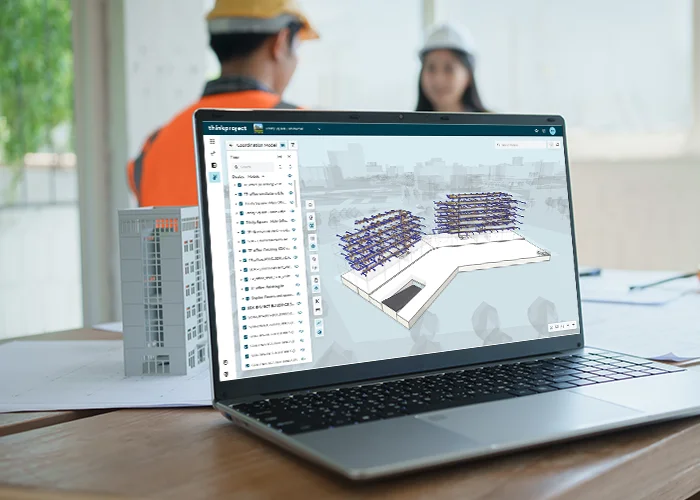
Thinkproject VDC COLLABORATION provides browser-based access to federated multidisciplinary models, allowing stakeholders to review project information without BIM authoring software.
This makes multidisciplinary conversations easier to follow. Instead of describing a problem and asking others to interpret its location, participants can review the same model context together.
Brings different disciplines together for coordinated model review
Architectural, structural, building services and specialist models are often developed separately. Federating them gives teams a shared view of how these disciplines interact.
Project participants can review the combined model, discuss areas requiring attention and create issues against precise locations. This gives conversations clearer context than text-based communication alone.
Open standards also help teams exchange information. BIM Collaboration Format (BCF), for example, supports the exchange of model-based issues, viewpoints, comments and statuses.
Thinkproject VDC COLLABORATION supports BCF-based issue management, including assignment, discussions and status workflows. This gives teams a structured way to communicate what needs attention, where the issue occurs and who needs to act.
Finds design conflicts early and turns them into coordinated action
Model checking can identify clashes, missing information and other potential problems before they reach the construction site. But detecting an issue does not resolve it.
Teams also need to understand:
- where the issue occurs
- which objects and disciplines are involved
- who is responsible
- what action is required
- whether the issue has been resolved.
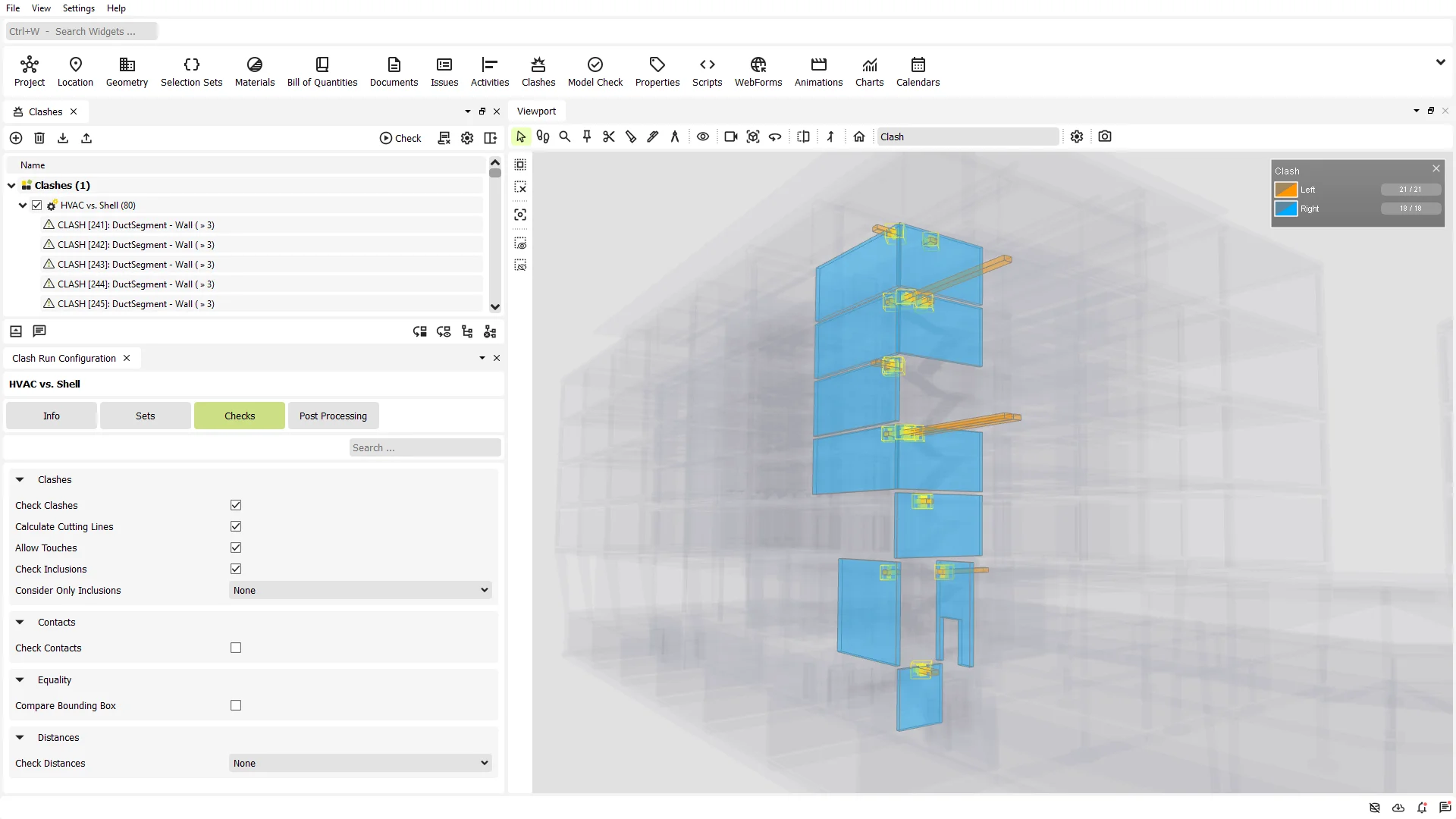
VDC COLLABORATION includes simplified in-browser clash detection, giving architects and engineers immediate feedback on model conflicts without installing specialist software, so cleaner revisions reach BIM Coordinators faster. For advanced model validation, rule-based checking and expert clash analysis, BIM specialists use VDC MANAGER.
Issues from both environments synchronise bidirectionally between VDC COLLABORATION and VDC MANAGER, keeping the wider project team connected to coordination progress.
This creates continuity between BIM validation and multidisciplinary coordination, rather than relying on screenshots, spreadsheets or disconnected issue lists.
Lets project teams collaborate across different BIM tools
Construction organisations rarely use exactly the same BIM software. Architects, engineers, contractors and specialist designers may all need different authoring and analysis applications.
Effective BIM collaboration should therefore allow information to move between different environments. Open formats help achieve this. Industry Foundation Classes (IFC) can support model exchange, while BCF supports issue-based communication.
Thinkproject’s VDC solutions support Open BIM workflows using standards such as IFC and BCF, reducing the need for every participant to work in the same authoring environment. Teams can continue using appropriate specialist tools while exchanging the information needed for multidisciplinary collaboration.
Makes BIM information accessible beyond specialist teams
Effective BIM collaboration does not mean putting every project participant into the same specialist BIM application. Different roles need different levels of functionality.
BIM managers and coordinators need specialist capabilities for model validation, clash detection and advanced BIM workflows. Project managers, engineers, owners and other stakeholders may instead need to understand models, review issues, make decisions and track responsibilities.
Thinkproject addresses these different needs through two connected environments:
- VDC MANAGER gives BIM specialists the depth required for model validation, clash detection and advanced BIM analysis, operating as the System of Execution where expert work happens before results surface to the wider team.
- VDC COLLABORATION gives the wider project team accessible, browser-based model review and issue management.
Connecting the two helps turn specialist BIM outputs into project action without requiring every stakeholder to become a BIM expert.
Connects model decisions with governed project information
BIM collaboration becomes harder when the model is current but the surrounding information is not. Teams need confidence that they are reviewing the right model revision and that decisions remain connected to the information behind them.
This is where BIM collaboration and a common data environment (CDE) work together.
A CDE provides governance around project information, including versions, metadata, reviews, approvals and access. Connecting this controlled information with model-based collaboration helps teams avoid working from uncontrolled files, screenshots or outdated local copies.
Thinkproject VDC COLLABORATION connects model review and issue management with the wider Thinkproject information environment. Instead of allowing coordination decisions to disappear into separate spreadsheets or email chains, teams can retain the model context, issue history, responsibility and project information around the decision.
The result is not simply better model sharing, but a more traceable flow of information between the people making and acting on project decisions.
Connects BIM collaboration with the wider delivery process
BIM collaboration should ultimately support what happens on the project, not stop at the coordination meeting.
Once a design or coordination decision results in an action, teams need to know that it has been assigned, completed and evidenced. Otherwise, the connection between digital coordination and physical execution can break down.
This is part of the wider Thinkproject platform approach. VDC solutions support model validation and coordination, while FIELD MANAGER supports governed field processes such as inspections, quality checks, observations, defects and follow-up.
Applying consistent governance across BIM coordination and field processes can help organisations improve visibility, traceability and accountability throughout project delivery.

What should BIM collaboration software help your team do?
Choosing BIM collaboration software should start with the way people need to work, not with a checklist of technical functions.
The right capabilities depend on project requirements, delivery methods and the organisations involved. However, effective software should make it easier to understand models, coordinate across disciplines, communicate issues and maintain the information context behind decisions.
| Capability | Why it matters for collaboration |
|---|---|
Federate multidisciplinary models | Gives participants a shared view of architectural, engineering and specialist information so they can review relationships between disciplines. |
Provide browser-based 3D viewing | Makes model information accessible to stakeholders who do not work in BIM authoring applications. |
Inspect model objects and properties | Helps teams understand the information associated with individual elements, not just their geometry. |
Support model-based issue management | Keeps discussions connected to the relevant model location and gives teams clearer responsibility and status information. |
Support open standards such as IFC and BCF | Helps different organisations exchange information while continuing to use appropriate specialist tools. |
Run initial clash checks in the browser | Gives modelers immediate feedback on conflicts without specialist software, so cleaner revisions reach coordination earlier. |
Connect model checking with review | Keeps the wider team connected to expert BIM findings without requiring specialist tool access. |
Control roles and permissions | Helps organisations collaborate while maintaining appropriate access to project information. |
Maintain issue history and traceability | Preserves the context of model-based discussions and decisions throughout the project. |
Connect models with governed project information | Helps teams work with controlled documents, workflows and records alongside model information. |
Support structured information management | Helps organisations establish clear processes for information creation, review, approval and exchange. |
These capabilities should be considered as part of a wider information management strategy. Our guide to BIM software explains the different types of technology involved and how they support BIM processes.
Technology also needs appropriate information management processes around it. ISO 19650 provides an international framework for managing information over the lifecycle of a built asset using BIM. It places emphasis on clearly defined information requirements, responsibilities and controlled information processes.
But software alone cannot create collaboration. A model viewer will not solve unclear responsibilities, and clash detection will not help if nobody owns the resolution process. Effective BIM collaboration combines technology with information governance and clearly defined ways of working.
Better BIM collaboration starts with connected information
BIM can give project teams a shared understanding of the design. But the value of collaboration depends on what happens to that information next.
A clash may begin with a BIM specialist and move into multidisciplinary coordination, while the resulting project decisions may ultimately influence activities on site. At every stage, teams need to retain the context around the issue: what was identified, where it occurred, who was responsible, what was decided and what happened next.
This is why effective BIM collaboration requires more than a model viewer or standalone coordination tool. It needs connected workflows that bring together:
- specialist BIM validation and model assurance
- accessible model review for the wider project team
- structured issue management and responsibilities
- governed project information
- field execution and evidence
- information that remains useful towards handover and operations.
This connected approach sits at the heart of the Thinkproject Platform.
- VDC MANAGER gives BIM specialists the depth needed to validate and analyse models.
- VDC COLLABORATION makes that information accessible for wider project coordination.
- FIELD MANAGER supports governed inspections, QSHE processes and field workflows.
- Together with Thinkproject’s CDE and wider platformcapabilities, these solutions support greater consistency, governance and information continuity across teams and project stages.
Better BIM collaboration is therefore not simply about getting more people into the model. It is about keeping the information, decisions and actions around that model connected and useful.
See how BIM collaboration and governed field processes can support more consistent project delivery. Watch the on-demand webinar, Introducing the future of field execution and BIM collaboration, to discover the complementary roles of VDC MANAGER, VDC COLLABORATION and FIELD MANAGER within the Thinkproject portfolio.
More resources
Innovation Series
Built Asset Lifecycle Platform
Thinkproject Live and Recorded Webinars
Read moreLive and recorded webinars for teams that design, build, operate, and maintain the assets that shape our physical world.
-
Blog
Asset Management
From delivery to lasting performance: four governance priorities for Spain’s asset owners
Read moreDiscover four asset governance priorities that help Spain’s asset owners improve information reliability, flexibility, decision speed and ROI.
-
Blog
Built Asset Lifecycle Platform
Construction project life cycle: 6 phases from concept to handover
Read moreUnderstand the construction project life cycle, from feasibility and design to procurement, construction, commissioning and handover.
-
Blog

Field Management
Thinkproject HANDOVER: Turn project information into operations-ready asset data
Read moreDiscover how Thinkproject HANDOVER helps asset owners and contractors reduce information gaps and deliver validated asset data from construction into operations.
-
Event

Built Asset Lifecycle Platform
Thinkproject Live London 2026
Join the waitlistDiscover how AI and connected data are helping teams reduce risk, improve control, and make faster, smarter decisions across the project lifecycle.
-
Event

Built Asset Lifecycle Platform
Thinkproject Live Events 2026
Read moreJoin construction, infrastructure, and asset management leaders for a day focused on the future of project and asset delivery.
-
Blog

Asset Management
Asset lifecycle management in construction: From planning to decommissioning
Read moreLearn how asset lifecycle management connects planning, construction, handover, operations and maintenance to improve built asset performance.
-
Blog

BIM
Browser-based BIM viewer performance: 10 factors that affect large IFC models
Read moreDiscover what impacts browser-based BIM viewer performance - from geometry and IFC file quality to client hardware and network. A technical guide for BIM teams.
-
Blog

BIM
8 best BIM collaboration software systems for construction teams
Read moreExplore the best BIM collaboration software systems, from CDEs and model coordination to issue tracking, document control, field collaboration, and handover.