
ISO 19650: A Practical Guide to BIM Information Management
As BIM projects grow in scale and complexity, managing information effectively becomes increasingly important. ISO 19650 provides an international framework for creating, sharing, and maintaining information throughout the asset lifecycle, helping teams improve collaboration, information quality, and project outcomes.
In this guide, we’ll explain what ISO 19650 is, how it relates to BIM information management, the role of the Common Data Environment (CDE), and the practical steps organisations can take to implement ISO 19650 successfully.
What is ISO 19650?
ISO 19650 is an international standard for managing information over the whole lifecycle of a built asset using Building Information Modelling (BIM).
It provides a framework for:
- Managing project and asset information consistently
- Defining information requirements
- Establishing roles and responsibilities
- Supporting collaboration across stakeholders
- Controlling information within a Common Data Environment (CDE)
- Maintaining information quality throughout delivery and operation

The standard evolved from the UK’s PAS 1192 framework and has since become the internationally recognised approach to BIM information management.
ISO 19650 is not a software standard and it is not a BIM authoring standard. Instead, it defines the processes, governance principles, and responsibilities required to ensure information remains accurate, traceable, and usable throughout the lifecycle of an asset.
💡 ISO 19650 across the UK, France, and Germany
In the UK, ISO 19650 is closely associated with Common Data Environments, BIM information management, and public-sector project requirements.
In France, searches may use terms such as norme ISO 19650 and norme ISO 19650 BIM alongside broader BIM terminology.
In Germany and across DACH markets, buyers may search for DIN EN ISO 19650 and often connect the topic to BIM software, project collaboration, and construction information management.
The standard itself is international, but terminology and buying language vary by market.
The main parts of the ISO 19650 series
ISO 19650 is a series of regulations, consisting of several parts that address different aspects of information management throughout the asset lifecycle.
ISO 19650 part | What it covers |
|---|---|
ISO 19650-1 | Concepts and principles for information management using BIM |
ISO 19650-2 | Information management during the delivery phase of assets |
ISO 19650-3 | Information management during the operational phase of assets |
ISO 19650-4 | Information exchange and the quality of information exchange |
ISO 19650-5 | Security-minded approach to information management |
ISO 19650-6 | Health and safety information management |
Most introductory discussions about ISO 19650 focus on Parts 1 and 2 because they establish the core principles and processes used during project delivery.
However, organisations responsible for operating and maintaining complex assets should also understand Parts 3, 4, 5, and 6. These parts address operational information management, information exchange requirements, security considerations, and health and safety information, all of which contribute to effective lifecycle information management.
ISO 19650 and the Common Data Environment
One of the concepts most closely associated with ISO 19650 is the Common Data Environment (CDE). A Common Data Environment is a governed environment used to collect, manage, review, approve, and distribute project information.
Rather than relying on disconnected file shares, email chains, and local storage, a CDE provides a structured approach to information management that helps ensure stakeholders are working with the correct information at the correct time.
A well-governed CDE helps organisations:
- Maintain version control
- Manage document approvals
- Track information status
- Support collaboration between project teams
- Maintain complete audit trails
- Improve information quality and consistency
Importantly, ISO 19650 does not prescribe a specific technology platform. Organisations can use different software solutions provided they support the governance, traceability, and information management requirements defined by the standard.
However, as projects increase in complexity, many organisations find that spreadsheets, shared folders, and email-based processes become difficult to govern effectively.
Thinkproject’s NextGen CDE serves as a governed information backbone that enables controlled document management, structured collaboration, review and approval workflows, metadata management, version control, and audit-ready traceability across the asset lifecycle. It is designed to support ISO-aligned information governance while maintaining flexibility for different project delivery approaches. flexibility for different project delivery approaches.
How to implement ISO 19650 in construction projects
Successfully implementing ISO 19650 requires more than creating new templates or updating naming conventions. It involves establishing repeatable information management processes that support collaboration, accountability, and information quality throughout the asset lifecycle.
While implementation approaches vary between organisations and projects, the following steps provide a practical framework for adopting ISO 19650 principles.

1. Define your information requirements
One of the most common challenges on construction and infrastructure projects is collecting large volumes of information without clearly defining how that information will be used. This often results in duplicated effort, inconsistent data quality, and information that provides little value to project teams or asset operators.
ISO 19650 encourages organisations to establish information requirements before project delivery begins. These requirements typically include:
- Organisational Information Requirements (OIR)
- Asset Information Requirements (AIR)
- Project Information Requirements (PIR)
- Exchange Information Requirements (EIR)
Together, these requirements help define the information needed to support business objectives, operational outcomes, and project delivery decisions.
2. Set clear roles and responsibilities
Any information management process can fail if project participants do not understand who is responsible for creating, reviewing, approving, and maintaining information.
ISO 19650 introduces several key information management roles, including:
- Appointing Party
- Lead Appointed Party
- Appointed Parties
Depending on the project structure, organisations may also assign responsibilities to BIM managers, BIM coordinators, information managers, document controllers, and project delivery teams.
Each participant should clearly understand:
- Their information management responsibilities
- Approval and review requirements
- Information exchange obligations
- Quality assurance expectations
Establishing clear ownership helps improve collaboration and ensures information management becomes part of everyday project delivery rather than a separate administrative exercise.
3. Establish information delivery processes
ISO 19650 places significant emphasis on structured information delivery. Rather than relying on informal exchanges or ad hoc document sharing, organisations should establish repeatable processes that govern how information is created, reviewed, approved, and shared.
These processes typically define:
- Information production methods
- Review and approval workflows
- Information exchange milestones
- Quality assurance procedures
- Responsibilities at each stage of the information lifecycle
For example, design information may need to pass through multiple review stages before being approved for coordination or construction. Clear workflows help ensure stakeholders understand when information is suitable for use and who is responsible for approving it.
4. Standardise naming conventions, metadata, and information containers
Without standardisation, project teams often develop different naming approaches, metadata structures, and document management practices. This can make information difficult to find, difficult to validate, and difficult to use throughout the asset lifecycle.
ISO 19650 encourages organisations to establish common rules for information containers, naming conventions, metadata, and classification systems.
Examples may include:
Information element | Example |
|---|---|
Status code | S0, S1, A |
Revision | P01, P02, C01 |
Discipline | ARC, STR, MEP |
Metadata | Asset type, location, contractor |
Standardisation provides several benefits:
- Improved searchability: Project teams can find information more quickly and reduce the risk of using outdated or incorrect documents.
- Improved reporting and automation: Consistent metadata enables organisations to generate more reliable reports, dashboards, and analytics.
- Strengthened auditability: Standardised information structures make it easier to demonstrate compliance with project requirements and information management processes.
5. Use a CDE to manage reviews, approvals, and version control
While policies, procedures, and governance frameworks are important, organisations need a practical way to manage information consistently across projects, disciplines, and supply chain partners. A CDE helps bring these requirements together in a controlled environment.
One of the key concepts associated with ISO 19650 is the progression of information through different states. Although implementations vary between organisations, information typically moves through the following stages:
Information state | Purpose |
|---|---|
Work in progress | Information currently being developed |
Shared | Information available for coordination and review |
Published | Approved information suitable for its intended use |
Archived | Historical information retained for future reference |
This structured approach helps ensure that project teams understand which information can be relied upon at different stages of delivery.
For organisations evaluating CDE platforms, our CDE Checklist provides a practical framework for assessing information management capabilities:
6. Apply security-minded information management
ISO 19650-5 introduces a security-minded approach to information management. The objective is to balance collaboration with appropriate protection of sensitive information.
This is particularly important on infrastructure, transportation, energy, defence, and public-sector projects where information may have operational, commercial, or security implications.
Organisations should consider:
- Information sensitivity
- Access permissions
- User authentication
- Data protection requirements
- Supply chain access controls
- Information sharing procedures
Not all project information should be accessible to every stakeholder. For example, commercial data, security-related information, or operational asset records may require additional controls.
Security-minded information management does not mean restricting collaboration unnecessarily. Instead, it means implementing governance processes that enable teams to work efficiently while protecting sensitive information appropriately.
7. Prepare information for handover and asset operation
Asset owners and operators rely on accurate information to manage maintenance, inspections, compliance requirements, asset performance, and long-term investment decisions. If information is incomplete, inconsistent, or difficult to access, operational teams may spend significant time recreating information that should already exist.
ISO 19650 encourages organisations to consider operational requirements from the earliest stages of a project:
- Defining asset information requirements early
- Collecting information progressively throughout delivery
- Validating information before handover
- Linking supporting documentation to asset records
- Ensuring operational teams receive usable information
Rather than treating handover as a single event at project closeout, many organisations are moving towards continuous information delivery throughout the project lifecycle. This approach reduces the risk of last-minute information gaps and helps improve operational readiness.
8. Monitor, audit, and improve information workflows
Information management processes need to evolve alongside organisational requirements, project complexity, technology changes, and lessons learned from delivery teams. Organisations should establish mechanisms to monitor information management performance and identify opportunities for improvement.
This may include:
- Information quality audits
- Governance reviews
- Compliance assessments
- Stakeholder feedback
- Process improvement initiatives
Useful performance indicators might include:
- Information approval cycle times
- Information completeness rates
- Metadata accuracy
- Number of information-related issues
- Workflow turnaround times
- Handover readiness performance
Regular reviews help organisations identify bottlenecks, improve collaboration, and maintain confidence in information quality.

ISO 19650 requirements: what organisations need in practice
Although implementation approaches vary between organisations, most ISO 19650-aligned information management frameworks include the following elements:
- Defined organisational, project, and asset information requirements
- Clearly assigned roles and responsibilities
- Standardised naming conventions and metadata structures
- Controlled information review and approval processes
- Version control and information status management
- Common Data Environment workflows
- Security-minded information governance
- Information quality assurance procedures
- Structured handover and operational readiness processes
- Ongoing monitoring, auditing, and continuous improvement
The benefits of an ISO 19650 implementation
For many organisations, ISO 19650 implementation delivers benefits that extend well beyond compliance. By improving how information is managed, organisations can strengthen collaboration, reduce risk, and create greater long-term value from project data.
Improved information quality
Structured processes help ensure information is complete, consistent, and reliable. Clear requirements, approval workflows, and governance procedures reduce the likelihood of missing or inaccurate information entering project workflows.
Reduced project risk
Project teams often make critical decisions based on information created by multiple stakeholders. ISO 19650 helps reduce the risk of teams working from outdated, unapproved, or incomplete information by introducing controlled review and approval processes.
Better collaboration across stakeholders
Construction and infrastructure projects involve asset owners, consultants, contractors, subcontractors, and operators. A shared information management framework helps these stakeholders collaborate more effectively while maintaining accountability and traceability.
Faster handover and operational readiness
When information is managed consistently throughout delivery, organisations spend less time collecting, validating, and correcting information during project closeout. This supports smoother transitions into operation and reduces the risk of information loss.
Stronger asset lifecycle management
ISO 19650 promotes lifecycle thinking rather than project-only information management. As a result, asset owners are better positioned to use project information to support maintenance, compliance, operations, and future investment decisions.
How a CDE supports ISO 19650-aligned information management
While ISO 19650 is a process standard rather than a technology standard, many of its principles become significantly easier to implement using a governed Common Data Environment.
A CDE supports ISO 19650-aligned workflows by providing:
- Information governance: Information can be managed using consistent workflows, permissions, metadata standards, and approval processes.
- Controlled reviews and approvals: Project teams can review, comment on, and approve information through structured workflows rather than relying on email chains and manual tracking.
- Auditability: Every change, approval, and information exchange can be recorded and traced, helping organisations demonstrate accountability and compliance.
- Information continuity: Validated information can move more effectively between project phases, supporting delivery, handover, and operations.
- Lifecycle traceability: Information remains connected to the wider asset context, helping organisations maintain continuity throughout the built asset lifecycle.
Build ISO 19650-ready information workflows with Thinkproject
ISO 19650 is ultimately about ensuring the right information reaches the right people at the right time. Achieving this requires more than document storage. Organisations need structured governance, clear accountability, controlled workflows, and technology that supports information continuity throughout the asset lifecycle.
The Thinkproject Platform helps organisations connect information across project delivery, handover, operations, and asset management. Through governed document management, workflow automation, audit-ready traceability, lifecycle information continuity, and secure collaboration, organisations can establish information management processes that align with ISO 19650 principles while supporting broader business objectives.
By connecting project delivery, handover, and operational information in a single environment, Thinkproject helps organisations establish consistent information management practices while reducing the risks associated with fragmented project data.
Whether you are establishing BIM information management processes for a single project or standardising information governance across an entire portfolio, a structured and lifecycle-focused approach can help improve both project outcomes and long-term asset performance.
Discover how Thinkproject’s NextGen CDE helps organisations implement ISO 19650-aligned information management at scale.
Frequently Asked Questions about ISO 19650
ISO 19650 is relevant for any organisation responsible for creating, managing, reviewing, approving, or using project information. This may include asset owners, operators, BIM managers, information managers, document controllers, consultants, contractors, subcontractors, and project managers.
SharePoint can support some document management requirements, but ISO 19650 compliance depends on governance processes rather than software alone. Organisations must be able to manage metadata, version control, workflows, approvals, permissions, audit trails, and information governance consistently. Many organisations use dedicated construction-focused CDE platforms to support these requirements more effectively.
ISO 19650 compliance generally refers to following the principles and information management processes defined by the standard. Certification usually involves independent assessment against recognised schemes or frameworks. Requirements vary between countries, clients, and industries.
ISO 19650 is not universally mandatory. However, many public-sector clients, infrastructure owners, and major project organisations increasingly expect suppliers and project teams to demonstrate ISO 19650-aligned information management practices. Specific requirements depend on local regulations, procurement frameworks, and project requirements.
BIM is a broader methodology for creating, managing, and using digital information about built assets.
ISO 19650 provides the information management framework that supports BIM implementation. In simple terms, BIM describes how digital information is used, while ISO 19650 defines how that information should be managed, governed, and exchanged throughout the asset lifecycle.
Implementation timelines vary depending on organisational maturity, project complexity, existing processes, and technology. Some organisations may establish core information management processes within a few months, while enterprise-wide implementation programmes can take considerably longer.
Common challenges include:
- Treating ISO 19650 as a documentation exercise
- Failing to define information requirements clearly
- Inconsistent naming conventions
- Weak metadata management
- Poor governance and accountability
- Limited stakeholder training
- Delaying handover planning until project closeout
- Using unmanaged file-sharing processes instead of governed information workflows
Organisations that focus on practical implementation, governance, and continuous improvement are typically better positioned to realise the full benefits of ISO 19650.
More insights
Innovation Series

Asset Management
Thinkproject ASSET HUB, ASSET MANAGER & WORK MANAGER | Live Webinar
Register nowAttend the live webinar on 16th September 2026, to learn more about the new Thinkproject ASSET HUB and the new releases coming to Thinkproject ASSET MANAGER and WORK MANAGER.
-
Blog

CDE
7 Best Common Data Environment Software Types for Construction
Read moreLearn the best common data environment software types for construction and how to choose the right CDE for project and asset data.
-
Event

Built Asset Lifecycle Platform
Thinkproject Live London 2026
Register nowDiscover how AI and connected data are helping teams reduce risk, improve control, and make faster, smarter decisions across the project lifecycle.
-
Blog

Asset Management
Construction handover management: Procedure, plan and checklist
Read moreLearn how to manage construction handover with a clear procedure, site checklist, required documents and digital handover workflows.
-
Event

Built Asset Lifecycle Platform
Thinkproject Live Events 2026
Read moreJoin construction, infrastructure, and asset management leaders for a day focused on the future of project and asset delivery.
-
Blog
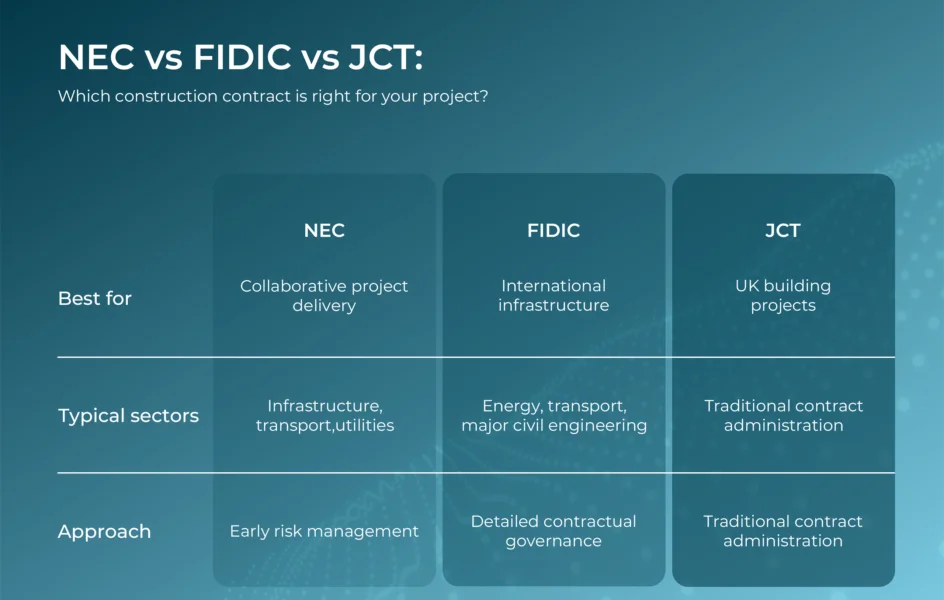
Contracts
NEC vs FIDIC vs JCT: Which construction contract should you use?
Read moreCompare NEC, FIDIC and JCT contracts by risk, roles, changes, delays and disputes to choose the right suite for your construction project.
-
Blog

Contracts
A guide to construction contract management: types of contracts, process and software
Read moreLearn how to manage construction contracts, control changes and payments, reduce risk, and keep project obligations on track.
-
Blog

CDE
Beyond document management: How NextGen CDE and HANDOVER are reshaping information management
Read moreDiscover how NextGen CDE and Handover help organisations move beyond document management with governed information that supports the full asset lifecycle.
-
Blog

CDE, Contracts
The hidden problem in project controls reporting: data confidence
Read moreMany project controls teams spend more time validating data than analysing performance. Discover why reporting confidence breaks down and how connected project information improves visibility and decision-making.