
A guide to construction document management: process, standards and best practices
Construction projects generate vast volumes of data: drawings, models, RFIs, contracts, and compliance records must all move between stakeholders at speed and with precision. If this flow of data breaks down, projects face delays, disputes, and rising costs.
This is where construction document management becomes critical. It is not simply about storing files, but about ensuring that the right information is available to the right people at the right time, in the right status and version, with ownership and traceability, across the entire lifecycle of a built asset.
In this guide, we explore construction document management best practices, why the process matters, and how a centralised approach helps reduce risk and improve outcomes across delivery, handover, and operations.
What is construction document management?
Construction document management is the structured process of creating, organising, sharing, controlling, and storing project information throughout the lifecycle of a construction project.
At its core, it ensures that all stakeholders are working from accurate, up-to-date information. This includes drawings, models, specifications, contracts, and site records.
From Thinkproject’s perspective, construction document management goes even further. It is not just about managing documents in isolation. It is about connecting information across the entire built asset lifecycle: from planning and design through to construction, handover, and operation. By centralising information in a controlled environment, teams can collaborate more effectively, maintain compliance, and make better decisions.
In practice, “document management” is really information governance: how information is created, reviewed, approved, shared, and can demonstrate who approved what, when.
Why document management for construction projects is non-negotiable
Regulatory drivers
Regulation is a key driver for structured document management construction practices. ISO 19650 has become the global standard for managing information in projects using Building Information Modelling (BIM). In the UK, compliance is mandatory for central government projects and increasingly expected across the private sector.
The IMI Framework (formerly the UK BIM Framework) builds on this standard, embedding document management requirements into procurement processes. Without a compliant approach, organisations risk being excluded from major opportunities.
Contractual requirements
Modern construction contracts now explicitly require robust information management. NEC4 and JCT contracts often mandate the use of a Common Data Environment (CDE), along with defined processes for information exchange.
This means document management is no longer optional or informal. It is a contractual obligation that must be clearly defined, consistently applied, and auditable. In practice, this also means maintaining a defensible, time-stamped record of communications, submissions, and approvals.
Commercial impact
Poor document management has direct financial consequences. Industry research consistently shows that a significant proportion of rework on construction projects is caused by incorrect or outdated information.
A high amount of construction rework can be attributed to poor information management. This translates into lost time, increased costs, and strained relationships across the supply chain.
Lifecycle and ESG implications
The importance of document management extends beyond construction. Regulations such as the Corporate Sustainability Reporting Directive (CSRD) and the EU Taxonomy are increasing demand for reliable, auditable lifecycle data.
This data begins during design and construction. If information is incomplete or inconsistent at this stage, it becomes difficult to support sustainability reporting, handover readiness, asset performance analysis, and long-term maintenance. This is why many organisations now treat document management as lifecycle information governance not just a project task.
How a CDE supports construction document management
A Common Data Environment (CDE) is the foundation of effective construction document management. It provides a single source of truth where all project information is stored, managed, and shared.
Operationally, a CDE enables:
- Controlled document workflows with defined status transitions
- Version management to ensure teams always access the latest information
- Role-based access to protect sensitive data
- Full audit trails for compliance and dispute resolution
What separates a purpose-built CDE from generic file storage or tools like SharePoint is its alignment with construction processes. A dedicated CDE is designed to support ISO 19650 workflows, BIM coordination, and complex supply chains.
Rather than acting as a passive repository, it actively manages how information moves through the project.
A CDE doesn’t just “store” files. It enforces naming conventions, workflows, approvals, and status (e.g., Work in Progress, Shared, Published), so teams can prove what was issued, when, and by whom.
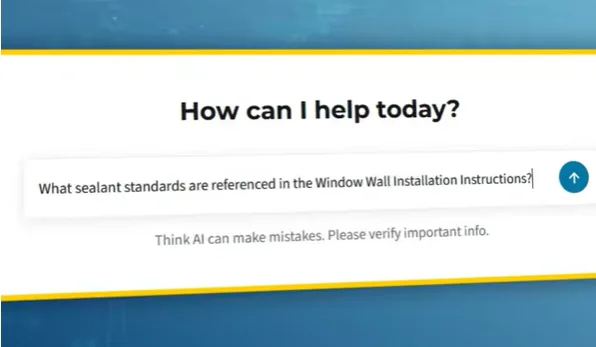
AI-assisted search can also help users find governed information faster based on access rights while governance and accountability remain with the user.
The construction document management process, step by step
Construction document management is not a single task but a structured process that spans the entire project lifecycle. From initial set-up through to operations, each stage plays a role in ensuring information is accurate, accessible, and controlled. The following steps outline how an effective process works in practice.
1. Project set-up
The construction document management process begins with establishing the CDE. This includes defining naming conventions aligned with standards such as ISO 19650, setting up roles and permissions, and configuring workflows.
At this stage, the Information Delivery Plan is also created, outlining how and when information will be produced and shared.
2. Procurement and appointment
During procurement, document management supports the creation and distribution of tender documents, contract formation, and supplier onboarding.
Information requirements such as the Employer’s Information Requirements (EIR) and Asset Information Requirements (AIR) are defined, ensuring all parties understand what data must be delivered.
3. Design
In the design phase, document management construction processes enable collaboration between disciplines. Both model-based and document-based information are exchanged through structured workflows.
Status codes such as Work in Progress (WIP), shared, and published ensure clarity on the maturity of information. Model coordination and clash detection are closely linked to document workflows, reducing the risk of design conflicts.
4. Construction
During construction, the volume of information increases significantly. RFIs, technical submissions, change requests, and site records must be managed efficiently.
Document management ensures that drawing revisions are controlled, approvals are tracked, and site teams have access to the latest information. Mobile access becomes particularly important, enabling teams to capture evidence (photos, checklists, inspections) and link it back to the controlled record.
5. Handover
Handover is a critical phase where structured information transfer is essential. As-built models, operation and maintenance (O&M) manuals, commissioning records, and asset data must be delivered in a consistent format.
Frameworks such as Government Soft Landings and ISO 19650-3 emphasise the importance of this structured handover, ensuring that asset owners receive usable, high-quality information.
6. Operations
Construction document management does not end at handover. Information must be retained, updated, and managed throughout the operational life of the asset.
Version-controlled updates support maintenance and refurbishment activities, while accurate records are essential for eventual decommissioning.
Standards that govern construction document management in the UK
Construction document management in the UK is shaped by a well-defined set of standards, frameworks, and contractual requirements. These provide a consistent approach to how information is created, structured, shared, and maintained across the lifecycle of a built asset.
- ISO 19650 (Parts 1–5): The international standard for managing information across the asset lifecycle
- IMI Framework (formerly UK BIM Framework): Provides UK-specific guidance aligned with ISO 19650
- BS 1192: A predecessor standard still referenced in legacy projects
- Government Soft Landings (GSL): Focuses on structured handover and post-occupancy performance
- NEC4 and JCT contract clauses: Embed information management requirements into contractual obligations
Together, these standards create a consistent approach to managing construction information, reducing ambiguity and improving collaboration. They also reinforce the need for clear status, approvals, and audit trails across information exchange.
Roles involved in the construction document management process
Effective construction document management depends on clearly defined roles and responsibilities across the project team. Understanding who is responsible for what helps ensure that the construction document management process runs smoothly, remains compliant, and supports better decision-making throughout the project lifecycle.
- Document controller: Manages day-to-day information flow, version control, and CDE integrity
- Information manager: Oversees standards, CDE configuration, and the information delivery plan
- BIM coordinator: Ensures coordination of model-based information across disciplines
- Project manager: Accountable for meeting contractual information requirements
- Design team leads: Responsible for producing discipline-specific information
- Supply chain participants: Contribute a significant portion of project documentation, often where challenges arise
Common pitfalls in the construction document management process
Even with the right tools and standards in place, many construction projects struggle with document management. Issues often arise not from a lack of effort, but from inconsistent processes, disconnected systems, and unclear responsibilities.
Inconsistent file naming conventions in construction documents
Without standardised naming, documents become difficult to find and track. This leads to confusion, duplication, and errors.
Siloed tools and disconnected workflows
Using multiple, unconnected systems creates gaps in information flow. Teams may rely on outdated data or duplicate work across platforms.
Poor mobile access to construction documents on site
If site teams cannot easily access or update documents, information becomes delayed or inaccurate. This increases the risk of errors during construction.
Inefficient document handover between project phases
Unstructured handover processes result in incomplete or unusable information, affecting operations and maintenance.
Compliance gaps and regulatory oversight risks
Without clear audit trails and controlled processes, organisations may struggle to demonstrate compliance with standards and contracts.
Key features of an effective construction document management system
Not all systems are designed for construction. To support the full construction document management process, organisations should look for:
- ISO 19650 alignment out of the box: Ensures compliance without requiring extensive customisation
- Deep BIM integration: BIM collaboration and interoperability (e.g., IFC/BCF), with advanced model checks handled in dedicated BIM/VDC tools where needed
- Auditable version history and legal defensibility: Provides a clear record of changes and approvals
- Role-based access control with supply chain extensibility: Supports complex project teams while maintaining security
- Field and mobile capability: Enables real-time access and updates on site
- Workflow automation to eliminate approval bottlenecks and manual errors
- Lifecycle coverage: Carries information from construction into operations
- UK data residency: Supports public-sector requirements and data governance
These capabilities help ensure that document management supports project delivery rather than slowing it down.
Modernising construction document management with a CDE
The shift towards digital construction has made centralised document management essential. A modern CDE provides the structure, control, and visibility needed to manage complex projects.
By centralising information, organisations can:
- Reduce risk by ensuring teams work from accurate data
- Improve collaboration across the supply chain
- Maintain compliance with standards and contracts
- Support better decision-making through reliable information
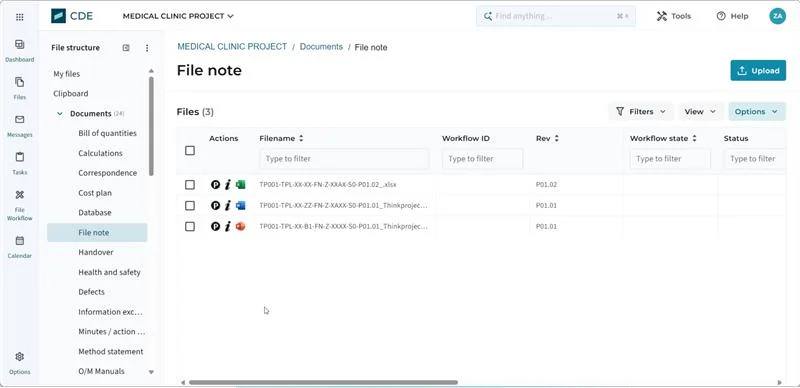
If you are looking to strengthen your construction document management process and move towards a fully centralised, lifecycle-driven approach, explore how Thinkproject’s NextGen CDE can support your projects.
Construction document management FAQs
A document management system focuses on storing and organising files. A CDE goes further by managing workflows, controlling information status, and supporting collaboration across the entire project lifecycle.
ISO 19650 is mandatory for UK central government projects and widely adopted across the private sector. Many contracts now require compliance as standard.
Typical documents include drawings, RFIs, technical submissions, change requests, quality records, safety documentation, and site reports.
Responsibility is shared. Document controllers manage daily processes, while information managers oversee standards and strategy. Project managers remain accountable for meeting contractual requirements.
A CDE supports BIM by managing model-related information in a controlled environment, linking issues and exchanges to the correct versions and approvals, and enabling structured information exchange aligned with ISO 19650.
Retention periods vary depending on legal, contractual, and regulatory requirements. In many cases, documents must be retained for several years to support maintenance, compliance, and potential disputes.
More insights
-
Event

Built Asset Lifecycle Platform
Thinkproject Live London 2026
Register nowDiscover how AI and connected data are helping teams reduce risk, improve control, and make faster, smarter decisions across the project lifecycle.
-
Event

Built Asset Lifecycle Platform
Thinkproject Live Events 2026
Read moreJoin construction, infrastructure, and asset management leaders for a day focused on the future of project and asset delivery.
-
Blog

Asset Management
Asset lifecycle management in construction: From planning to decommissioning
Read moreLearn how asset lifecycle management connects planning, construction, handover, operations and maintenance to improve built asset performance.
-
Blog

BIM
Browser-based BIM viewer performance: 10 factors that affect large IFC models
Read moreDiscover what impacts browser-based BIM viewer performance - from geometry and IFC file quality to client hardware and network. A technical guide for BIM teams.
-
Blog

BIM
8 best BIM collaboration software systems for construction teams
Read moreExplore the best BIM collaboration software systems, from CDEs and model coordination to issue tracking, document control, field collaboration, and handover.
-
Blog
CDE
AI Search in NextGen CDE: How Thinkproject AI turns governed construction data into confirmed answers
Read moreDiscover how AI search in a NextGen CDE helps construction teams find current, approved project information while preserving permissions and control.
-
Blog

Digitalization
Construction business intelligence: Turning data into better decisions
Read moreLearn how construction business intelligence connects project data, improves reporting and supports better decisions across the asset lifecycle.
-
Blog

Contracts
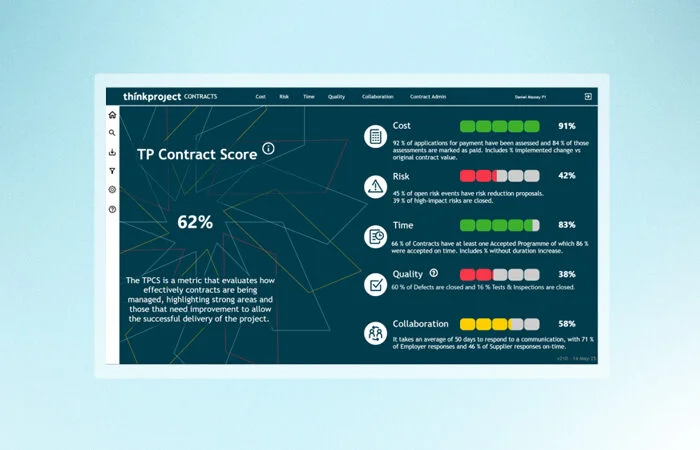
Best construction contract management software: 11 features to look for
Read moreCompare the key features to look for in construction contract management software, from NEC, JCT and FIDIC workflows to audit trails and risk control.
-
Blog
Contracts
JCT contract types: Choosing and managing the right contract
Read moreCompare the main JCT contract types, understand construction management contracts and learn how to choose and administer the right form.