
A guide to construction contract management: types of contracts, process and software
Thinkproject Live London is now at capacity.
Join the waitlist and we’ll be in touch if a place becomes available.
Join us in London for an in-person event exploring how AI, connected information and customer innovation are shaping the future of project delivery.
London | 3 November 2026


Construction projects depend on contracts to define responsibilities, manage risk and keep work progressing as planned. But effective construction contract management goes beyond signing agreements. It requires project teams to manage obligations, track changes, monitor payments and maintain clear records throughout the project lifecycle.
As projects become more complex and involve multiple contractors, suppliers and consultants, organisations are increasingly adopting new contruction technology to improve collaboration, automate processes and maintain greater commercial control. This guide explains how construction contract management works, what are the most common contract forms used across the industry, what the key stages of the contract management process are, and how contract management software helps improve commercial control and reduce risk.
How construction contract management works across a project
Construction contract management is the process of planning, administering and monitoring contractual obligations from project award through to final closeout. It ensures that all parties understand their responsibilities and that contractual requirements are met throughout the project lifecycle.
Unlike traditional document management, contract management focuses on the commercial and operational activities that arise during project delivery. These include managing notices, instructions, payment applications, change events, programme updates and contractual communications, while maintaining a complete record of decisions and approvals.
An effective contract management process supports project teams by helping them to:
- define contractual responsibilities from the outset
- manage contractual obligations and key milestones
- track notices, instructions and response deadlines
- control variations and commercial changes
- manage payment processes and valuations
- identify and mitigate contractual risks early
- maintain an auditable record of communications and approvals
- close out contracts with complete project documentation
When these activities are managed consistently, organisations can reduce disputes, improve collaboration between project participants and maintain greater confidence in commercial performance.
The contract forms that shape how projects are managed
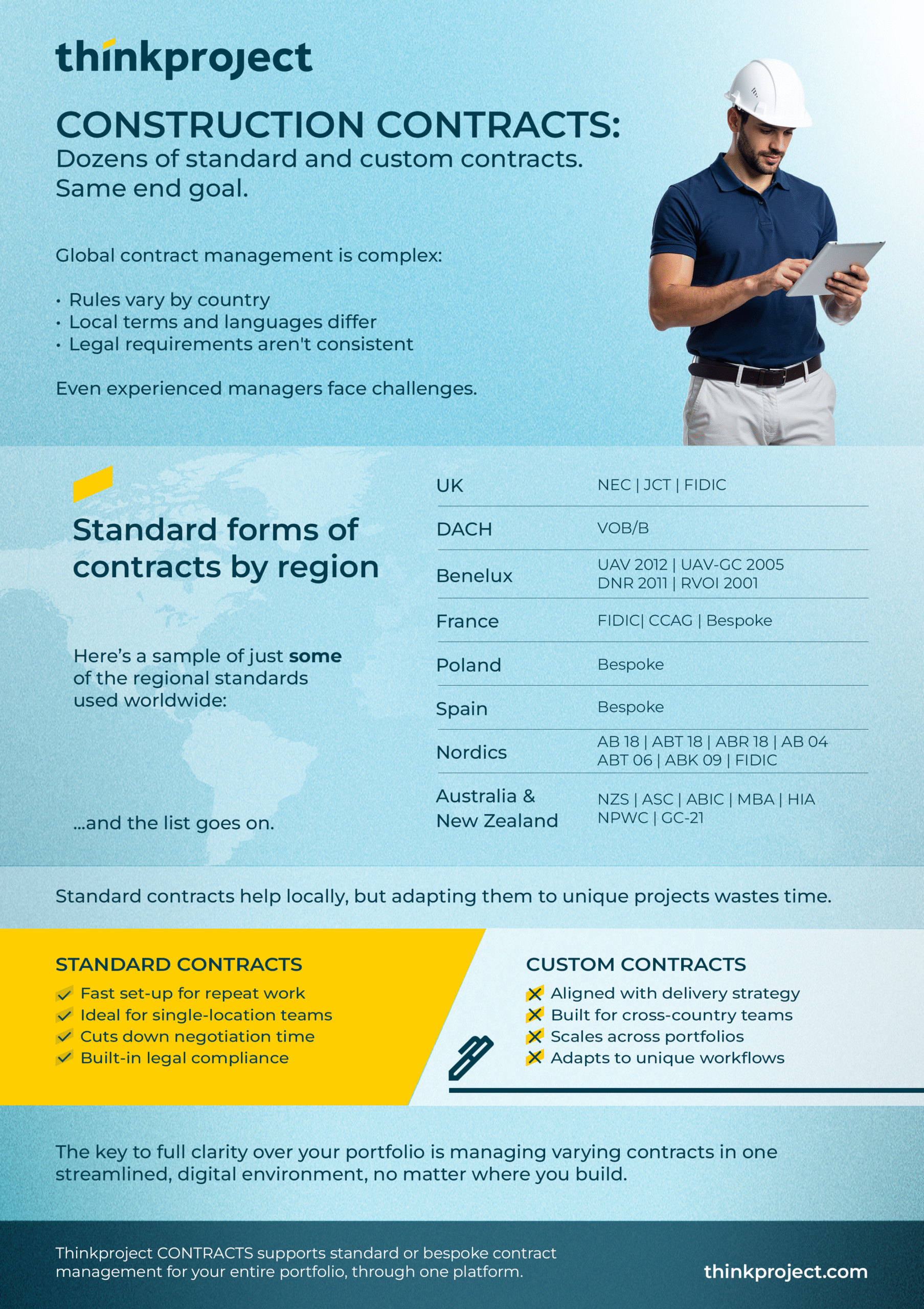
Different construction projects use different forms of contract depending on the type of work, procurement strategy and project location. While each contract has its own terminology and processes, they all establish how risks, responsibilities and contractual events are managed throughout the project.
The most common forms include:
Bespoke contracts
Some organisations develop project-specific contracts to reflect unique commercial or technical requirements. While these agreements can provide greater flexibility, they often introduce additional complexity because obligations, notice periods, approval routes and contractual terminology may differ from recognised industry standards.
Regardless of the contract form, successful management depends on consistent administration, timely communication and clear visibility of contractual obligations throughout the project.
NEC
NEC (New Engineering Contract) contracts are a suite of standard forms primarily used in the UK, but also internationally for various construction and engineering projects. Their distinctive feature is a strong emphasis on collaboration, clear communication, and proactive risk management between parties.
Written in plain English, NEC contracts aim to foster a “spirit of mutual trust and co-operation” and prevent disputes through bespoke processes for potential issues. They provide flexibility through various pricing options and encourage active project management, making them a popular choice for complex infrastructure schemes where partnership is key.
FIDIC
FIDIC, or the International Federation of Consulting Engineers, publishes globally recognized, standardized contract forms for construction and civil engineering. These “FIDIC contracts” are pre-drafted templates aiming for a balanced allocation of risks and responsibilities between the Employer and Contractor.
Key characteristics include their international recognition, structured format with General (standard) and Particular (project-specific) Conditions, as well as a multi-tiered dispute resolution process. These contracts are known for their “Rainbow Suite,” with different “Books” tailored to various project types. For instance, the Red Book is for Employer-designed projects, the Yellow Book for Contractor design-build, and the Silver Book for high-risk EPC/Turnkey projects.
By standardizing practices and providing a common language, FIDIC contracts streamline international construction, fostering more predictable project outcomes.
JCT
Established in 1931, the JCT (Joint Contracts Tribunal) produces a suite of documents designed to clearly define the responsibilities, obligations and liabilities of all parties involved in a construction project.
These contracts cover a broad range of projects, from minor domestic works to large commercial developments, and allocate risk in a fair and recognizable way. Their standardized nature helps save time, minimize transaction costs, and provide a familiar framework for managing construction projects, including provisions for payment and dispute resolution.
The construction contract management process
Construction contract management is an ongoing process rather than a single administrative task. From mobilisation to final account, project teams need to manage contractual obligations, monitor commercial risks and maintain accurate records that support decision-making throughout delivery.
The following seven stages form the foundation of an effective construction contract management process.
1. Set up contract responsibilities and key obligations
Effective contract management begins before work starts on site.
Every contract establishes obligations, responsibilities, approval authorities and timeframes that govern how the project will be delivered. These requirements should be clearly understood by all parties before mobilisation, ensuring project teams know who is responsible for contractual decisions, approvals and communications.
Key contractual information should include:
- roles and responsibilities
- key dates and milestones
- notice requirements
- payment procedures
- delegated authorities
- change management processes
- dispute resolution procedures
Capturing this information early helps reduce uncertainty and creates a consistent framework for contract administration throughout the project.
2. Centralise contract documents and records
Construction projects generate a significant volume of contractual information, including executed contracts, amendments, drawings, correspondence, meeting minutes and supporting documentation.
When these records are stored across email inboxes, shared drives and personal folders, finding the latest information becomes increasingly difficult. Teams may work from outdated documents or struggle to retrieve evidence when commercial issues arise.
Centralising contract documentation creates a single source of truth for project teams. Combining effective contract management with construction document management helps ensure everyone is working from the latest approved information while reducing duplication and administrative effort.

3. Track notices, instructions and deadlines
Most construction contracts include strict requirements for issuing notices, responding to instructions and meeting contractual deadlines.
Missing a notification period or failing to respond within the required timeframe can affect entitlement to additional time or cost, increasing commercial risk.
A structured contract management process helps teams monitor:
- contractual notices
- employer and engineer instructions
- early warnings
- compensation events
- response deadlines
- key programme milestones
4. Manage variations and change control
Change is inevitable on construction projects. Design development, unforeseen site conditions, client requests and regulatory changes all have the potential to affect scope, programme and cost.
Without formal change control, variations can quickly become disputed, leading to uncertainty around entitlement, payment and project delivery.
An effective contract management process provides structured workflows for recording, assessing, reviewing and approving contractual changes. Each variation should be supported by clear documentation, linked to relevant instructions and tracked through to commercial agreement.
Maintaining visibility of change events helps organisations understand their impact on programme, budget and contractual obligations before issues escalate.
5. Monitor payment, valuations and commercial exposure
Payment is one of the most commercially sensitive aspects of construction contract management.
Applications for payment, valuations, certificates, retention, compensation events and final accounts all depend on accurate contractual information and timely approvals.
Maintaining clear visibility of payment status helps commercial teams:
- monitor cash flow
- identify outstanding approvals
- understand cost exposure
- forecast commercial performance
- reduce payment disputes
6. Maintain an audit trail for decisions and approvals
Construction projects involve hundreds (if not thousands) of contractual decisions throughout delivery.
Instructions, approvals, correspondence, variations and payment decisions all contribute to the contractual record. When information is incomplete or difficult to retrieve, resolving claims and disputes becomes significantly more challenging.
Maintaining a complete audit trail provides evidence of what was agreed, when decisions were made and who authorised them. This strengthens governance, supports compliance requirements and provides valuable protection if contractual disagreements arise.
7. Close out contracts with complete project records
Contract management continues beyond practical completion.
Final accounts, outstanding variations, warranties, certificates, defects management and contractual obligations all need to be resolved before contracts can be formally closed.
A structured closeout process ensures contractual records are complete, obligations have been fulfilled and project documentation is retained for future reference.
Complete contract records also provide valuable information for future projects, helping organisations improve procurement, commercial management and risk planning over time.
Where contract management breaks down on construction projects
Even with well-written contracts, poor contract management can quickly create commercial and operational risks. As projects become more complex, relying on spreadsheets, email and manual processes makes it increasingly difficult to maintain control.
Common challenges include:
- Poorly defined scope: Ambiguous contract requirements can lead to misunderstandings, rework and disputes over responsibilities.
- Missed notices and deadlines: Failing to issue contractual notices or respond within the required timeframe can affect entitlement to additional time or payment.
- Uncontrolled variations: Without structured change control, it becomes difficult to understand the commercial impact of design changes, client requests or unforeseen site conditions.
- Informal approvals: Decisions made through phone calls or email without formal records create uncertainty and make future claims harder to support.
- Payment disputes: Delayed approvals, missing documentation or inconsistent valuation processes can disrupt cash flow and damage supplier relationships.
- Scattered documents: Contracts, correspondence and supporting evidence stored across email, spreadsheets and shared drives make information difficult to locate when it’s needed most.
- Limited visibility across multiple contracts: Managing several contractors and suppliers without a central view makes it harder to identify risks, monitor performance and maintain commercial oversight.
- Weak audit trails: Incomplete records of decisions, communications and approvals increase the complexity of resolving claims, audits or disputes.
Many of these challenges stem from disconnected systems and manual processes. As the industry continues its digital transformation in construction, organisations are replacing spreadsheets and email-driven workflows with connected digital platforms that improve visibility, collaboration and commercial governance.

How Thinkproject supports contract and commercial management
Managing construction contracts requires more than storing contract documents. Teams need visibility on contractual obligations, commercial events and approval workflows throughout the project lifecycle.
Thinkproject CONTRACTS provides a structured approach to commercial and contract management by organising contracts around obligations, events and workflows rather than static documents. This helps project teams manage contractual processes consistently while maintaining full visibility of commercial performance.
With Thinkproject, organisations can:
- manage contractual obligations, actions and key deadlines in one place
- track contract events such as instructions, variations and compensation events through structured workflows
- monitor contractual risks and early warnings before they develop into disputes
- link payments directly to approved contractual events and commercial processes
- maintain complete audit trails for communications, approvals and commercial decisions
- gain portfolio-level visibility across contract performance, risk, cost and compliance
As part of the Thinkproject Platform, CONTRACTS also connects with governed project information held within NextGen CDE, helping ensure commercial decisions are supported by approved documentation and a traceable record of project activity. It also integrates with Analytics to provide portfolio-level reporting and commercial insights across multiple projects.
By replacing disconnected spreadsheets and manual processes with structured digital workflows, organisations can improve commercial certainty, reduce administrative effort and maintain greater control over contract performance from project award through to closeout.
If you’re looking to strengthen commercial governance and gain greater visibility across your contracts, explore how Thinkproject CONTRACTS helps construction teams manage obligations, changes, payments and risk through structured, audit-ready workflows. Request a personalised demo.
FAQs
Contract management covers the entire commercial lifecycle of a construction contract, including obligations, risk management, change control, payments and contract closeout. Contract administration focuses on the day-to-day activities required to implement the contract, such as issuing instructions, managing notices, certifying payments and maintaining project records.
Responsibility varies depending on the project and procurement route. Contract managers, commercial managers, quantity surveyors, project managers and employers’ representatives may all have responsibilities for managing contractual obligations. Contractors, consultants and clients also have contractual duties that must be fulfilled throughout the project.
No. Contract management software supports contract managers by improving visibility, automating workflows and maintaining accurate records, but it does not replace professional judgement or commercial decision-making. The software provides the structure and information needed for teams to manage contracts more efficiently while reducing administrative effort and contractual risk.
Thinkproject Live London 2026
Join us in London for an in-person event exploring how AI, connected information and customer innovation are shaping the future of project delivery. Hear practical insights, customer stories and the latest Thinkproject innovation.
London | 3 November 2026
More insights
Innovation Series

Built Asset Lifecycle Platform
Thinkproject Live and Recorded Webinars
Read moreLive and recorded webinars for teams that design, build, operate, and maintain the assets that shape our physical world.
-
Blog
BIM
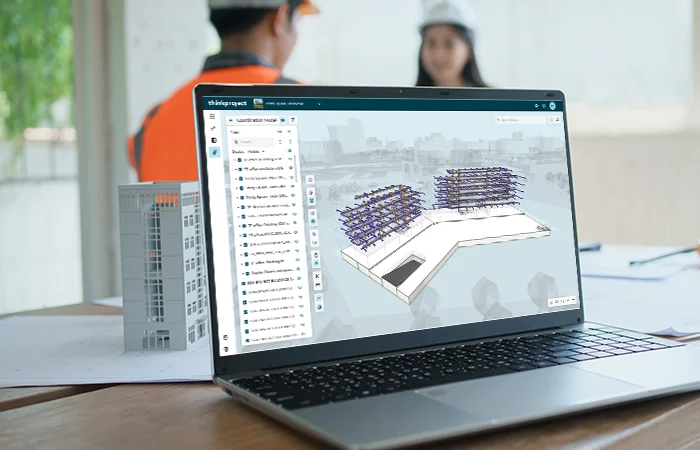
BIM collaboration: How connected project teams work better together
Read moreSee how BIM improves construction collaboration through shared models, clash detection, issue tracking, CDE workflows and connected project information.
-
Blog

Asset Management
From delivery to lasting performance: four governance priorities for Spain’s asset owners
Read moreDiscover four asset governance priorities that help Spain’s asset owners improve information reliability, flexibility, decision speed and ROI.
-
Blog
Built Asset Lifecycle Platform
Construction project life cycle: 6 phases from concept to handover
Read moreUnderstand the construction project life cycle, from feasibility and design to procurement, construction, commissioning and handover.
-
Blog

Field Management
Thinkproject HANDOVER: Turn project information into operations-ready asset data
Read moreDiscover how Thinkproject HANDOVER helps asset owners and contractors reduce information gaps and deliver validated asset data from construction into operations.
-
Event

Built Asset Lifecycle Platform
Thinkproject Live London 2026
Join the waitlistDiscover how AI and connected data are helping teams reduce risk, improve control, and make faster, smarter decisions across the project lifecycle.
-
Event

Built Asset Lifecycle Platform
Thinkproject Live Events 2026
Read moreJoin construction, infrastructure, and asset management leaders for a day focused on the future of project and asset delivery.
-
Blog

Asset Management
Asset lifecycle management in construction: From planning to decommissioning
Read moreLearn how asset lifecycle management connects planning, construction, handover, operations and maintenance to improve built asset performance.
-
Blog

BIM
Browser-based BIM viewer performance: 10 factors that affect large IFC models
Read moreDiscover what impacts browser-based BIM viewer performance - from geometry and IFC file quality to client hardware and network. A technical guide for BIM teams.