
Construction project management process: Key stages, benefits, and best practices
Construction projects involve countless moving parts, from budgets and schedules to contractors, consultants, and site teams. Without a structured approach, delays, cost overruns, communication gaps, and quality issues can quickly derail delivery. This is why a clear construction project management process is essential.
The construction project management process provides a framework for planning, coordinating, and controlling every stage of a project, from initial concept through to handover. In this guide, we explore the key stages of the process, the benefits of project management in construction, common challenges teams face, and how digital tools can help deliver projects on time, within budget, and to the required standard.
What is construction project management?
Construction project management is the process of planning, coordinating, and controlling all activities required to deliver a construction project successfully.
It covers everything from defining project objectives and developing schedules to managing contracts, overseeing site execution, controlling risks, and ensuring a smooth handover.
Unlike project management in other industries, project management in construction must account for complex stakeholder networks, strict regulatory requirements, physical site conditions, safety considerations, and significant cost pressures.
The ultimate goal is to deliver a project that meets the required scope, quality, budget, and timeline while ensuring effective collaboration between owners, contractors, consultants, suppliers, and site teams.
Construction project management process at a glance
While every project is unique, most follow a similar set of construction project management stages. Each stage builds on the previous one and contributes to overall project success.
| Stage | Main goal | Key activities | Main output |
|---|---|---|---|
Project initiation | Define project objectives and feasibility | Business case development, feasibility studies, stakeholder identification | Approved project concept |
Project planning | Establish delivery strategy and controls | Scheduling, budgeting, risk planning, resource allocation | Project execution plan |
Procurement and contract setup | Secure resources and define responsibilities | Tendering, contractor selection, contract negotiation | Awarded contracts and procurement plan |
Construction execution | Deliver physical construction work | Site management, coordination, quality control, inspections | Completed construction works |
Monitoring, control, and risk management | Maintain project performance | Progress tracking, cost control, risk management, reporting | Performance insights and corrective actions |
Handover and project closeout | Transfer completed asset to owner | Documentation, commissioning, training, final approvals | Operationally ready asset |
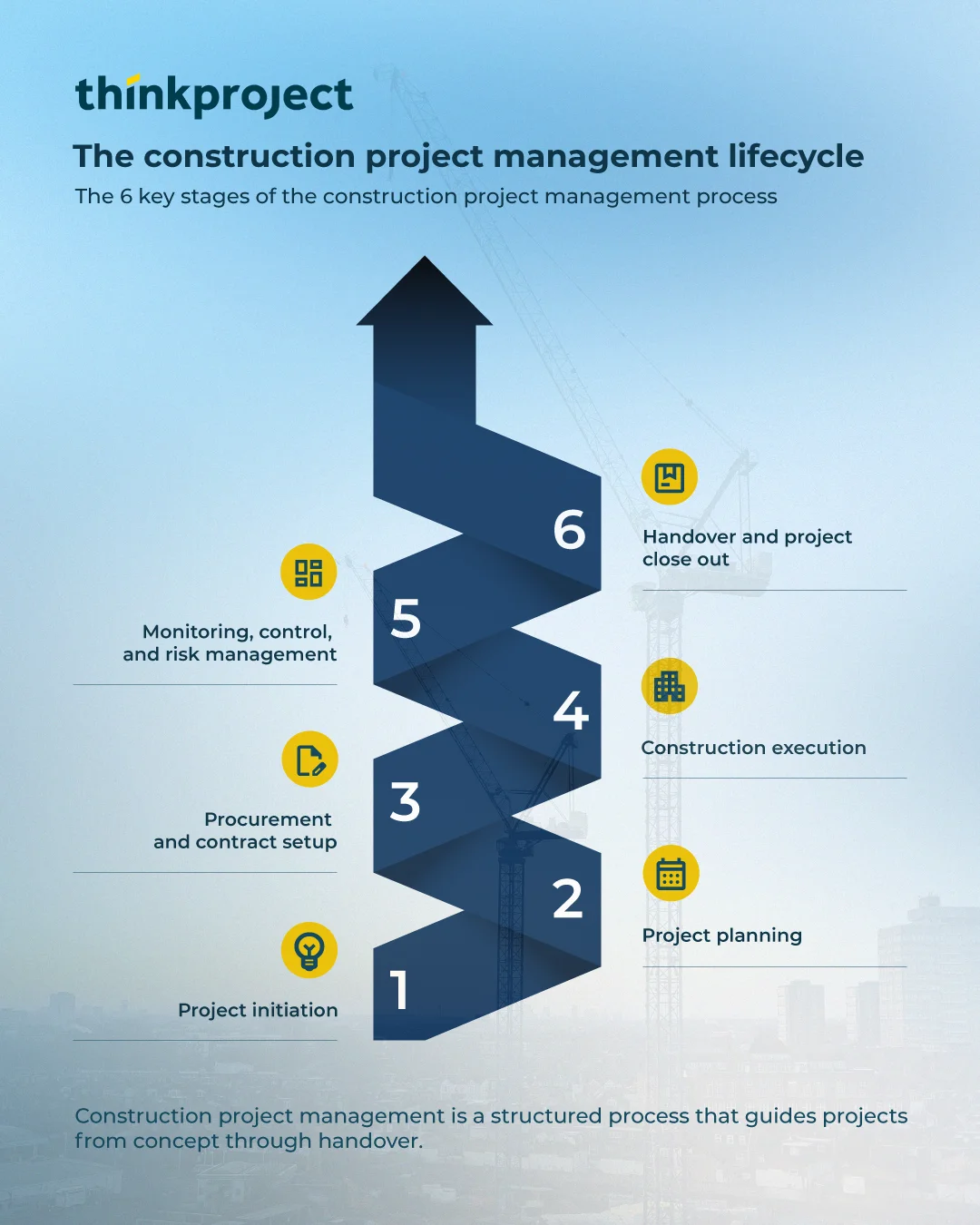
The 6 key stages of the construction project management process
Understanding the individual construction project management stages helps teams maintain control and ensure nothing is overlooked throughout delivery.
1. Project initiation
Every successful project starts with a clear understanding of what needs to be achieved and why. During project initiation, stakeholders establish project objectives, evaluate feasibility, identify constraints, and define high-level requirements.
The primary purpose is to determine whether the project is viable and aligned with organisational goals before significant investment begins.
Key activities typically include:
- Defining project scope and objectives
- Conducting feasibility studies
- Assessing technical and financial viability
- Identifying key stakeholders
- Establishing governance structures
- Creating preliminary budgets and timelines
Strong project initiation creates a foundation for all subsequent stages and helps reduce uncertainty later in the process.
2. Project planning
Once the project is approved, detailed planning begins. Planning transforms strategic objectives into actionable delivery plans. This stage is often considered one of the most important parts of the construction project management process because decisions made here influence cost, schedule, quality, and risk throughout the project.
Project teams develop detailed schedules, budgets, procurement plans, risk registers, communication plans, and resource strategies. Increasingly, organisations are using digital models and VDC solutions to improve planning accuracy, identify clashes early, and optimise construction sequencing before work begins on site.
Key planning activities include:
- Work breakdown structures
- Detailed scheduling
- Resource planning
- Cost estimating
- Risk identification
- Stakeholder communication planning
- Quality management planning
- Safety planning
Comprehensive planning creates greater predictability and helps teams respond more effectively when challenges arise.
3. Procurement and contract setup
With plans established, organisations can begin securing the resources and partners required to deliver the project.
Procurement involves selecting contractors, suppliers, consultants, and subcontractors while ensuring commercial arrangements support project objectives. Contract structures play a critical role in defining responsibilities, managing risk allocation, and establishing mechanisms for handling changes and disputes.
Key activities include:
- Tender preparation
- Bid evaluation
- Supplier selection
- Contract negotiation
- Procurement scheduling
- Risk allocation
- Commercial governance setup
Understanding best practices for construction contract management and proactively addressing construction contract risks can help project teams avoid costly disputes and delays later in delivery.
4. Construction execution
Construction execution is where plans become reality. This stage involves coordinating labour, equipment, materials, and subcontractors to deliver the physical asset safely and efficiently.
Site teams must balance productivity with quality, safety, and compliance requirements while responding to changing site conditions and unforeseen challenges.
Key activities include:
- Site mobilisation
- Construction activities
- Resource coordination
- Quality inspections
- Safety management
- Progress reporting
- Stakeholder communication
Execution depends heavily on timely access to accurate information. Effective construction document management helps ensure teams are working from current drawings, specifications, and approved documentation.
5. Monitoring, control, and risk management
Monitoring and control occur throughout project delivery rather than as a standalone phase. The purpose is to measure actual performance against planned performance and take corrective action when required.
Construction projects operate in dynamic environments where delays, design changes, supply chain disruptions, and unforeseen site conditions can affect outcomes. Continuous monitoring enables teams to identify issues early and minimise their impact.
Key activities include:
- Progress tracking
- Cost control
- Schedule management
- Quality assurance
- Risk monitoring
- Change management
- Performance reporting
6. Handover and project closeout
The final stage of the construction project management process is often underestimated. A successful handover ensures the owner receives not only a completed asset but also the information needed to operate and maintain it effectively.
Project closeout includes final inspections, commissioning, defect resolution, documentation delivery, training, and formal acceptance.
Key activities include:
- Asset information collection
- Commissioning
- Testing and validation
- Defect management
- Operations training
- Documentation transfer
- Final approvals
A structured handover process reduces operational risk and improves long-term asset performance.
Thinkproject’s Handover solution supports continuous asset information management throughout project delivery, helping organisations collect, validate, and transfer operationally ready information rather than scrambling to assemble documentation at the end of the project.
Benefits of project management in construction
The benefits of project management in construction extend far beyond keeping projects on schedule. A structured management approach creates measurable advantages throughout the project lifecycle:
- Better cost and budget control by establishing clear baselines, monitoring performance, and managing changes effectively.
- Fewer delays and reduced risk exposure through proactive planning, monitoring, and early issue identification.
- Stronger quality assurance with structured inspections, validation processes, and accountability.
- Clearer communication between owners, contractors, consultants, and site teams through defined workflows and information management practices.
- Improved resource utilisation by aligning labour, equipment, and materials with project requirements.
- Greater visibility into project performance through reporting, analytics, and progress tracking.
- More effective change management when scope, requirements, or site conditions evolve.
- Enhanced compliance and auditability through documented processes and decision records.
- More structured handover and closeout that supports operational readiness from day one.
- Better long-term asset outcomes through improved information continuity across the asset lifecycle.
Common challenges in the construction project management process
Despite careful planning, construction projects frequently encounter challenges that can affect delivery. Some of the most common include:
- Information fragmentation: Project information is often spread across multiple systems, spreadsheets, emails, and documents. This makes it difficult to maintain a single source of truth.
- Poor communication: Misaligned stakeholders, unclear responsibilities, and delayed information sharing can create confusion and slow decision-making.
- Scope changes: Changing requirements can impact schedules, budgets, procurement plans, and resource allocation.
- Cost escalation: Material price fluctuations, labour shortages, and unforeseen conditions can create budget pressures.
- Risk visibility: Many organisations struggle to identify emerging risks early enough to take effective corrective action.
- Handover complexity: Collecting and validating asset information at the end of a project often causes delays and increases operational risk.
As construction projects become increasingly digital, many organisations are investing in new technologies to address these challenges. Current trends in construction show growing adoption of connected platforms, data-driven decision-making, automation, and digital collaboration tools.
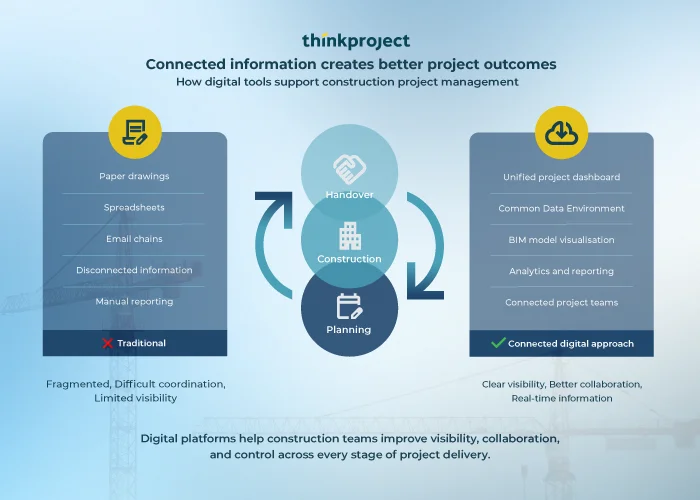
How digital tools support construction project management
Technology is reshaping project management in construction by improving visibility, collaboration, and control. Modern construction management platforms help connect teams, workflows, and information across the project lifecycle.
Key capabilities include:
Common data environments
A Common Data Environment (CDE) provides a controlled, centralised location for project information, helping teams work from approved and traceable data.
Thinkproject’s NextGen CDE acts as a governed information backbone that supports document management, collaboration, workflows, and lifecycle-ready information management.
Model-based collaboration
Virtual design and construction technologies support design coordination, clash detection, constructability reviews, and project planning.
VDC Collaboration help teams improve coordination and reduce rework through model-based workflows.
Field management and quality control
Digital field workflows help standardise inspections, quality checks, safety processes, and issue management while providing complete traceability from site to office.
Thinkproject’s Field Manager enables construction teams to configure and manage field workflows, inspections, and approvals in a single environment.
Contract and commercial management
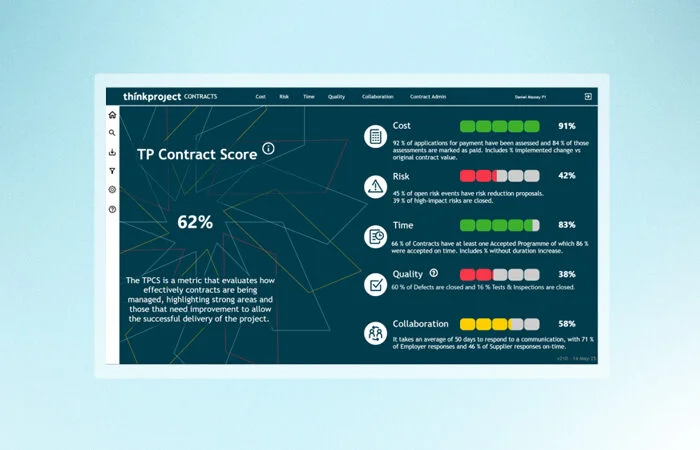
Structured contract management tools improve visibility into obligations, risks, changes, payments, and compliance requirements throughout project delivery.
Analytics and reporting
Connected analytics solutions provide project and portfolio-level insights that support better governance, risk management, and decision-making.
AI-assisted workflows
The growing use of AI in construction is helping organisations improve information discovery, reporting, risk identification, and decision support. When built on governed and traceable project data, AI can help teams work more efficiently while maintaining accountability. Thinkproject’s platform approach supports AI-assisted work on trusted, permissioned project information.
Bring more control to every stage of construction project management
The construction project management process provides the structure needed to keep projects on track, control costs, reduce risk, and improve collaboration. From planning and procurement to execution and handover, every stage plays a role in delivering successful project outcomes.
As projects become more complex, digital tools can help teams maintain visibility, connect information, and make better decisions throughout the project lifecycle. By combining structured processes with connected technology, construction organisations can improve efficiency, strengthen governance, and deliver higher-quality outcomes.
Discover how Thinkproject’s Built Asset Lifecycle Platform helps construction teams connect project information, streamline collaboration, and maintain control across every stage of delivery.
Frequently asked questions about construction project management
Many organisations describe construction project management using five phases:
- Initiation
- Planning
- Execution
- Monitoring and control
- Closeout
However, in practice, procurement and contract management are often treated as a distinct stage because of their significant impact on project delivery and commercial outcomes.
Construction project stages describe the physical progression of the project, such as design, procurement, construction, commissioning, and operation.
Project management stages describe the management activities used to control and coordinate delivery, including initiation, planning, execution, monitoring, and closeout.
The two frameworks overlap but serve different purposes. Construction stages focus on what is being delivered, while project management stages focus on how delivery is planned, managed, and controlled.
Thinkproject Live London 2026
Join us in London for an in-person event exploring how AI, connected information and customer innovation are shaping the future of project delivery. Hear practical insights, customer stories and the latest Thinkproject innovation.
London | 3 November 2026


More insights
-
Blog

Asset Management
Asset lifecycle management in construction: From planning to decommissioning
Read moreLearn how asset lifecycle management connects planning, construction, handover, operations and maintenance to improve built asset performance.
-
Blog

BIM
Browser-based BIM viewer performance: 10 factors that affect large IFC models
Read moreDiscover what impacts browser-based BIM viewer performance - from geometry and IFC file quality to client hardware and network. A technical guide for BIM teams.
-
Blog

BIM
8 best BIM collaboration software systems for construction teams
Read moreExplore the best BIM collaboration software systems, from CDEs and model coordination to issue tracking, document control, field collaboration, and handover.
-
Blog
CDE
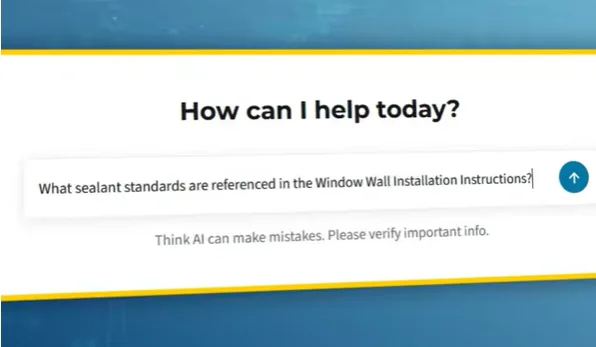
AI Search in NextGen CDE: How Thinkproject AI turns governed construction data into confirmed answers
Read moreDiscover how AI search in a NextGen CDE helps construction teams find current, approved project information while preserving permissions and control.
-
Blog

Digitalization
Construction business intelligence: Turning data into better decisions
Read moreLearn how construction business intelligence connects project data, improves reporting and supports better decisions across the asset lifecycle.
-
Blog

Contracts
Best construction contract management software: 11 features to look for
Read moreCompare the key features to look for in construction contract management software, from NEC, JCT and FIDIC workflows to audit trails and risk control.
-
Event

Built Asset Lifecycle Platform
Thinkproject Live London 2026
Register nowDiscover how AI and connected data are helping teams reduce risk, improve control, and make faster, smarter decisions across the project lifecycle.
-
Event

Built Asset Lifecycle Platform
Thinkproject Live Events 2026
Read moreJoin construction, infrastructure, and asset management leaders for a day focused on the future of project and asset delivery.
-
Blog
Contracts
JCT contract types: Choosing and managing the right contract
Read moreCompare the main JCT contract types, understand construction management contracts and learn how to choose and administer the right form.