
AI in construction: Uses, benefits and real-world examples
Artificial intelligence (AI) is becoming an increasingly important part of digital transformation in construction. As projects generate more data than ever before, organisations are exploring how AI can improve decision-making, reduce manual effort and increase efficiency across the built asset lifecycle.
From planning and design to construction, handover and asset operations, AI is helping teams analyse information, identify risks and automate repetitive tasks. However, its success depends on one critical factor: access to trusted, well-governed data.
This article explores what AI in construction is, where it is being used today, the benefits it can deliver and the challenges organisations should consider when adopting it.
What is AI in construction?
AI in construction refers to the use of artificial intelligence to analyse project and asset data, automate routine tasks and support better decision-making across the built asset lifecycle.
Unlike traditional software, AI can analyse large volumes of information, identify patterns, generate insights and help users interact with complex data in new ways. In the construction industry, AI is increasingly being combined with technologies such as BIM software, Common Data Environments (CDEs), asset management systems and connected project platforms.
The opportunity becomes particularly significant when AI can work across connected information rather than within isolated applications. Documents, models, contracts, field information and asset records can provide valuable context for AI, provided that the underlying information is structured, governed and accessible to the right users.

AI in construction examples across the built asset lifecycle
The adoption of AI is expanding across every phase of the built asset lifecycle. Rather than being limited to one specific discipline, AI can support design teams, commercial managers, site teams and asset operators by helping them manage complex information more effectively. The following AI in construction examples illustrate where artificial intelligence is creating value today.
Planning, design and estimating
The earliest opportunities for AI can begin before construction starts. During planning and design, project teams must evaluate multiple options while balancing cost, programme, sustainability, regulations and technical requirements.
Across the industry, potential applications include using AI to:
- analyse historical project information to support planning
- assist early-stage cost estimation
- identify potential constructability issues
- support schedule analysis and optimisation
- assist quantity take-offs from digital models
When combined with BIM workflows, AI can also help teams interrogate complex models, identify relevant objects and information and support model validation.
This builds on established digital construction processes such as clash detection, model validation, 4D planning and model-based quantity take-offs. Thinkproject’s VDC capabilities already support these workflows.
AI-enabled BIM search in VDC COLLABORATION allows users to ask natural-language questions about models and identify relevant objects more quickly, with follow-up actions such as selecting, isolating or hiding objects.
At the agentic layer, the BIM Model Checker Agent is designed to go further: using CDE and VDC capabilities to validate new or updated models against defined standards and project rules, identify issues and clashes, and raise BCF issues for follow-up.
This illustrates an important distinction between conventional digitalisation and AI: AI does not replace established BIM workflows. It can make them faster, easier to interrogate and increasingly automated.
Explore how our innovations on VDC and FIELD MANAGER can transform your field execution, BIM collaboration and connected project delivery, in our dedicated Innovation Series Webinar.
Contracts, documents and project information
Construction projects generate vast amounts of information, including drawings, specifications, contracts, requests for information, approvals and correspondence. Finding the right information at the right time remains one of the biggest challenges facing project teams.
This is an area where AI can create immediate value.
Instead of manually searching through thousands of files, AI can help users interact with project information using natural-language questions. Potential applications include:
- document classification and data extraction
- identifying relevant information within documents
- improving search across large information repositories
- summarising lengthy technical documents
- comparing information across documents
- supporting information-quality checks
For example, a project manager may need to locate the latest approved drawing or understand information contained within a lengthy technical document. AI-assisted search and document Q&A can help surface that information more quickly.
These capabilities become considerably more powerful when the underlying information is managed through a Common Data Environment.
Thinkproject’s NextGen CDE provides the governed information environment on which these AI capabilities can operate. Thinkproject AI capabilities for CDE include AI-assisted document analysis and AI-enabled search across CDE files and their contents, allowing users to ask natural-language questions while respecting the permissions and information context of the underlying environment.
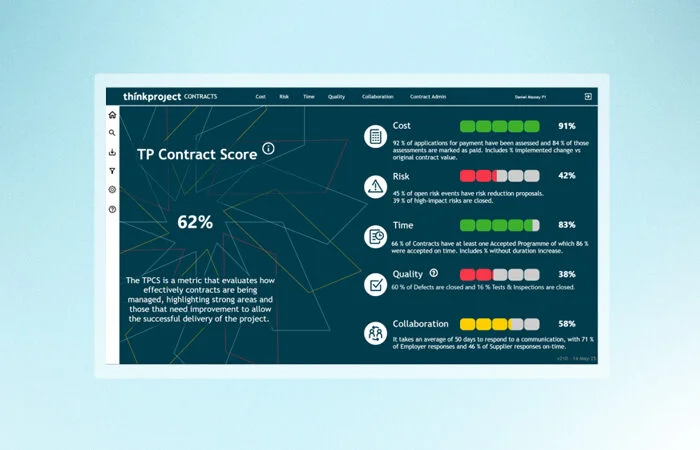
Thinkproject CONTRACTS provides another important source of structured lifecycle information by managing contractual processes, events and workflows. Connecting information across applications creates the potential for AI and agents to support increasingly sophisticated cross-application workflows in the future.
The principle is simple: the more connected and contextual the underlying information becomes, the more useful AI can become.
Project controls and risk management
Construction projects involve thousands of interconnected activities. Delays or changes in one area can create knock-on effects across schedules, budgets, contracts and resources.
Across the industry, AI has the potential to complement conventional project controls through applications such as:
- schedule risk analysis
- cost forecasting
- identifying programme deviations
- monitoring commercial exposure
- identifying unusual trends
- surfacing potential risks earlier
Portfolio-level analysis is particularly interesting. Organisations managing dozens or hundreds of projects often struggle to achieve consistent visibility because information is spread across multiple applications and organisational structures.
For Thinkproject, this is where our platform strategy becomes important. Thinkproject ANALYTICS provides an enterprise-level view across connected application data, enabling organisations to explore information and identify insights across projects and portfolios.
Thinkproject AI extends this direction with platform-wide AI services such as enterprise AI search and answers, as well as predictive insights and early warnings based on governed lifecycle data.
Rather than AI replacing project controls, the opportunity is to help teams find relevant signals sooner and give decision-makers additional context for intervention.
Our newest generation of the Thinkproject Platform represents a leap in innovation, transforming project and asset data into actionable intelligence. Watch our on-demand webinar to learn more.
Construction progress, safety and quality
During construction, AI can also help site teams capture, analyse and respond to information more efficiently.
Across the industry, organisations are exploring AI in combination with mobile devices, images, drones, sensors and digital inspections for applications such as:
- analysing site information
- identifying potential safety risks
- recognising possible quality defects
- assisting inspection reporting
- supporting issue management
- helping teams prioritise corrective actions
Computer vision, for example, can analyse images and drawings to identify objects or patterns that would otherwise require manual review.
These applications depend heavily on the quality of the digital processes around them. Digitising inspections, observations, issues and evidence creates structured information that can become increasingly valuable to AI over time.
Thinkproject FIELD MANAGER supports configurable digital inspections, quality processes and safety workflows, creating structured and traceable field information.
Thinkproject VDC COLLABORATION enables multidisciplinary teams to review federated models, manage issues using the Building Collaboration Format (BCF) and maintain traceability throughout project delivery.
Together, these types of connected workflows create the digital foundation on which future AI capabilities can deliver greater value.
Handover and asset information
Handover remains one of the most information-intensive stages of the built asset lifecycle.
Asset owners need complete, accurate and usable information before an asset becomes operational. Yet handover information is often assembled late in the project, creating significant manual work and increasing the risk of missing or incorrectly linked documentation.
AI can help organisations move towards more continuous and automated handover processes.
Potential applications include:
- identifying missing asset information
- checking documentation requirements
- monitoring information completeness
- supporting data validation
- connecting documents to the assets they describe
Thinkproject HANDOVER supports structured handover processes and helps organisations manage information requirements and asset information throughout delivery.
Thinkproject AI aill also introduce another level of automation through the Handover Agent, currently on our product roadmap. The agent is designed to identify relevant handover documents in the CDE, match them to the corresponding assets using asset information such as asset tags, and create the relevant links.
On projects involving thousands of assets and potentially tens of thousands of documents, automating this type of repetitive linking can significantly reduce manual effort while helping create a more complete digital asset record.
To explore our upcoming HANDOVER developments, as well as our latest NextGen CDE capabilities, watch our on-demand Innovation Series webinar.
Asset operations and maintenance
The opportunity for AI continues after construction is complete.
Operational assets generate significant volumes of information through inspections, maintenance activities, asset registers, sensors and other connected systems.
Across the industry, AI can potentially support:
- identifying deteriorating asset conditions
- predictive maintenance
- prioritising maintenance activities
- analysing asset performance
- supporting capital investment decisions
- identifying portfolio-wide trends
Realising these use cases requires reliable asset information.
Incomplete or inconsistent asset records reduce the quality of the context available to AI. This reinforces a principle that applies across the entire built asset lifecycle: AI is only as powerful as the data behind it.
Thinkproject’s asset management capabilities provide the foundation for this connected approach. Asset information, inspections, condition data, maintenance activities and supporting project information can be brought into a connected information environment rather than remaining isolated in individual systems.
Challenges of adopting AI in construction
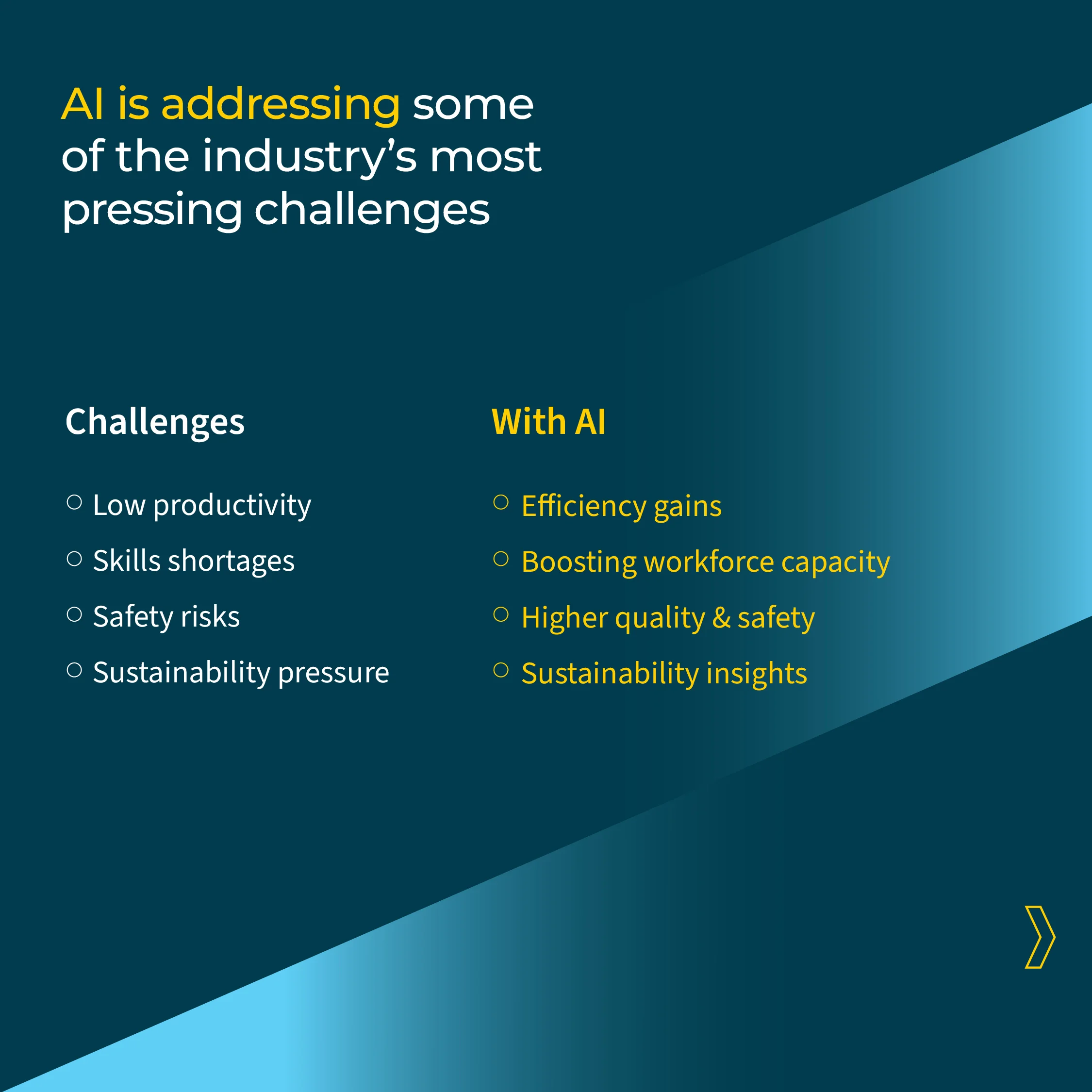
While the potential benefits of artificial intelligence in construction are significant, successful adoption depends on having the right foundations in place. Key challenges include:
- Poor data quality: AI is only as reliable as the information it uses. Incomplete, inconsistent or outdated data can lead to inaccurate outputs.
- Information governance: Organisations need confidence that AI operates on approved, permission-based information with full traceability and auditability.
- Disconnected systems: Project information is often spread across multiple platforms, making it difficult for AI to generate meaningful insights without connected data.
- Change management: Successful AI adoption requires people to trust the technology and understand how to use it effectively alongside existing processes.
- Human oversight: AI should support decision-making, not replace it. Engineers, project managers and asset owners remain responsible for validating recommendations and making final decisions.
What construction organisations need to use AI responsibly
As AI adoption grows, many organisations are shifting their focus from whether to use AI to how to use it responsibly. While AI can improve efficiency and support better decision-making, its effectiveness depends on the quality of the data and governance behind it.
To use AI responsibly, construction organisations should focus on five key areas:
- Trusted, high-quality data: AI performs best when it works with accurate, complete and up-to-date information. Poor data quality or inconsistent records can reduce the reliability of AI-generated insights.
- Strong information governance: AI should operate on approved, permission-based information with clear ownership, version control and full auditability. This helps ensure outputs are traceable and aligned with organisational policies.
- Connected systems: Construction data often sits across multiple applications, from design and document management to contracts and asset systems. Connecting these sources creates the context AI needs to generate more meaningful insights.
- Human oversight: AI should support professionals, not replace them. Project teams, engineers and asset managers remain responsible for reviewing recommendations and making final decisions.
- A scalable digital foundation: Organisations achieve the greatest long-term value from AI when it is built on standardised processes, consistent workflows and connected information that spans the entire asset lifecycle.
How Thinkproject applies AI across the built asset lifecycle
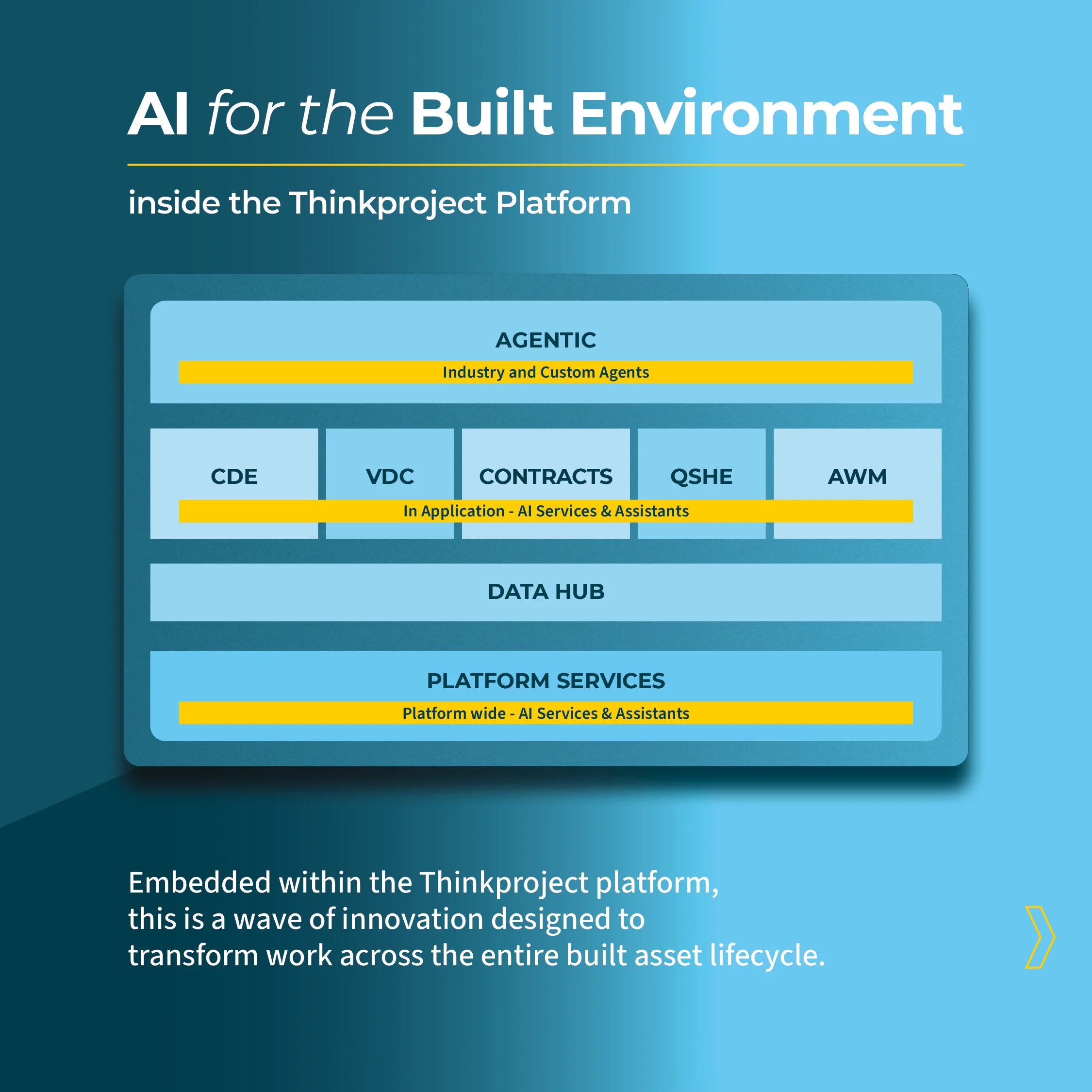
At Thinkproject, we believe AI should be practical, accessible, and built on trusted data. Thinkproject AI extends this approach by applying AI across the built asset lifecycle.
This is being introduced across three layers of the platform:
Platform-wide AI services
Platform-wide capabilities use connected lifecycle information to provide services such as enterprise AI search and answers, predictive insights and early warnings, multilingual capabilities and AI governance.
This enables AI to work across a broader information context rather than remaining limited to a single application or project.
AI services and assistants inside applications
AI is also embedded into the applications where users already work.
Initial examples include:
- CDE: AI document analysis and AI-enabled search across files and their contents
- VDC COLLABORATION: natural-language queries across BIM models, with actions such as select, isolate and hide
The objective is practical: reduce repetitive work and make complex project and asset information easier to access and use.
Thinkproject agentic
Thinkproject Agentic adds an agentic layer on top of the applications.
Unlike an assistant that primarily helps a user find or analyse information, an agent can orchestrate defined workflows and actions across applications.
Alongside Industry Agents, Thinkproject Agentic is designed to support Custom Agents for enterprise-specific processes.
This cross-application approach is important because many of the industry’s most valuable workflows do not begin and end in a single application.
From construction data to better lifecycle decisions
The future of the built environment is not just about streamlining processes or saving costs, but about shaping spaces that are smarter, safer, and more sustainable. Technology alone is not enough. Its value depends on the quality of information underneath it and the governance that makes that information trustworthy.
AI has the potential to change how built assets are planned, delivered and operated. But technology alone is not enough. Its value depends on trusted information, connected workflows and clear human oversight. With these foundations in place, construction organisations can use AI to identify risks earlier, reduce manual effort and make better-informed decisions across the built asset lifecycle.
For the strategic case for governance-first AI in construction, read our CTPO’s perspective here.
Want to see how AI and connected project data are already transforming construction in practice? Join customers, partners and industry experts at Thinkproject Live 2026 to explore real-world AI use cases, smarter risk management and the future of project delivery.
More insights
-
Event

Built Asset Lifecycle Platform
Thinkproject Live London 2026
Register nowDiscover how AI and connected data are helping teams reduce risk, improve control, and make faster, smarter decisions across the project lifecycle.
-
Event

Built Asset Lifecycle Platform
Thinkproject Live Events 2026
Read moreJoin construction, infrastructure, and asset management leaders for a day focused on the future of project and asset delivery.
-
Blog

Asset Management
Asset lifecycle management in construction: From planning to decommissioning
Read moreLearn how asset lifecycle management connects planning, construction, handover, operations and maintenance to improve built asset performance.
-
Blog

BIM
Browser-based BIM viewer performance: 10 factors that affect large IFC models
Read moreDiscover what impacts browser-based BIM viewer performance - from geometry and IFC file quality to client hardware and network. A technical guide for BIM teams.
-
Blog

BIM
8 best BIM collaboration software systems for construction teams
Read moreExplore the best BIM collaboration software systems, from CDEs and model coordination to issue tracking, document control, field collaboration, and handover.
-
Blog
CDE
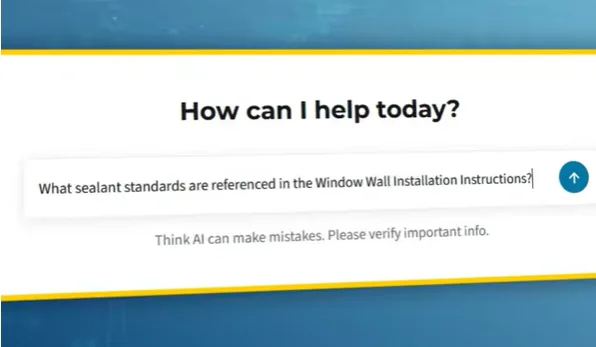
AI Search in NextGen CDE: How Thinkproject AI turns governed construction data into confirmed answers
Read moreDiscover how AI search in a NextGen CDE helps construction teams find current, approved project information while preserving permissions and control.
-
Blog

Digitalization
Construction business intelligence: Turning data into better decisions
Read moreLearn how construction business intelligence connects project data, improves reporting and supports better decisions across the asset lifecycle.
-
Blog

Contracts
Best construction contract management software: 11 features to look for
Read moreCompare the key features to look for in construction contract management software, from NEC, JCT and FIDIC workflows to audit trails and risk control.
-
Blog
Contracts
JCT contract types: Choosing and managing the right contract
Read moreCompare the main JCT contract types, understand construction management contracts and learn how to choose and administer the right form.