
Construction data management: your documents are governed. Your project data isn’t.
I have spent twenty years in construction technology watching the same pattern.
The industry agrees on a problem. Produces a principle. Declares the problem solved. Then the same underlying gap appears in the next project, programme or digital initiative.
Construction data management has made significant progress. Common data environments (CDEs), ISO 19650 principles and structured approval workflows give project teams greater control over documents and information during delivery.
But managing construction data within a project is only part of the challenge.
Information continuity means keeping governed project and asset information connected, traceable and usable as a built asset moves from design through construction and handover into operations. Without that continuity, information may survive the project while the context around it is lost.
That matters even more as the construction industry explores artificial intelligence (AI). The question is no longer simply which AI model, vendor or use case to choose. It is whether the underlying information is governed, connected and reliable enough to support an answer that can be trusted.
The gap is not governance.
The gap is that governance often stops when the project does.
At handover, at the start of operations or when someone asks a question about an asset years later, the original record may still exist. But the approvals, relationships and context needed to understand it may sit elsewhere.
Effective data management in construction therefore needs to address a bigger question: does governance travel with the information?
What is construction data management?
Construction data management is the structured process of capturing, organising, governing and using information throughout the delivery of a built asset.
It covers more than storing documents. Effective construction data management maintains control over versions, approvals, responsibilities and access while connecting information to the project, contract and asset context in which it was created.
The challenge is maintaining that context when information moves between teams, systems and lifecycle stages.
That is where information continuity becomes critical.
Where construction data management breaks down
Construction projects generate information continuously. Documents are approved. Models change. Contract events occur. Inspections are completed. Assets are commissioned.
The problem often appears when that information moves from one context to another.
Three transitions repeatedly create this challenge.
1. From the CDE to downstream processes
A document is submitted, reviewed, approved and versioned. The CDE holds the governed record.
But project information rarely stays inside one system.
Teams may need it for procurement, commercial management, field activities, handover or other downstream processes. If information is downloaded, copied or manually transferred, the file can move while its governance context does not.
The approval history remains in one place. The information continues elsewhere.
A strong approach to construction data management therefore needs to preserve more than the latest file. It needs to maintain the connection between information and its history, status and context.
2. From project delivery to handover
The second break happens between construction and operations.
Asset information is created throughout delivery by designers, contractors, commissioning teams and inspectors. Specifications, certificates, test results, manuals and as-built information accumulate over months or years.
If handover is treated primarily as an end-of-project exercise, teams have to assemble and validate that information when time is already under pressure.
A more continuous approach changes the process.
Asset information requirements can be defined earlier. Data can be collected and validated as delivery progresses. Missing information can be identified before project closeout rather than after it.
The result is not simply a better handover package. It is information that is better prepared for operational use.
3. From handover to operations
The third break happens after the asset becomes operational.
Project teams leave. Responsibilities change. Different systems take over. Maintenance, inspections and operational activities begin generating a new body of information.
Without a persistent connection between the project record and the operational asset, context can fragment over time.
The challenge for data management in construction is therefore not only to create an accurate record of what was designed and built. It is to ensure that useful context can continue into the asset’s operational life.
Construction data governance must travel with the information
Closing these gaps requires a broader view of construction data management.
Governance cannot simply be applied to individual systems. It needs to remain with information as that information moves between documents, contracts, field activities, handover and asset operations.
That has different implications across each area.
Document governance
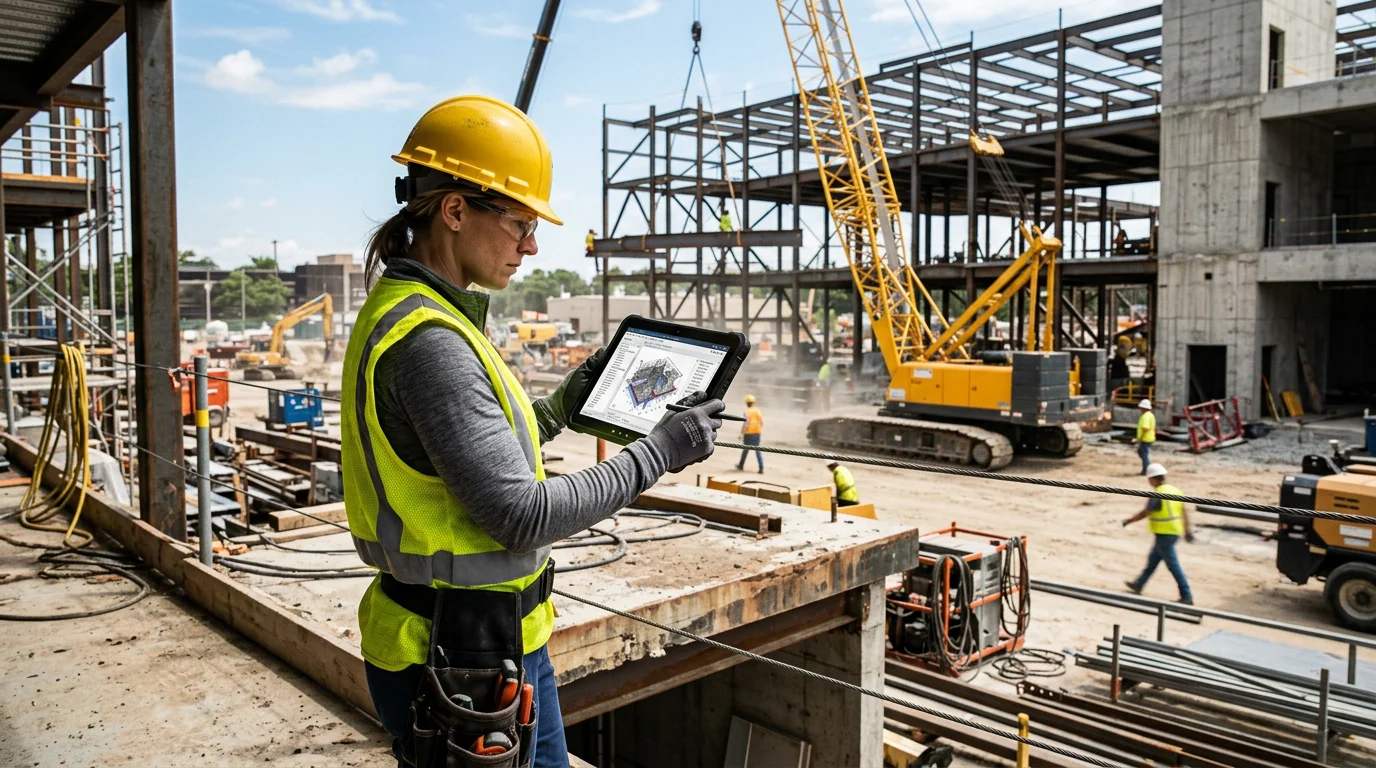
Document governance means maintaining controlled versions, approvals, access and a traceable history of project information.
A CDE provides the structured environment needed to manage that process. But the value increases when approved information can also provide trusted context for downstream workflows rather than becoming another disconnected source.
The goal is not simply to know where the latest document sits. It is to understand its status, history and relationship to the work around it.
Commercial governance
Construction data also has a commercial context.
Variations, instructions, contractual events, payments and obligations need to remain connected to the contract processes that produced them. Structured contract management provides a traceable record of these events and their relationship to project information.
That reduces dependence on disconnected email threads and spreadsheets and makes the commercial history easier to understand and audit.
Field governance
The same principle applies on site.
Inspections, observations and field workflows create evidence about what actually happened during delivery. That information is most valuable when it remains connected to the wider project context rather than ending in an isolated field tool.
Good construction data management therefore connects office and site information while preserving responsibility, status and traceability.
Handover governance
Handover should not be the point at which teams suddenly begin thinking about operational information.
A continuous approach allows asset information to be defined, collected and validated throughout delivery. Specifications, test records, certificates, as-built information and other evidence can progressively contribute to an operations-ready asset record.
This turns handover from an exercise in collecting information into a controlled transition of trusted information.
From BIM object to operational asset
Consider a single air handling unit in a hospital wing.
Early in design, it may exist primarily as an object within a building information modelling (BIM) environment. As design develops, teams coordinate the model, identify issues and make decisions around that object.
During construction, more information appears. Specifications are confirmed. Installation evidence is captured. Tests are completed. Documents are approved.
At handover, the same physical unit becomes an operational asset. Facilities teams need its specifications, manuals, commissioning evidence and other relevant information.
Later, inspections and maintenance create further records.
The problem is that these pieces of information may describe the same physical asset without sharing a consistent identity or context.
A persistent asset identity changes that.
It provides a way to connect information from different lifecycle stages and source systems around the asset itself. Model information, handover records and operational data can remain linked through a common asset context without requiring every source system to be replaced.
Now the question changes.
Instead of asking:
“Where is the latest drawing?”
an authorised user could ask:
“What information and evidence do we hold for this asset?”
That is a fundamentally more useful question.
And it shows why construction data management is becoming so important to the AI conversation.
Why construction data management matters for AI

AI in construction can make information easier to find, explore and understand. But it does not remove the need for governance.
If underlying construction data is fragmented, duplicated, outdated or separated from its context, AI has a weaker foundation from which to produce useful answers.
If information is governed, permissioned and traceable, the situation is different.
AI-assisted tools can work with information whose provenance and context are clearer. Users can understand where information came from and retain responsibility for the decisions that follow.
This is why data management in construction should be part of any serious AI strategy.
The objective is not simply to give AI access to more construction data.
It is to give people better ways to work with the right information, in the right context, under the right permissions.
From construction data management to lifecycle information continuity
The platform argument is not about putting every construction process into a single application.
Different disciplines require depth.
Document management needs structured review and approval. Commercial management needs contract-aware processes. Field teams need workflows suited to site execution. Handover needs structured asset information and validation. Operations need reliable asset context.
The opportunity is to connect those areas without removing the governance each one requires.
That is the principle behind a Built Asset Lifecycle Platform: depth where it matters, connection where the lifecycle demands it.
The Thinkproject Platform provides a governed environment spanning delivery, handover and operations. Asset Hub extends that principle through an asset-centric context that can connect information across Thinkproject solutions and external enterprise systems while preserving the distinction between source systems and contextual references.
This creates a stronger foundation for both human decisions and AI-assisted work.
As Olivier Collinet, CTPO at Thinkproject, put it during the Thinkproject Innovation Series:
“AI isn’t layered on top. It’s embedded at the core.”
For me, the important part of that statement is what sits underneath the AI.
Governed information. Persistent context. Clear permissions. Traceable decisions.
Read Olivier’s blog on why governed data represents the foundation of effective use of AI, here.
Construction data management gives us the foundation. Information continuity allows that foundation to extend across the built asset lifecycle.
Governed documents are the beginning.
Governed, connected construction data is what makes the rest possible.
Explore the Thinkproject Platform and how it connects information across delivery, handover and operations by watching our on-demand webinar.
 About the author:
Richard Moyle is Chief Product Officer at Thinkproject. He leads the product strategy for the platform covering the full project and asset lifecycle — from CDE and Contracts management through field execution, handover, and asset operations.
Frequently asked questions
Construction data management is the process of capturing, organising, governing and using project and asset information throughout construction. It includes document control, versions, approvals, permissions and traceability, as well as the connections between information and its wider project, contract and asset context.
A common data environment provides a governed environment for managing project information. It helps teams control document versions, approvals, access and information exchanges. Its value can extend further when governed information remains connected to downstream processes such as contract management, field execution, handover and asset operations.
AI-assisted tools depend on the quality and context of the information available to them. Governed, permissioned and traceable construction data provides a stronger foundation for AI-assisted search and insight. It also helps users understand the source and context of information while retaining responsibility for decisions and approvals.
More resources
Innovation Series
Built Asset Lifecycle Platform
Thinkproject Live and Recorded Webinars
Read moreLive and recorded webinars for teams that design, build, operate, and maintain the assets that shape our physical world.
-
Blog

Connected Data & Asset Intelligence
From projects to intelligent assets: 8 takeaways from Thinkproject Live London 2026
Read moreExplore 8 takeaways from Thinkproject Live London 2026: on connectedconstruction, asset intelligence, better decisions, AI adoption and more.
-
Blog
BIM
BIM collaboration: How connected project teams work better together
Read moreSee how BIM improves construction collaboration through shared models, clash detection, issue tracking, CDE workflows and connected project information.
-
Blog
Asset Management
From delivery to lasting performance: four governance priorities for Spain’s asset owners
Read moreDiscover four asset governance priorities that help Spain’s asset owners improve information reliability, flexibility, decision speed and ROI.
-
Blog
Built Asset Lifecycle Platform
Construction project life cycle: 6 phases from concept to handover
Read moreUnderstand the construction project life cycle, from feasibility and design to procurement, construction, commissioning and handover.
-
Blog

Field Management
Thinkproject HANDOVER: Turn project information into operations-ready asset data
Read moreDiscover how Thinkproject HANDOVER helps asset owners and contractors reduce information gaps and deliver validated asset data from construction into operations.
-
Event

Built Asset Lifecycle Platform
Thinkproject Live London 2026
Register your interest for 2027Discover how AI and connected data are helping teams reduce risk, improve control, and make faster, smarter decisions across the project lifecycle.
-
Event

Built Asset Lifecycle Platform
Thinkproject Live Events 2026
Read moreJoin construction, infrastructure, and asset management leaders for a day focused on the future of project and asset delivery.
-
Blog

Asset Management
Asset lifecycle management in construction: From planning to decommissioning
Read moreLearn how asset lifecycle management connects planning, construction, handover, operations and maintenance to improve built asset performance.