
Your AI is ready.
Your data isn't.
AI is delivering faster. Not better.
Every board in infrastructure and construction has now approved an AI strategy. Pilots are live. The business cases were signed.
Twelve months later, the results do not match the presentations.
Teams find documents faster. They do not always find the right ones. Decisions are still disputed. The project record is still the source of arguments, not the resolution of them. In some cases, AI has made things worse: more material surfaced, faster, with no reliable way to know which version is authoritative.
This isn’t a failure of AI. It’s a structural problem that AI has made visible. And it’s the most important conversation in construction technology right now, because the industry hasn’t yet had it honestly.
The infrastructure
you forgot to build
I’ve watched this pattern repeat. In cloud, in mobile, in enterprise software. Every time, the tool arrived before the organisations were ready for it. I’m watching it happen again now.
The tool arrives. The underlying infrastructure isn’t ready. The results disappoint. The industry concludes the tool was not right. In most cases, the tool was fine. The data layer was not.
AI is not different. The sequence has not changed.
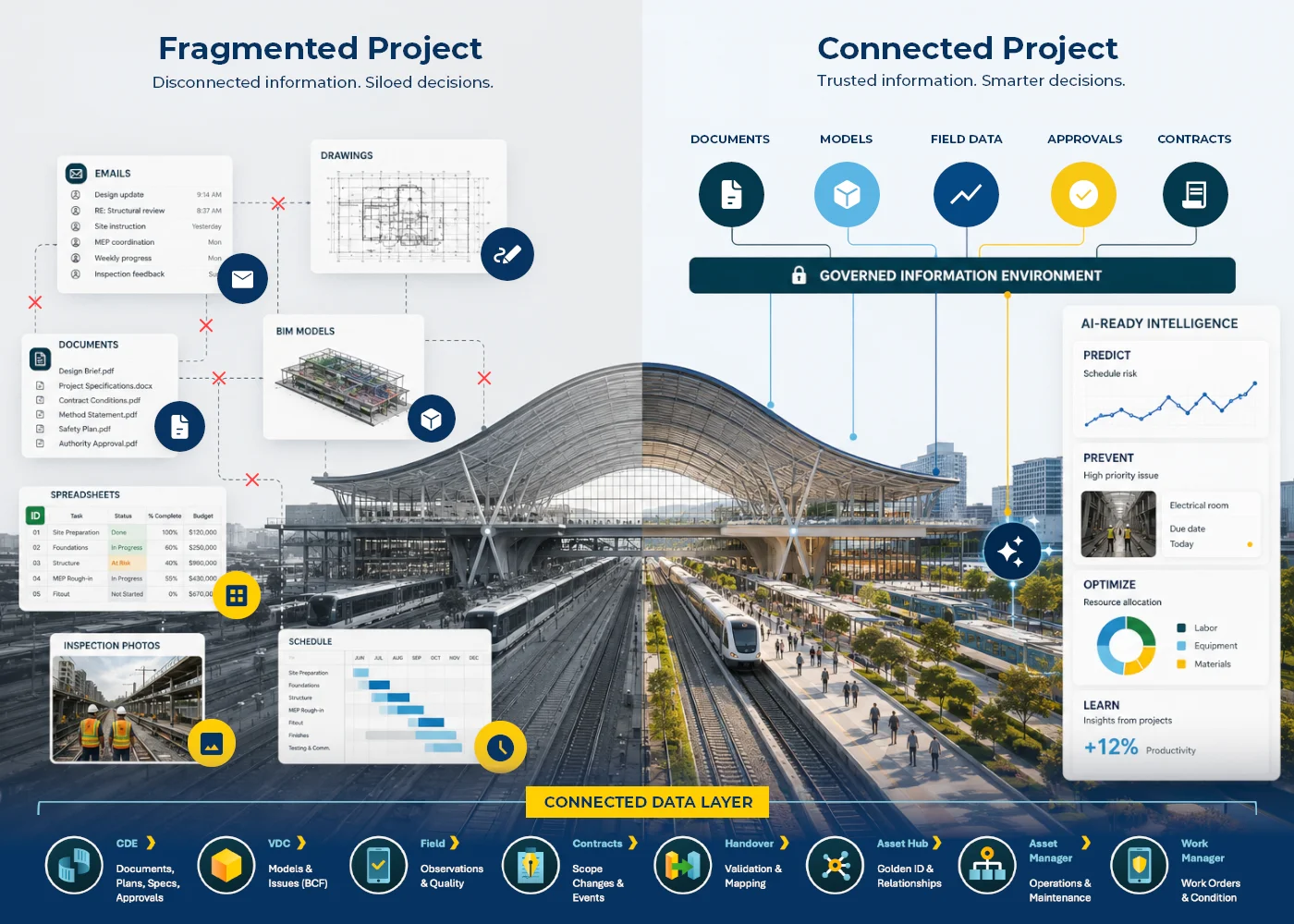
On a typical major infrastructure project today, documents live in the CDE. Models live in the BIM environment. Field evidence lives in the inspection tool. Contract correspondence lives in email threads no formal process has ever touched. Each system holds a version of the project the others can’t see. Each is technically digital. None of it is connected with shared context, version control, or a structured approval process that tells you whether a piece of information is still current.
AI on fragmented, ungoverned data doesn’t lack capability. It lacks verifiability. It can contextualise, synthesise, and generate recommendations faster than any human team. But it can’t tell you whether the document it’s reasoning from is the current approved version, the superseded draft, or the contractor’s working copy from three weeks before the record was issued.
The output is confident. The provenance is unknown.
Eighty per cent of construction organisations believe AI will transform their industry within five years. Fewer than one in five has the data infrastructure to deploy it beyond a proof of concept. (PwC, Bauindustrie Report, 2026.)
The gap isn’t ambition. The gap is what sits underneath it.
Three risks hiding in your AI deployment
Google DeepMind’s leadership has made this explicit: competitive advantage belongs to whoever has the complete stack, from infrastructure through to frontier models. The layer you can’t afford to leave weak is the one that feeds everything else.
In construction and infrastructure, that weakest layer is not the model. It is the information layer beneath it.
Most organisations have deployed AI on top of isolated data sources. SharePoint folders. Email attachments. CDE exports. Project drives. Each a snapshot at a point in time, with no shared context and no approval chain confirming whether any of it is still current.
The efficiency cost is visible: faster outputs that still require human verification, because no one trusts the source. But the risks run deeper than wasted effort.
Ungoverned data has no access controls the AI respects. An AI operating across unstructured sources can surface information across project boundaries, between contractor and client, across procurement stages, reaching records it was never authorised to touch. In regulated industries, public sector infrastructure, or any project involving commercial confidentiality or personal data, that’s not an efficiency problem. It’s a compliance failure and a security breach waiting to happen.
A governed information environment removes this risk by design. Every submission reviewed. Every approval timestamped and attributed. Every document carrying a status. Access controls enforced at the information layer, not bolted on afterwards. This is what ISO 19650 was designed for. Not compliance overhead. Data quality infrastructure and security architecture delivered as one.
Eighty-three per cent of enterprises say they need infrastructure upgrades before they can run production-grade AI at scale. Forty-three per cent name legacy data integration as the single biggest barrier. Eighty-one per cent describe operational complexity, not model performance, as the hidden cost of scaling AI. (Google Cloud, State of AI Infrastructure Report, 2026)
They’re not describing a software problem. They’re describing a governance problem.
The answer is not a different model. It is a different foundation.
AI that can be held accountable
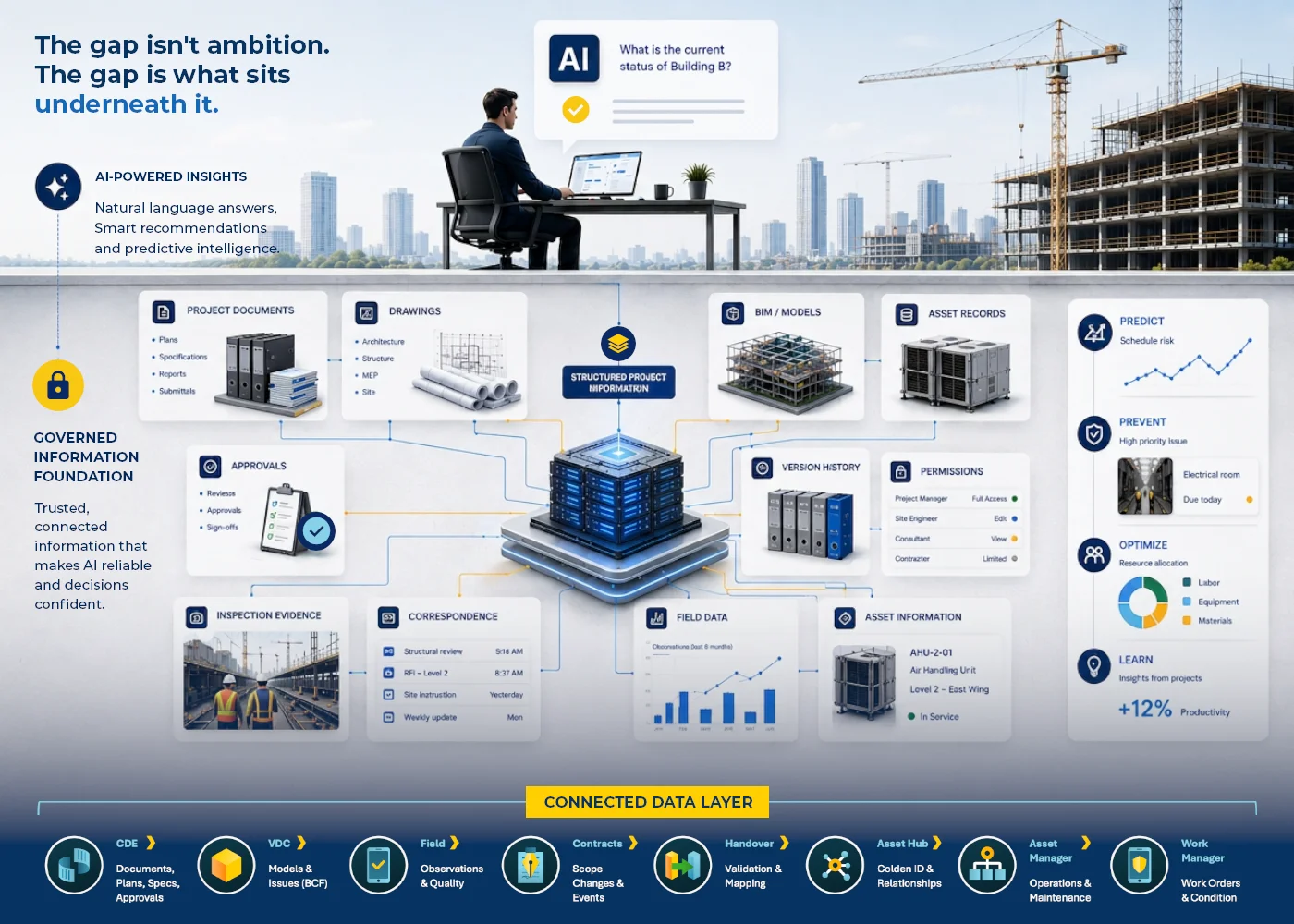
When information is governed, versioned, permission-stamped, approval-traced and status-confirmed, AI can do something fundamentally different from what it does on unstructured data.
It can return results with source, status and context. Not “here is a document that might be relevant.” Here is the current approved version. Submitted by this contractor on this date. Reviewed and accepted. Currently valid for this scope. No pending revision.
That’s not AI-assisted search. That’s AI-assisted decision support.
The distinction matters most at moments of highest consequence: procurement disputes, regulatory submissions, defect liability, insurance claims. At those moments, the question is never simply what the record says. It’s what the authorised record says, as of which date, and which party is accountable for its accuracy.
Governed information answers that question precisely. Ungoverned data returns a confident approximation.
The same logic applies at handover — and this is where I’ve watched more project information disappear than at any other point in the lifecycle. Think of a mechanical system installed in a hospital wing. By the time it’s handed over, years of decisions surround it: design choices, coordination resolutions, inspection records, commissioning sign-offs. That history exists. But it’s scattered across systems that don’t share a common reference for the physical asset those decisions were about. The operations team inherits the equipment. They don’t inherit the evidence chain.
The most powerful thing a governed information platform can do is give every asset a single persistent identity from the moment it’s conceived in design to the last maintenance record decades later. Not a folder structure. A thread that connects every decision, every submission, every inspection to the physical thing they describe. When that exists, handover isn’t a transfer of documents. It’s a transfer of verified knowledge.
Governance first.
Intelligence second.
The pressure to deploy AI is real and legitimate. I’m not arguing against it. I’m arguing for the sequence.
The organisations that will benefit most from AI in construction and infrastructure won’t be the ones with the most sophisticated models or the most pilots running in parallel. They’ll be the ones that structured, governed, and connected their project information first — and in doing so addressed compliance, security and efficiency in a single move rather than three separate programmes.
The winners won’t be the ones with the smartest agents. They’ll be the ones who can feed those agents knowledge that can actually be trusted.
That work is happening now. A governed information layer, built to ISO 19650, connected across design, construction, commissioning and operations, anchored to a persistent digital asset record, on which AI can finally produce results that matter at the moments that matter most.
The question for every organisation building and operating assets in 2026 isn’t whether to invest in AI. That decision has been made.
The question is whether the information underneath it is ready for what you’re asking it to do.
Your AI is ready. Is your data?
 About the author:
Olivier Colinet is Chief Technology and Product Officer at Thinkproject, a platform for governed information management across the construction and asset lifecycle.
Want to see how AI and connected project data are already transforming construction in practice? Join customers, partners and industry experts at Thinkproject Live 2026 to explore real-world AI use cases, smarter risk management and the future of project delivery.
More resources
-
Blog

Asset Management
Asset lifecycle management in construction: From planning to decommissioning
Read moreLearn how asset lifecycle management connects planning, construction, handover, operations and maintenance to improve built asset performance.
-
Blog

BIM
Browser-based BIM viewer performance: 10 factors that affect large IFC models
Read moreDiscover what impacts browser-based BIM viewer performance - from geometry and IFC file quality to client hardware and network. A technical guide for BIM teams.
-
Blog

BIM
8 best BIM collaboration software systems for construction teams
Read moreExplore the best BIM collaboration software systems, from CDEs and model coordination to issue tracking, document control, field collaboration, and handover.
-
Blog
CDE
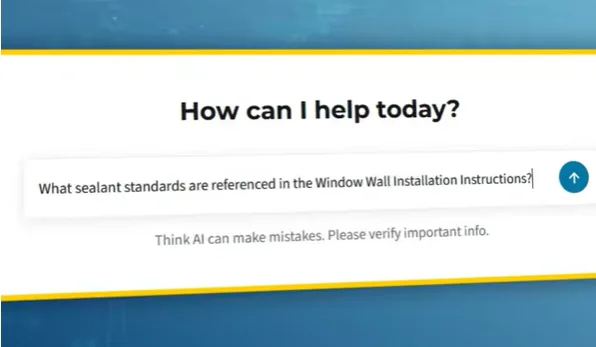
AI Search in NextGen CDE: How Thinkproject AI turns governed construction data into confirmed answers
Read moreDiscover how AI search in a NextGen CDE helps construction teams find current, approved project information while preserving permissions and control.
-
Blog

Digitalization
Construction business intelligence: Turning data into better decisions
Read moreLearn how construction business intelligence connects project data, improves reporting and supports better decisions across the asset lifecycle.
-
Blog

Contracts
Best construction contract management software: 11 features to look for
Read moreCompare the key features to look for in construction contract management software, from NEC, JCT and FIDIC workflows to audit trails and risk control.
-
Event

Built Asset Lifecycle Platform
Thinkproject Live London 2026
Register nowDiscover how AI and connected data are helping teams reduce risk, improve control, and make faster, smarter decisions across the project lifecycle.
-
Event

Built Asset Lifecycle Platform
Thinkproject Live Events 2026
Read moreJoin construction, infrastructure, and asset management leaders for a day focused on the future of project and asset delivery.
-
Blog
Contracts
JCT contract types: Choosing and managing the right contract
Read moreCompare the main JCT contract types, understand construction management contracts and learn how to choose and administer the right form.