
From BIM coordination to field execution: the case for one delivery environment
Most construction and infrastructure organisations are already digitally enabled. Teams use tools for BIM coordination, model review, site inspections, QSHE workflows and issue management every day.
Yet many projects still struggle with rework, delays and coordination gaps.
The issue is not a lack of technology. It‘s fragmentation.
Too often, critical workflows still operate across disconnected environments with inconsistent processes, limited visibility and weak continuity between teams.
The shift from isolated tools to connected project delivery
Digital delivery should improve clarity and control. But when workflows operate in silos, projects become harder to manage, not easier.
Many organisations still rely on:
- separate workflows for coordination, collaboration and field execution
- disconnected approvals and project information
- inconsistent processes across teams and projects
- limited traceability between decisions and site activity
The result is familiar across the industry:
- slower decision-making
- duplicated effort
- coordination blind spots
- inconsistent execution
- increased delivery risk
As projects become more complex, these gaps become harder to manage at scale.
This is why leading organisations are starting to move beyond standalone tools towards more consistent delivery environments, where teams work within shared project context, clear accountability, and better visibility across the delivery process.
Because the real value of digital delivery is not simply having more tools. It is creating continuity across the workflows that shape project outcomes.
VDC Manager: Bringing constructability assurance into mainstream delivery
For many project teams, BIM coordination still operates as a specialist activity rather than a core part of delivery governance. Models are reviewed, clashes are identified, and coordination meetings take place, yet constructability issues are still often discovered too late, after decisions have already been made or work has started on site.
The challenge with isolated BIM workflows
Many organisations continue to face familiar coordination challenges:
- design issues identified late in the delivery process
- limited confidence in model quality
- manual coordination effort across disciplines
- poor visibility into constructability risks
- disconnected workflows between design, planning and delivery teams
This creates a gap between model review and project execution.
Moving beyond standalone BIM management
VDC Manager supports a more structured and governed approach to constructability assurance, helping teams improve delivery confidence earlier in the project lifecycle.
Its capabilities include:
- BIM automation
- Customised workflows
- Configurable validation rule sets
- Clash detection across disciplines
- Model-checking and quality assurance
- 4D sequencing support
- 5D quantity take-off workflows
The objective is not simply to identify clashes. It is to improve confidence in delivery-readiness even before execution begins.
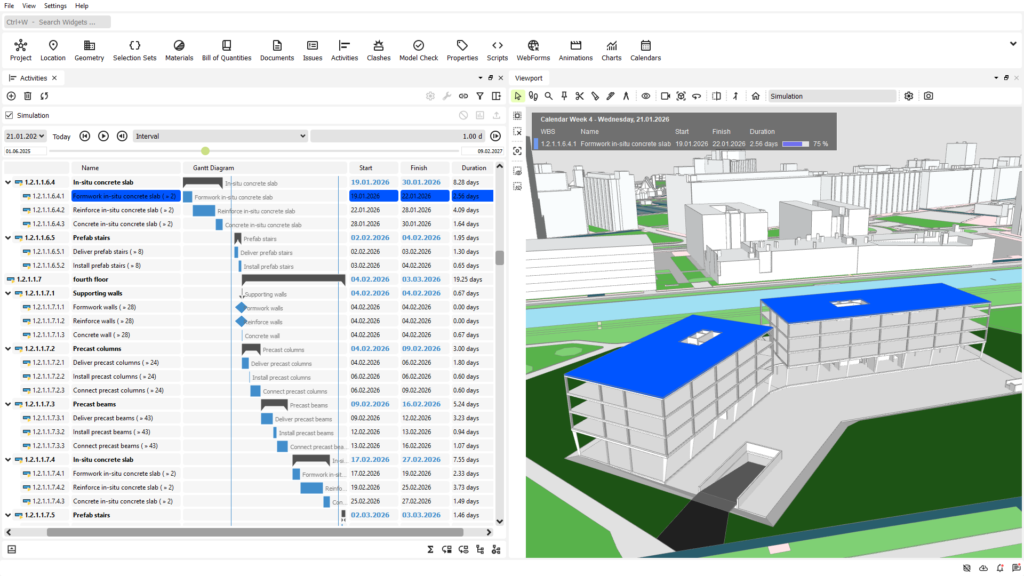
Construction planning and 4D simulation on VDC Manager
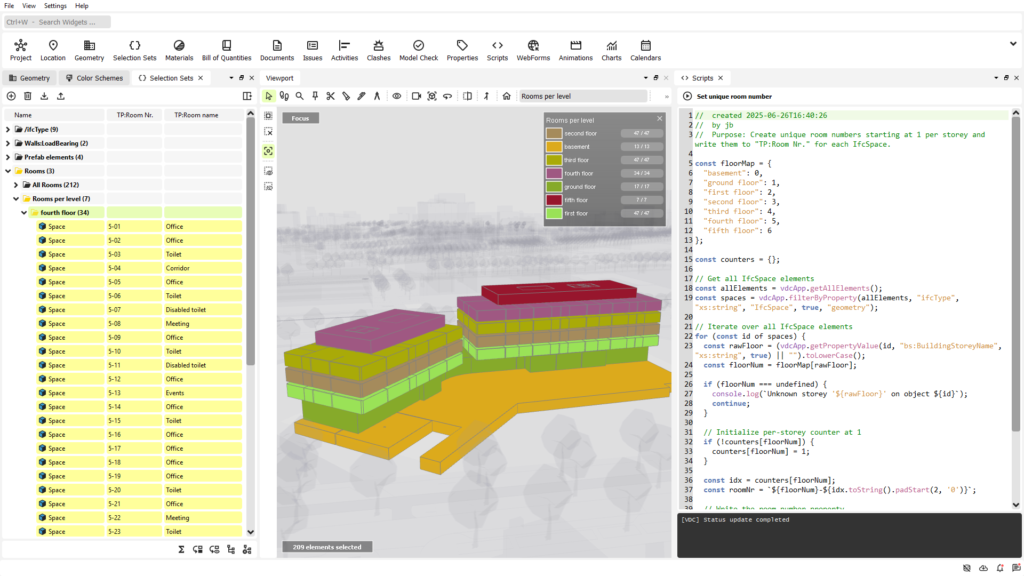
Custom workflows and automation on VDC Manager
What changes with a more governed approach?
With a more governed approach, teams gain:
- Reduced manual work through BIM automation
- Standardised execution through customised workflows
- Early visibility into constructability risks
- More structured validation workflows
- Stronger coordination across disciplines
- Clear accountability before work reaches site
- More reliable project execution
As digital delivery matures, constructability assurance is becoming less about managing models in isolation and more about improving project-wide decision confidence.
VDC Collaboration: Making coordination accessible across the project team
Identifying constructability risks earlier is only part of the challenge. Teams also need a faster, more accessible way to collaborate around those decisions.
As BIM adoption has matured, model complexity has increased significantly across construction and infrastructure projects. But the biggest coordination challenge today is not simply managing larger models. It is ensuring that the right stakeholders can collaborate around them effectively.
The challenge with fragmented coordination
Many organisations continue to face common collaboration challenges:
- limited visibility across disciplines
- slow issue resolution cycles
- disconnected coordination discussions
- inconsistent communication between teams
- limited accountability around design decisions
When coordination workflows operate in isolation, project teams lose shared visibility and decisions become harder to track over time.
Moving beyond specialist-only BIM collaboration
VDC Collaboration helps create a more accessible and transparent coordination environment across the wider project team.
This is possible due to:
- Integration within the Thinkproject Platform
- Connectivity with a CDE
- Integration with Asset Work Manager (Facility Management)
- Lifecycle continuity
- Browser-based access to federated models
- Multidisciplinary model review
- Open BIM collaboration through BCF-based issue workflows and interoperability
- Shared viewpoints and coordination context
- Issue tracking and workflow visibility
The objective is not simply model visualisation. It is to provide a shared environment where stakeholders can understand, review and act on BIM information.
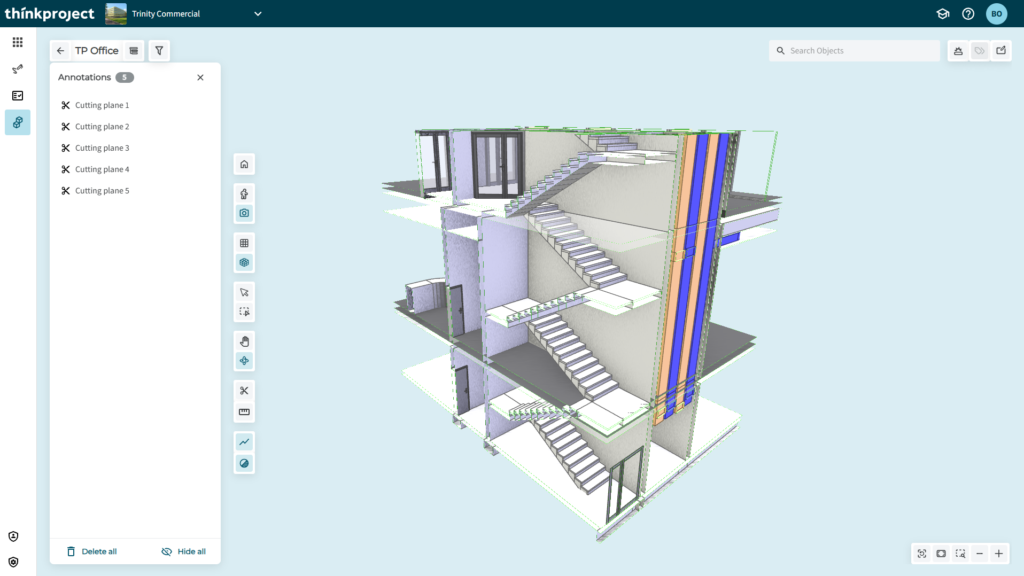
Model visualisation on VDC Collaboration
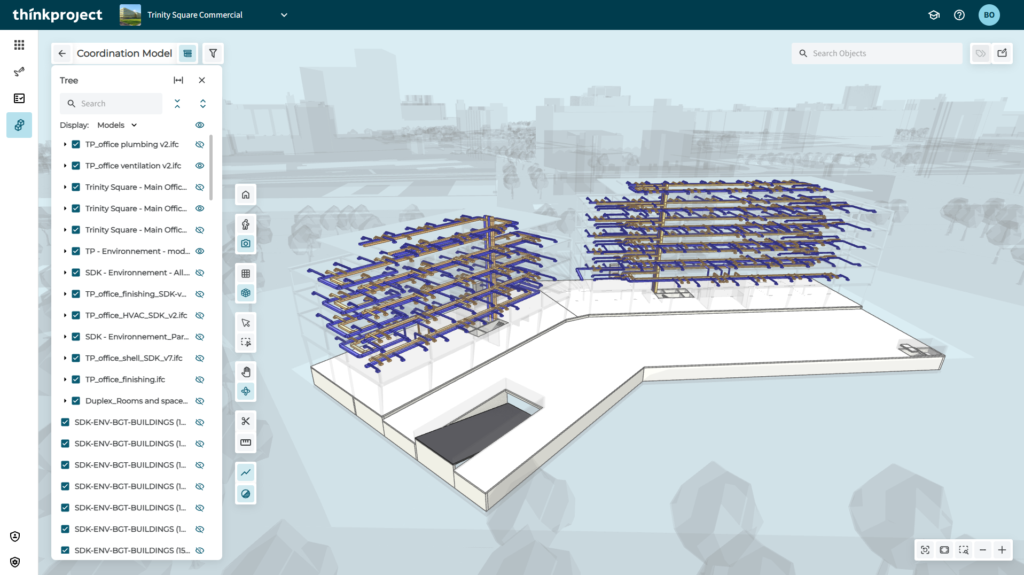
Design coordination on VDC Collaboration
Why accessible collaboration matters
A more transparent collaboration environment helps teams:
- resolve issues faster
- improve coordination across disciplines
- reduce communication gaps
- strengthen accountability
- support more informed project decisions
When model collaboration operates within the same project environment, teams gain clearer visibility, more consistent governance, and stronger continuity across delivery workflows.
Because successful coordination is not only about model complexity. It is about giving project teams the context and visibility needed to make better decisions together.
From BIM validation to project-wide collaboration
Effective BIM workflows require more than high-quality models. They require the right information to reach the right stakeholders at the right time.
VDC Manager is where BIM experts validate, enrich, and process model data. It helps teams identify and resolve issues before they impact delivery.
Once BIM data has been validated, VDC Collaboration extends its value across the wider project team. Through model visualisation, design coordination, issue management, and collaborative workflows, stakeholders can access, review, coordinate, and resolve project information in a shared environment.
An effective overall workflow will look like this:
- Validate: VDC Manager validates and processes BIM data
- Coordinate: VDC Collaboration makes that data accessible and actionable for the wider project team
- Resolve: BIM experts execute
- Deliver: Project teams coordinate
Field Manager: Standardising execution across the field
Coordination decisions only create value if they translate into consistent execution on site.
Many construction and infrastructure organisations have already digitised parts of their field operations. But digitalisation alone does not guarantee consistency. Across projects and sites, field workflows are still often managed through disconnected processes, spreadsheets and manual reporting methods that reduce visibility between office and site teams.
The challenge with fragmented field workflows
Site teams continue to face common operational challenges:
- inconsistent inspection and QSHE processes
- delayed reporting from site
- spreadsheet-driven workflows
- weak audit trails
- limited visibility between field and office teams
These gaps create operational friction and make it harder to maintain consistent execution standards across projects and portfolios.
Moving beyond digital forms
Field Manager supports a more structured and repeatable approach to field execution, due to its core capabilities:
- Configurable inspection and workflow templates
- Mobile-first field execution
- Standardised QSHE workflows
- Role-based approvals and escalations
- Audit-ready reporting and traceability
The objective is not only to digitise site activity, but to improve consistency, accountability and governance across field operations.
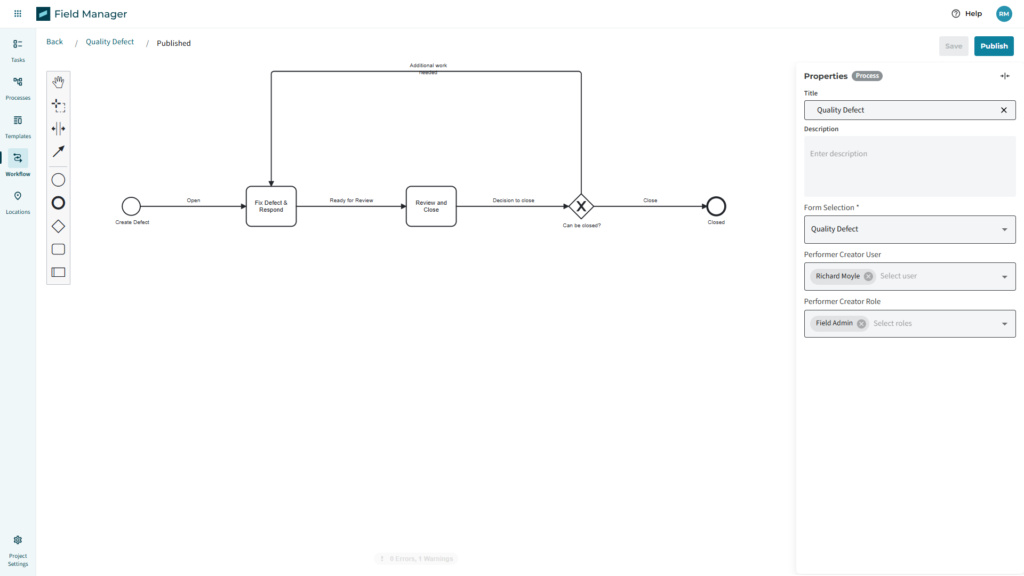
Pre-configured workflows on Field Manager
Why standardisation matters
A more governed approach to field execution helps organisations:
- Standardise workflows across projects
- Improve visibility into site activity
- Reduce reporting delays
- Strengthen audit readiness
- Improve coordination between field and office teams
When field execution operates within the same project environment as coordination and project information, teams work with more consistent context and clearer accountability across delivery processes.
Because the real challenge is not simply collecting more field data. It is ensuring that field execution remains governed, visible and aligned with the wider delivery process.
Why continuity matters more than isolated functionality
The industry does not have a data problem. It has a data consistency and workflow continuity problem.
For years, digital transformation focused on improving individual activities:
- BIM coordination
- Field reporting
- Document management
- Issue tracking
But improving isolated workflows does not automatically improve project delivery.
When coordination, collaboration and field execution operate in separate environments, teams lose shared context. Information becomes harder to track, accountability weakens and delivery risks become more difficult to identify.
This is why leading organisations are shifting their focus from standalone functionality towards more connected delivery environments. As projects become larger and more complex, organisations are under growing pressure to:
- standardise delivery processes
- maintain clear audit trails
- improve accountability
- reduce coordination risk
- ensure operational continuity beyond project completion
That requires more than point solutions.
It requires an environment where teams work with shared project context, traceable workflows and consistent governance across the asset lifecycle.
This is where the Thinkproject Platform vision becomes increasingly important.
By bringing coordination, collaboration and field execution into one governed delivery environment, organisations can reduce fragmentation, improve delivery confidence and create more scalable delivery processes across projects and portfolios.
Join the webinar
The future of digital delivery is no longer a set of disconnected tools. It is continuity across coordination, collaboration and field execution.
Join our upcoming webinar to explore how organisations are improving delivery confidence through more consistent, governed project environments.
During the session, we will discuss:
- how VDC Manager supports earlier constructability assurance
- why accessible model collaboration improves coordination outcomes
- how Field Manager helps standardise site execution and QSHE workflows
- the value of working within one consistent delivery environment
You will also gain practical insights into how leading project teams are reducing fragmentation, improving accountability and creating stronger continuity across the delivery lifecycle.
More insights
-
Blog
Built Asset Lifecycle Platform
Construction project life cycle: 6 phases from concept to handover
Read moreUnderstand the construction project life cycle, from feasibility and design to procurement, construction, commissioning and handover.
-
Blog

Field Management
Thinkproject HANDOVER: Turn project information into operations-ready asset data
Read moreDiscover how Thinkproject HANDOVER helps asset owners and contractors reduce information gaps and deliver validated asset data from construction into operations.
-
Event

Built Asset Lifecycle Platform
Thinkproject Live London 2026
Join the waitlistDiscover how AI and connected data are helping teams reduce risk, improve control, and make faster, smarter decisions across the project lifecycle.
-
Event

Built Asset Lifecycle Platform
Thinkproject Live Events 2026
Read moreJoin construction, infrastructure, and asset management leaders for a day focused on the future of project and asset delivery.
-
Blog

Asset Management
Asset lifecycle management in construction: From planning to decommissioning
Read moreLearn how asset lifecycle management connects planning, construction, handover, operations and maintenance to improve built asset performance.
-
Blog

BIM
Browser-based BIM viewer performance: 10 factors that affect large IFC models
Read moreDiscover what impacts browser-based BIM viewer performance - from geometry and IFC file quality to client hardware and network. A technical guide for BIM teams.
-
Blog

BIM
8 best BIM collaboration software systems for construction teams
Read moreExplore the best BIM collaboration software systems, from CDEs and model coordination to issue tracking, document control, field collaboration, and handover.
-
Blog
CDE
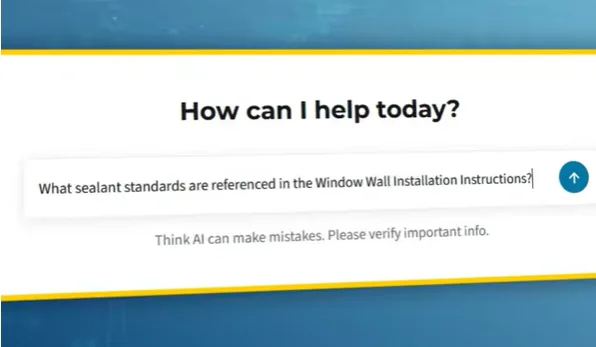
AI Search in NextGen CDE: How Thinkproject AI turns governed construction data into confirmed answers
Read moreDiscover how AI search in a NextGen CDE helps construction teams find current, approved project information while preserving permissions and control.
-
Blog

Digitalization
Construction business intelligence: Turning data into better decisions
Read moreLearn how construction business intelligence connects project data, improves reporting and supports better decisions across the asset lifecycle.