
NEC vs FIDIC vs JCT: Which construction contract should you use?
Thinkproject Live London 2026
Join us in London for an in-person event exploring how AI, connected information and customer innovation are shaping the future of project delivery. Hear practical insights, customer stories and the latest Thinkproject innovation.
London | 3 November 2026


Choosing the right construction contract has a lasting impact on project delivery. Beyond defining legal obligations, the contract shapes how teams manage risk, respond to change and resolve disputes throughout the project lifecycle.
When comparing NEC vs FIDIC vs JCT contract types, there is no single “best” option. NEC promotes proactive contract management and collaboration, JCT provides familiar forms for UK building projects, and FIDIC is widely used on complex international infrastructure programmes. As digital transformation in construction continues to reshape project delivery, organisations are placing greater emphasis not only on selecting the right contract but also on managing contractual obligations, project information and commercial workflows through connected digital processes.
This guide compares NEC vs FIDIC vs JCT across the areas that matter most, including risk allocation, change management, payment, contract administration and dispute resolution. It also explores NEC vs JCT for UK projects and explains when FIDIC is the preferred choice for international delivery.
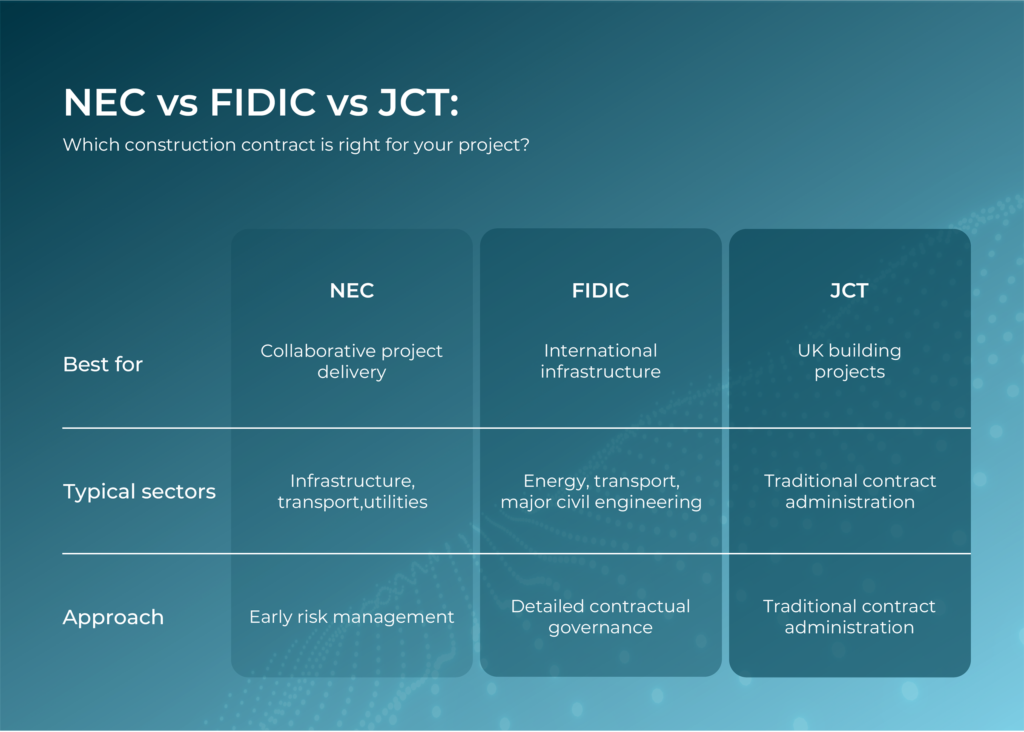
NEC vs FIDIC vs JCT at a glance
Although NEC, FIDIC and JCT all provide a contractual framework for construction projects, they take different approaches to collaboration, risk allocation and contract administration.
The table below summarises the main characteristics of each contract family.
| Criteria | NEC | FIDIC | JCT |
|---|---|---|---|
Primary focus | Collaborative project delivery and proactive management | International engineering and infrastructure projects | Traditional procurement for UK building projects |
Typical use | UK infrastructure, utilities, transport, public sector | International infrastructure, energy and major civil engineering | UK commercial, residential and public building projects |
Geographic focus | Widely used in the UK, increasingly adopted internationally | Global | Primarily UK |
Contract philosophy | Collaboration, transparency and early risk management | Clearly defined contractual rights and risk allocation | Established legal certainty with flexible procurement options |
Risk management | Early Warning process and shared risk management | Risk allocated through detailed contract provisions | Traditional allocation of risk between employer and contractor |
Change management | Compensation events | Variations and contractual claims | Variations under contract provisions |
Programme management | Strong emphasis on maintaining an accepted programme | Programme requirements vary by contract | Less prescriptive than NEC |
Administration workload | High, requiring active contract management | Moderate to high | Generally lower |
Best suited for | Projects requiring collaboration and active administration | Large international or multi-jurisdictional projects | UK projects seeking familiar contract forms |
While this comparison highlights the key differences, choosing the right contract depends on more than project size or location. Procurement strategy, commercial capability, risk appetite and the resources available for contract administration all play an important role.
Increasingly, organisations also evaluate how well each contract can be administered through digital contract management processes that improve governance, traceability and collaboration.
Key differences between NEC, FIDIC and JCT
All three contract suites provide a good legal framework, but they reflect different approaches to project delivery. Understanding these differences helps organisations select the contract that best aligns with their commercial objectives and delivery model.
1. Contract roles and decision-making
One of the main differences lies in how contracts are administered and who is responsible for key decisions.
- Under NEC, the Project Manager has an active contractual role, issuing instructions, assessing compensation events, monitoring programmes and encouraging early communication throughout delivery.
- FIDIC appoints an Engineer to administer the contract and make contractual determinations. Depending on the project, the Engineer may be required to act impartially when assessing claims or disputes.
- Under JCT, the Contract Administrator (typically the architect or employer’s agent) certifies payments, issues instructions and administers variations through established contractual procedures.
For many organisations, this distinction influences the level of commercial resource required. NEC generally demands more active day-to-day administration than JCT, while FIDIC sits between the two depending on project complexity.
2. Risk allocation and ground conditions
Every construction contract allocates risk differently, making this one of the most important considerations during procurement.
- NEC promotes proactive risk management through its Early Warning process. Both parties are expected to identify emerging issues early and work together to reduce their impact before they become formal disputes.
- FIDIC adopts a more structured approach, defining responsibilities through detailed contractual provisions covering unforeseen physical conditions, delays and employer risks. This makes it well-suited to large infrastructure and international projects where complex risk allocation is expected.
- JCT follows a more traditional allocation of risk based on established legal principles and agreed amendments. While familiar across the UK construction industry, it places less contractual emphasis on collaborative risk management than NEC.
The right approach depends on the project’s complexity, procurement strategy and the parties’ willingness to manage risk proactively.
3. Programme, delays and time control
The three contract suites also differ significantly in how they manage programme and delay.
- NEC places the programme at the centre of contract administration. Contractors submit programmes for acceptance, update them regularly and demonstrate the impact of change throughout delivery. This improves visibility but requires disciplined programme management.
- FIDIC also requires programmes and uses them when assessing extensions of time and project performance. However, they play a less central role in day-to-day contract administration than under NEC.
- JCT includes established mechanisms for extensions of time and delay management but is generally less prescriptive about programme acceptance and ongoing updates.
For projects involving multiple stakeholders or evolving scopes, NEC’s programme-driven approach can improve transparency when administered consistently.
4. Variations, compensation events and claims
Changes are inevitable on construction projects, but each contract manages them differently.
- Under NEC, most changes are handled through compensation events, with defined notification periods, assessment procedures and timescales. The objective is to resolve commercial issues as work progresses rather than allowing claims to accumulate.
- FIDIC manages change through variations and contractual claims, allowing contractors to seek additional time or cost where permitted under the contract.
- JCT also uses a variations process alongside established mechanisms for loss and expense, extensions of time and valuation. These procedures are familiar across the UK construction sector but are generally less structured than NEC’s event-driven approach.
Regardless of the contract, effective change management depends on timely notices, complete records, governed project information and clear supporting evidence. Missing contractual deadlines can quickly turn routine changes into costly disputes.
5. Payment, cost control and commercial certainty
Commercial certainty relies on consistent administration as much as contractual wording.
- NEC links payment closely to compensation events, accepted programmes and defined assessment procedures, providing greater visibility of commercial impacts throughout delivery.
- FIDIC includes detailed payment mechanisms based on valuations, interim certificates and contractual entitlements, reflecting the needs of large and complex infrastructure projects.
- JCT provides well-established payment procedures familiar to contractors, consultants and employers across the UK, with flexibility across different procurement routes and pricing models.
Whichever contract is used, many organisations now rely on digital commercial management to improve transparency, maintain accurate records and keep contractual obligations on track.
6. Notices, records and administration workload
The practical differences between the three contract suites often become most apparent during contract administration.
- NEC places significant emphasis on timely communication. Early warnings, compensation events, notifications and programme updates all have contractual deadlines that can directly affect commercial outcomes.
- FIDIC also relies heavily on formal notices and supporting documentation, particularly when administering claims, variations and contractual determinations.
- JCT may require fewer formal notices, although accurate record keeping remains essential for managing variations, payment applications and potential disputes.
This is where many organisations discover that selecting the right contract is only part of the challenge. Successful delivery depends on maintaining accurate records, meeting contractual deadlines and ensuring every commercial action is linked to the supporting project information. Increasingly, organisations support this through integrated construction document management systems that keep contractual records, drawings and correspondence connected throughout the project lifecycle.
7. Dispute avoidance and dispute resolution
Although disputes cannot always be avoided, each contract provides different mechanisms for managing them.
- NEC focuses on preventing disputes through early warnings, proactive communication and ongoing contract management.
- FIDIC includes detailed dispute avoidance and resolution procedures, often involving Dispute Avoidance and Adjudication Boards (DAABs) before arbitration where appropriate. These mechanisms are particularly valuable on complex international projects.
- JCT relies on established UK dispute resolution processes, including adjudication, arbitration and litigation where required.
Successful dispute avoidance depends less on the wording of the contract than on how consistently contractual processes are followed throughout delivery.
JCT vs NEC: which is better for UK construction projects?
For UK organisations, the decision often comes down to JCT vs NEC. Both are widely used, but they suit different delivery environments.
JCT remains a popular choice for commercial, residential and private sector building projects. Its familiarity simplifies procurement, and most contractors, consultants and legal advisers have extensive experience administering JCT contracts. Where projects follow established procurement routes and traditional contract management practices, JCT is often the natural choice.
NEC has become a popular option for many public sector, infrastructure, utilities and transport projects. Its emphasis on collaboration, early risk management and programme control supports projects involving multiple stakeholders and evolving requirements.
When comparing NEC vs JCT, consider the following:
- Does the project involve significant change or evolving requirements?
- Is proactive collaboration a priority?
- Can the team dedicate sufficient resources to active contract administration?
- Are programme management and early risk identification critical to success?
If the answer to most of these questions is yes, NEC is often the stronger choice. If the project is relatively straightforward and the parties prefer familiar contractual processes, JCT may provide a simpler solution.
Where FIDIC fits when JCT and NEC are not enough
While JCT and NEC are widely used across UK construction projects, they are not always the best fit. Projects involving international stakeholders, cross-border delivery or complex contractual arrangements often require a framework designed specifically for those environments.
Developed by the International Federation of Consulting Engineers, FIDIC is a very popular contract suite for international infrastructure and engineering projects. It provides a recognised framework that is widely accepted by employers, contractors, consultants and funding organisations around the world.
FIDIC is often the preferred choice when a project involves:
- Multiple countries or jurisdictions, where a globally recognised contractual framework provides consistency.
- International funding, particularly from development banks or public authorities that specify FIDIC contracts.
- Large-scale infrastructure projects in sectors such as transport, energy, water and civil engineering.
- Complex risk allocation, where detailed contractual provisions help define responsibilities and manage claims.
- Multi-party delivery models, requiring clear governance across organisations, contractors and consultants.
Rather than focusing on collaboration in the same way as NEC or the familiarity of JCT, FIDIC provides a comprehensive framework for managing contractual complexity on major infrastructure programmes.
Many organisations use more than one contract suite across their portfolio. A UK commercial building may be delivered under JCT, a public infrastructure programme under NEC, and an overseas rail or energy project under FIDIC.
The challenge is not simply choosing the right contract for each project, but maintaining consistent governance, traceability and commercial control across them all. Standardised contract management processes and digital workflows help organisations administer different contract forms with the same level of visibility, control and compliance.
Which contract suite should you choose?
Choosing between NEC, FIDIC and JCT is not about finding a universally superior contract. The right choice depends on your project objectives, procurement strategy, commercial capability and the level of collaboration required throughout delivery.
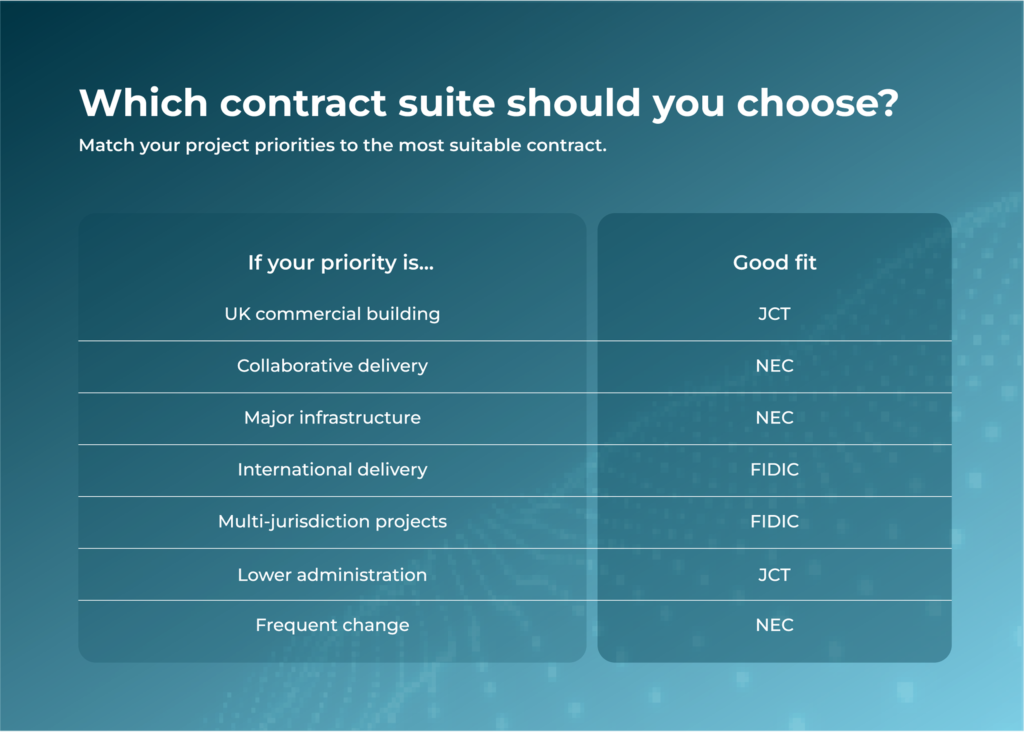
The matrix below provides a practical starting point.
| If your priority is… | Commonly suited contract type | Why |
|---|---|---|
Delivering a typical UK commercial or residential building project | JCT | Familiar processes, broad industry adoption and flexible procurement options. |
Encouraging collaboration and proactive contract management | NEC | Early Warning mechanisms, programme management and structured change control support collaborative delivery. |
Managing major infrastructure or public sector programmes | NEC | Designed for complex delivery environments requiring active commercial management. |
Delivering international infrastructure projects | FIDIC | Internationally recognised framework suited to multi-jurisdictional delivery. |
Working with international funding organisations or overseas clients | FIDIC | Frequently specified by international employers and development banks. |
Minimising administration on relatively straightforward projects | JCT | Typically requires less intensive day-to-day contract management than NEC. |
Managing frequent scope changes throughout delivery | NEC | Compensation events provide a structured approach to assessing change as it occurs. |
Operating across multiple contract forms | NEC, FIDIC and JCT | A consistent digital contract management approach standardises governance across projects. |
This guide is for general information only and should not replace legal, procurement or commercial advice.
This matrix may serve as a broad guide, but every organisation should also consider factors such as internal expertise, client requirements, procurement route and regulatory obligations.
It’s equally important to remember that the contract itself does not guarantee successful delivery. Effective outcomes depend on disciplined administration, accurate records and timely communication throughout the project lifecycle.
These priorities also reflect wider trends in construction, where owners and contractors are adopting more collaborative delivery models, greater digital oversight and increasingly data-driven commercial management.
Managing NEC, FIDIC and JCT contracts with Thinkproject
Choosing the right contract is only the starting point. Commercial outcomes depend on how consistently teams manage obligations, notices, change, approvals, risk and evidence throughout delivery. Successful delivery depends on administering it consistently, with clear processes, accurate records and complete visibility of contractual obligations.
As projects become more complex, managing notices, variations, claims, approvals and contractual deadlines through spreadsheets and email chains increases the risk of missed obligations, inconsistent records and commercial disputes.
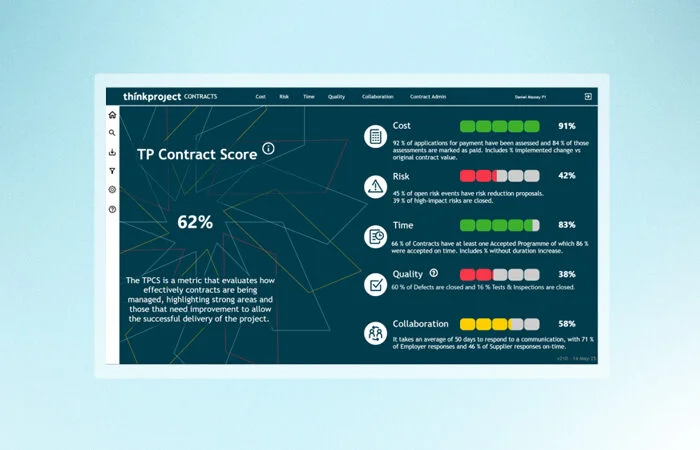
Thinkproject CONTRACTS helps organisations manage contract compliance, change, risk and reporting across NEC, FIDIC, JCT and other contract forms through structured workflows, reminders, approvals and audit-ready records. By connecting contract processes with project information in a single environment, teams can improve visibility, strengthen compliance and maintain greater commercial control throughout the project lifecycle.
As part of a broader digital transformation in construction strategy, connected contract management supports better collaboration, more informed decision-making and creates high-quality structured data that enables emerging applications of AI in construction, from risk identification to commercial insights.
Ultimately, the contract you choose matters, but how you manage it matters even more. With the right digital processes in place, organisations can reduce commercial risk, improve governance and deliver projects with greater confidence.
Discover how Thinkproject CONTRACTS helps teams manage obligations, change, risk and audit-ready evidence across NEC, FIDIC, JCT and other contract forms
More insights
-
Blog

Digitalization
Construction business intelligence: Turning data into better decisions
Read moreLearn how construction business intelligence connects project data, improves reporting and supports better decisions across the asset lifecycle.
-
Blog

Contracts
Best construction contract management software: 11 features to look for
Read moreCompare the key features to look for in construction contract management software, from NEC, JCT and FIDIC workflows to audit trails and risk control.
-
Event

Built Asset Lifecycle Platform
Thinkproject Live London 2026
Register nowDiscover how AI and connected data are helping teams reduce risk, improve control, and make faster, smarter decisions across the project lifecycle.
-
Event

Built Asset Lifecycle Platform
Thinkproject Live Events 2026
Read moreJoin construction, infrastructure, and asset management leaders for a day focused on the future of project and asset delivery.
-
Blog
Contracts
JCT contract types: Choosing and managing the right contract
Read moreCompare the main JCT contract types, understand construction management contracts and learn how to choose and administer the right form.
-
Blog

Built Asset Lifecycle Platform
AI in construction: Uses, benefits and real-world examples
Read moreExplore how AI in construction improves planning, safety, project controls, handover and asset performance across the built asset lifecycle.
-
Blog

Health & Safety
Construction risk management: How to identify, assess and control project risks
Read moreLearn how to identify, assess and control construction risks across cost, safety, contracts, programmes and project information.
-
Blog

Digitalization
Your AI is ready. Your data isn’t.
Read moreAI is exposing a deeper problem in construction: fragmented project data. See why connected, governed information is the foundation for reliable AI.
-
Blog

Information Security
7 Construction cybersecurity risks that can disrupt project delivery
Read moreLearn how construction cybersecurity risks can disrupt project delivery and how secure CDEs, access controls and supplier governance reduce exposure.