
JCT contract types: Choosing and managing the right contract
Thinkproject Live London 2026
Join us in London for an in-person event exploring how AI, connected information and customer innovation are shaping the future of project delivery. Hear practical insights, customer stories and the latest Thinkproject innovation.
London | 3 November 2026


Whether you’re a contractor managing residential extensions or a developer overseeing complex commercial projects, JCT contracts are likely a part of your work. These standard form contracts are some of the most utilised in the UK construction industry, offering a structured legal framework for managing contractual obligations and risks.
In this guide, we’ll explain the differences between JCT contract types, how they are used, and how to manage them effectively to keep your projects on track and your business protected.
Disclaimer: This guide is for general information only and does not constitute legal advice.
What are JCT contracts?
JCT contracts are standard forms of construction contracts commonly used in the UK to define the responsibilities, obligations, timelines and risk allocation between employers, contractors and project stakeholders.
JCT contracts are published by the Joint Contracts Tribunal (JCT). Established in 1931, the JCT provides a legally binding contracts framework that clearly defines the obligations of employers, contractors, and subcontractors on a construction project. JCT contracts have been designed to provide clarity, reduce disputes, and make project delivery more efficient.
The JCT 2024 edition is now the current contract suite
The JCT 2024 Edition is now the current suite of JCT contracts, replacing the JCT 2016 Edition, which was officially withdrawn on 31 March 2026. For all new projects, and any projects that have not yet gone out to tender, the Joint Contracts Tribunal (JCT) recommends using the 2024 contract forms.
While existing projects can continue under JCT 2016 where contracts have already been executed, organisations planning new procurement should familiarise themselves with the latest editions to ensure they benefit from the most up-to-date contractual provisions. Understanding these changes is essential when selecting the right JCT contract types for your project, as the 2024 suite reflects current industry practices and legal developments.

12 JCT contract types and when to use each
Choosing the right JCT contract is one of the most important decisions in any construction project. The most suitable option depends on factors such as project size, complexity, procurement method, risk allocation and who is responsible for the design. Selecting the appropriate contract can also help reduce construction contract risks by clearly defining responsibilities, payment mechanisms and procedures for managing changes and disputes.
The table below provides a quick comparison of the main JCT contract types, followed by a closer look at when each contract is most appropriate.
| JCT contract type | Commonly suited for |
|---|---|
Minor Works Building Contract | Simple projects with straightforward work |
Intermediate Building Contract | Moderately complex projects |
Standard Building Contract | Traditional procurement with employer-designed works |
Design and Build Contract | Single point of responsibility for design and construction |
Construction Management Contract | Complex projects requiring fast-tracked delivery |
Management Building Contract | Projects delivered through works contractors managed by a management contractor |
Target Cost Contract | Collaborative projects with shared cost risk |
Major Project Construction Contract | Large-scale developments with experienced project teams |
Prime Cost Building Contract | Projects where work cannot be fully defined at the outset |
Measured Term Contract | Ongoing maintenance and improvement works |
Repair and Maintenance Contract | Routine repair and maintenance works |
Home Owner Contracts | Domestic residential projects |
1. Minor Works Building Contract
The Minor Works Building Contract is designed for relatively simple construction projects where the work is straightforward and the risks are low. It is commonly used for small commercial developments, alterations, refurbishments and extensions where the employer provides the design.
2. Intermediate Building Contract
The Intermediate Building Contract is suitable for projects that are more complex than minor works but do not require the full provisions of the Standard Building Contract. It offers greater flexibility, making it a popular choice for medium-sized commercial buildings and larger refurbishment projects.
3. Standard Building Contract
The Standard Building Contract is one of the most widely used JCT contract types for traditional procurement. The employer appoints consultants to complete the design before construction begins, while the contractor is responsible for delivering the works in accordance with that design. It is commonly used on larger commercial, education and public sector projects.
4. Design and Build Contract
The Design and Build Contract places responsibility for both the design and construction with a single contractor. This provides the employer with one point of accountability, helping to streamline project delivery and reduce coordination risks. It is widely used where programme certainty and cost control are priorities.
5. Construction Management Contract
The Construction Management Contract is intended for complex projects where early contractor involvement and overlapping design and construction activities are required. The construction manager coordinates multiple trade contractors on behalf of the employer, allowing greater flexibility and faster delivery.
6. Management Building Contract
The JCT Management Building Contract is designed for large, complex projects where construction needs to begin before the design is fully complete. Under this procurement method, the employer appoints a management contractor to plan, coordinate and manage the delivery of the works. This approach is often chosen for large or technically complex projects where work packages can be procured progressively.
7. Target Cost Contract
The Target Cost Contract supports collaborative project delivery by setting an agreed target cost. The employer and contractor share any savings or cost overruns according to an agreed formula, encouraging joint risk management and greater cost transparency throughout the project.
8. Major Project Construction Contract
The Major Project Construction Contract is intended for high-value, complex developments undertaken by experienced organisations. It provides greater flexibility for sophisticated procurement strategies and is typically used on large infrastructure and commercial projects.
9. Prime Cost Building Contract
The Prime Cost Building Contract is designed for projects where it is not possible to define the full scope of work before construction begins. It allows work to proceed while costs are established as the project develops, making it suitable for specialist or highly bespoke projects.
10. Measured Term Contract
The Measured Term Contract is commonly used where a client requires ongoing construction work over a fixed period rather than a single project. It is frequently adopted for planned maintenance, repairs and improvement programmes across multiple sites.
11. Repair and Maintenance Contract
The Repair and Maintenance Contract provides a framework for carrying out routine repairs, maintenance and minor improvements to existing buildings. It is often used by housing providers, local authorities and facilities management organisations that require responsive maintenance services.
12. Home Owner Contracts
Home Owner Contracts are specifically designed for domestic residential projects such as extensions, renovations and home improvements. They use simpler language than commercial JCT contracts, making them easier for homeowners and residential contractors to understand while still providing a recognised contractual framework.
JCT construction management contract vs. management building contract
Although the JCT Construction Management Contract and JCT Management Building Contract are both designed for complex projects, they allocate responsibility and risk in different ways. Understanding these differences is essential when choosing the right procurement strategy.
| Feature | Construction Management Contract | Management Building Contract |
|---|---|---|
Who appoints the trade contractors? | The employer appoints each trade contractor directly. | The management contractor appoints the works contractors. |
Contractual relationship | The employer holds separate contracts with each trade contractor and a separate contract with the construction manager. | The employer has a single contract with the management contractor, who then enters into contracts with the works contractors. |
Role of the manager | The construction manager coordinates and manages the works but does not carry out the construction work. | The management contractor manages and coordinates the project while procuring and administering the works contractors. |
Risk allocation | The employer assumes more responsibility for cost and programme risk. | The management contractor takes greater responsibility for managing the delivery of the works, although project risks are still shared differently from traditional contracts. |
Flexibility | Very high, allowing work packages to be procured as designs develop. | High, enabling phased procurement while providing a more structured contractual arrangement. |
Best suited for | Large, fast-track or highly complex projects where the employer wants direct control over trade contractors. | Large, complex projects where the employer prefers a single management contractor to coordinate multiple works packages. |
How to choose the right JCT contract for your project
Choosing the right JCT contract depends on your project’s size, complexity, procurement method and how you want to allocate risk and responsibility. You’ll also need to consider who is responsible for the design, how much flexibility the project requires, and whether speed, cost certainty or collaboration is the priority. Taking the time to select the most appropriate contract from the outset can help reduce disputes, improve project outcomes and provide a clearer framework for everyone involved.
Steps to follow when choosing the best contract type
Before choosing a contract, consider the following factors:
- Assess your project size and complexity. Smaller, straightforward projects may only require a Minor Works Contract, while larger or more technically demanding projects often need a Standard Building Contract, Design and Build Contract or one of the management contracts.
- Choose the right procurement method. Decide whether you want a traditional approach, where the design is completed before construction begins, or a design and build approach that gives a single contractor responsibility for both design and construction.
- Define who will carry the risk. Different JCT contract types allocate responsibility for design, cost, programme and construction risks in different ways. Make sure the chosen contract reflects your preferred risk allocation.
- Consider the level of cost certainty required. If maintaining a fixed budget is a priority, choose a contract that provides clear pricing mechanisms. If flexibility is more important, a target cost or management contract may be more suitable.
- Think about your project timeline. Fast-track projects that require overlapping design and construction stages may benefit from Construction Management or Management Building Contracts.
- Evaluate your internal resources. Some JCT contracts require greater client involvement and contract administration than others. Ensure your team has the experience and capacity to manage the contractual responsibilities effectively.
- Consider future contract administration. Managing variations, payment notices, deadlines and contractual correspondence can become complex as a project progresses. Using construction contract management software can help improve visibility, maintain compliance and keep contract administration organised.
JCT contracts in real-world scenarios
Here are some examples of how JCT contract types work in real-world scenarios:
Commercial Office Development
Scenario: A developer commissions a construction firm to build a six-storey office block with modern energy-efficient features. The developer wants a single point of responsibility for both design and construction, enabling faster delivery and less coordination overhead.
Contract used: JCT Design and Build Contract (D&B)
Why use this contract:
- D&B contracts streamline delivery by combining design and build in one entity.
- The contractor assumes responsibility for completing the project as specified in the employer’s requirements.
- It reduces risk for the employer and simplifies communication.
How it works:
The contractor manages design and its expected performance, ensuring the building meets both design and performance expectations. They’re also in control of the sequencing of work and any design-related changes.
Public Sector School Expansion
Scenario: A local authority appoints a contractor to deliver a large school expansion, with complete design and specifications provided by the client’s design team. The work involves complex phasing to minimize disruptions to school operations.
Contract used: JCT Standard Building Contract (SBC)
Why use this contract:
- The Standard Building Contract supports projects where the client retains control over design.
- It is ideal for large projects with detailed documentation and the need for a strong contract administrator role.
- It includes detailed procedures for variations, extensions of time, and valuation of work.
How it works:
The contractor works closely with the architect and quantity surveyor. Delays due to weather or access restrictions are managed through the extension of time provision in the contract. Payment mechanism is managed by the contract administrator, ensuring fairness and impartiality for both parties.
Mixed-Use Development with Multiple Subcontractors
Scenario: A real estate developer is building a retail and entertainment park plus a hotel and appoints a management contractor to oversee a series of separate trade contractors. Some units are being let with bespoke fit-out needs, and construction process needs to be fast-tracked.
Contract used: JCT Management Contract
Why use this contract:
- The Management Contract allows overlapping design and build phases.
- It gives the client control over key trade packages while outsourcing their coordination.
- Best suited to large, complex projects with phased delivery.
How it works:
The management contractor appoints and manages trade contractors for specialist packages such as groundwork, cladding, roofing, and fit-out. The client benefits from flexible phasing and tenant-specific customization. The management contractor takes a greater role in coordinating works packages and managing delivery interfaces, while risk allocation remains governed by the contract terms.
Why manage JCT Contracts with specialised software?
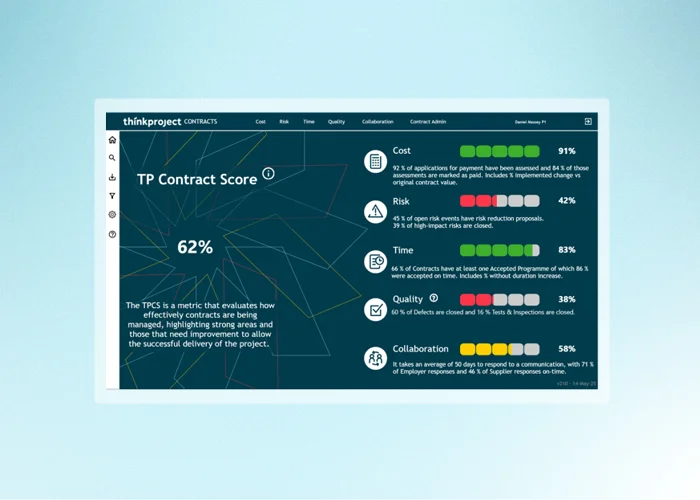
Managing JCT contracts with specialised software offers parties greater accuracy, efficiency, and control. It helps track, standardise and evidence payment-related notices, tracking variations, and managing deadlines, reducing the risk of errors and missed obligations. Centralised document storage, real-time dashboards, and audit trails improve visibility, collaboration, and compliance, while also strengthening the company’s position in the event of disputes.
Construction contract management software provides a central, structured environment for administering JCT contracts. By combining contract administration with construction document management, organisations can digitise workflows, track contractual events, assign responsibilities and link supporting documents directly to contract records. This creates a single source of truth, improves visibility of obligations and commercial risk, and helps project teams make faster, more informed decisions across the project lifecycle.
Manage JCT contracts with more control
Choosing the right JCT contract is only the first step. Project teams also need a consistent way to manage obligations, contract events, variations, payment-related processes, deadlines and supporting evidence throughout delivery.
Thinkproject CONTRACTS provides a structured, event-based approach to commercial and contract management. It helps teams standardise contract administration, assign responsibilities, track key actions and maintain a complete audit trail across complex construction projects.
Built on the Thinkproject Platform, CONTRACTS connects contract management with project information, reporting and wider delivery workflows. When integrated with Thinkproject’s Common Data Environment (CDE), teams can link approved documents, correspondence and supporting evidence directly to contract events, helping create a traceable source of contractual information.

Whether you’re managing JCT, NEC, FIDIC or bespoke contracts, Thinkproject CONTRACTS helps you improve commercial control, standardise contract administration and maintain a complete audit trail.
More resources
-
Event

Built Asset Lifecycle Platform
Thinkproject Live London 2026
Register nowDiscover how AI and connected data are helping teams reduce risk, improve control, and make faster, smarter decisions across the project lifecycle.
-
Event

Built Asset Lifecycle Platform
Thinkproject Live Events 2026
Read moreJoin construction, infrastructure, and asset management leaders for a day focused on the future of project and asset delivery.
-
Blog

Asset Management
Asset lifecycle management in construction: From planning to decommissioning
Read moreLearn how asset lifecycle management connects planning, construction, handover, operations and maintenance to improve built asset performance.
-
Blog

BIM
Browser-based BIM viewer performance: 10 factors that affect large IFC models
Read moreDiscover what impacts browser-based BIM viewer performance - from geometry and IFC file quality to client hardware and network. A technical guide for BIM teams.
-
Blog

BIM
8 best BIM collaboration software systems for construction teams
Read moreExplore the best BIM collaboration software systems, from CDEs and model coordination to issue tracking, document control, field collaboration, and handover.
-
Blog
CDE
AI Search in NextGen CDE: How Thinkproject AI turns governed construction data into confirmed answers
Read moreDiscover how AI search in a NextGen CDE helps construction teams find current, approved project information while preserving permissions and control.
-
Blog

Digitalization
Construction business intelligence: Turning data into better decisions
Read moreLearn how construction business intelligence connects project data, improves reporting and supports better decisions across the asset lifecycle.
-
Blog

Contracts
Best construction contract management software: 11 features to look for
Read moreCompare the key features to look for in construction contract management software, from NEC, JCT and FIDIC workflows to audit trails and risk control.
-
Blog

Built Asset Lifecycle Platform
AI in construction: Uses, benefits and real-world examples
Read moreExplore how AI in construction improves planning, safety, project controls, handover and asset performance across the built asset lifecycle.