Construction risk management: How to identify, assess and control project risks
No matter how well you plan them, construction projects may still involve uncertainty. Delays, cost overruns and safety incidents can all affect project success if risks are not identified and managed early. Effective construction risk management provides a structured approach to anticipating potential issues, reducing their impact and keeping projects on track.
In this guide, we’ll explain what construction risk management is, explore the main types of construction risk and outline practical steps for identifying, assessing and controlling risk throughout a construction project’s lifecycle. We’ll also look at how better information management and digital tools can help improve visibility, support informed decision-making and strengthen project outcomes.
What is construction risk management?
Construction risk management is the structured process of identifying, assessing, controlling and monitoring risks that could affect the successful delivery of a construction project.
Its objective is to reduce uncertainty by understanding what could go wrong, evaluating the likelihood and potential impact of those events, and implementing actions to prevent them or minimise their consequences.
Risks can emerge at any point during a project. Some originate during planning and design, while others arise during procurement, construction, commissioning or handover. External factors such as weather events, market volatility, labour shortages and regulatory changes can also introduce new challenges.
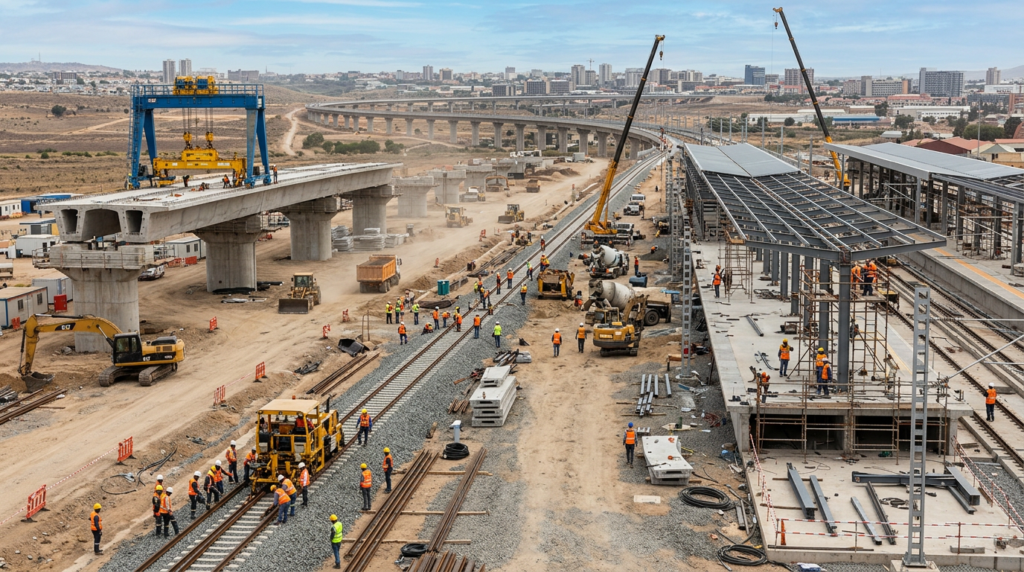
A structured approach to risk management for construction enables organisations to:
- Reduce project delays and cost overruns
- Improve health and safety performance
- Strengthen contractual compliance
- Improve quality and reduce rework
- Support better decision-making through greater visibility
- Protect project profitability and stakeholder confidence
Importantly, risk management in construction is closely connected to information quality. Teams can only make informed decisions when everyone is working from accurate, up-to-date project information. Controlled documentation, clear communication and complete audit trails help reduce uncertainty while supporting accountability throughout the project lifecycle.
The main types of construction risk
Every construction project faces a combination of technical, commercial and operational risks. While no two projects are identical, understanding the most common categories helps teams build more comprehensive risk registers and mitigation plans.
The table below summarises the principal types of risk management construction teams should consider throughout the project lifecycle.
| Risk category | Common examples | Potential project impact |
|---|---|---|
Health and safety | Site accidents, unsafe working practices, inadequate training | Injury, project stoppages, legal action, reputational damage |
Financial | Budget overruns, inflation, cash flow issues, funding changes | Increased costs, reduced profitability, project delays |
Contractual | Contract disputes, unclear responsibilities, change orders, claims | Delays, disputes, litigation, additional costs |
Design | Design errors, incomplete information, coordination issues | Rework, programme delays, increased costs |
Programme and schedule | Labour shortages, delayed approvals, poor sequencing | Missed milestones, liquidated damages, resource conflicts |
Supply chain | Material shortages, supplier insolvency, delivery delays | Programme disruption, increased procurement costs |
Quality | Defective workmanship, specification failures, inadequate inspections | Rework, client dissatisfaction, compliance issues |
Environmental | Severe weather, contamination, environmental breaches | Delays, fines, remediation costs |
Regulatory and compliance | Building code changes, permitting issues, non-compliance | Enforcement action, redesign, project delays |
Technology and information | Poor document control, outdated drawings, data loss, cyber security incidents | Incorrect construction, communication failures, increased project risk |
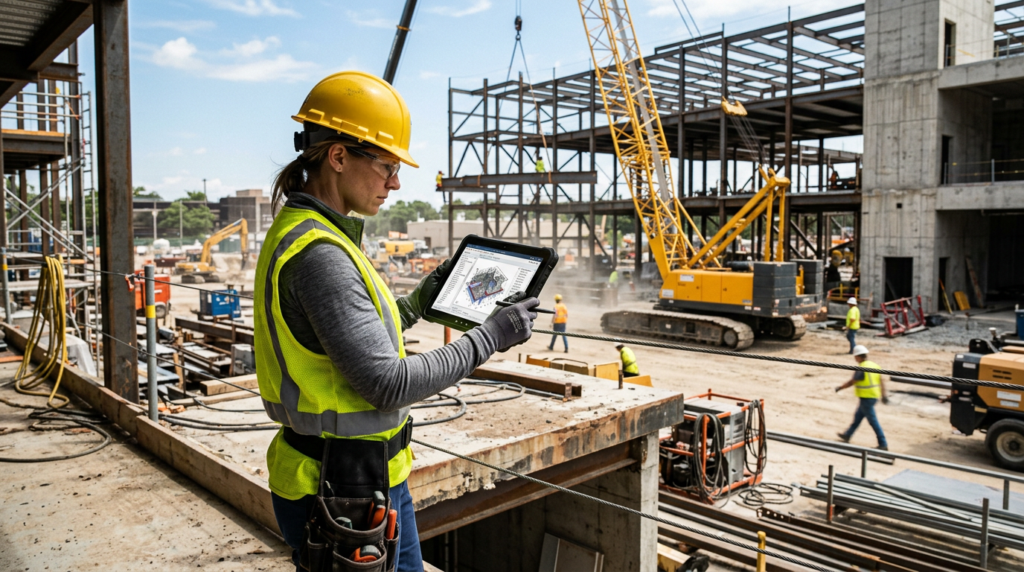
Many of these risks are interconnected. For example, outdated design information can lead to construction errors, which then create contractual disputes, programme delays and additional costs. Similarly, poor document management can affect quality assurance, compliance and commercial claims simultaneously.
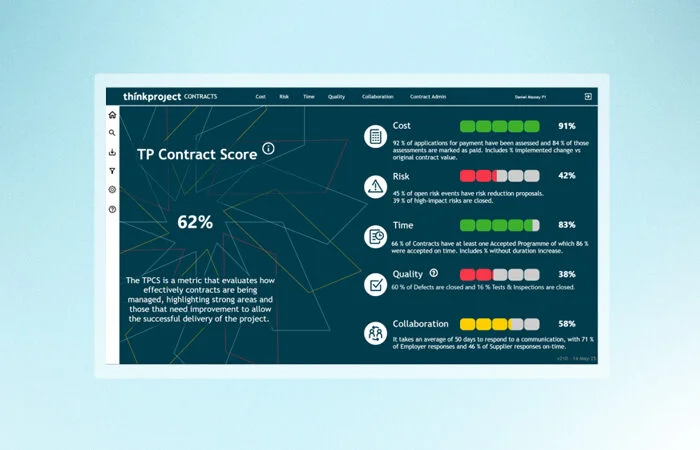
Contractual risk also requires structured contract workflows, clear event tracking and audit-ready records. Thinkproject CONTRACTS supports contract compliance, change management, early warnings and risk reduction processes for complex construction contracts.
How to manage risk throughout a construction project
Effective construction risk management is not a one-time exercise completed during project planning. Risks evolve continuously as designs develop, contractors are appointed, work progresses and project conditions change.
Following a structured process helps project teams identify emerging issues early, assign responsibility and ensure mitigation measures remain effective throughout the project lifecycle.
1. Establish the project context and risk criteria
Every project has a different risk profile. A major infrastructure programme involving multiple contractors and complex regulatory requirements presents very different challenges from a smaller commercial development.
Before identifying individual risks, project teams should first define the context in which risks will be assessed. This creates a consistent framework for decision-making throughout the project.
Key considerations include:
- Project objectives and success criteria
- Contract type and procurement strategy
- Regulatory and compliance requirements
- Stakeholder expectations
- Budget and programme constraints
- Risk appetite and acceptance thresholds
Establishing common risk criteria ensures that everyone evaluates risks using the same definitions and scoring methodology. It also helps prioritise resources towards the issues that pose the greatest threat to project success.
This stage should also establish governance processes, including how risks will be recorded, reviewed and escalated throughout delivery.
2. Identify risks as early as possible
Risk identification is most effective when it begins during project planning and continues throughout the entire project lifecycle.
Many significant project issues originate long before construction starts. Design coordination problems, incomplete information, procurement challenges and contractual ambiguities can all create downstream risks if they are not recognised early.
Project teams should gather input from a broad range of stakeholders, including:
- Project managers
- Designers and consultants
- Commercial teams
- Site managers
- Health and safety specialists
- Contractors and subcontractors
- Asset owners and operators
Using multiple perspectives improves the quality of risk identification and reduces the likelihood that important issues will be overlooked.
Common techniques include:
- Risk workshops
- Design reviews
- Lessons learned from previous projects
- Site inspections
- Contract reviews
- Supply chain assessments
- Stakeholder interviews
Digital collaboration platforms also help identify risks earlier by improving visibility across documents, approvals, design changes and communications. When project information is centralised within a governed common data environment, teams are less likely to work from outdated drawings or miss critical project updates.
3. Assess likelihood and potential impact
Once risks have been identified, the next step is to understand which ones matter most.
Not every risk requires the same level of attention. Some events may be highly unlikely, while others have the potential to significantly affect cost, programme or project performance.
Most organisations assess risks using two primary factors:
- Likelihood: How probable is the risk?
- Impact: What would be the consequence if it occurred?
Many organisations use qualitative scoring systems, such as low, medium and high, while larger projects may adopt more detailed probability-impact matrices or quantitative risk analysis. The objective is not to predict the future with complete certainty. Instead, it is to establish a consistent basis for comparing risks and allocating resources appropriately.
Maintaining accurate project information is particularly important during this stage. Reliable documentation, version control and traceable approvals provide the evidence needed to assess risks objectively rather than relying on assumptions. Controlled construction document management and audit-ready workflows support more confident decision-making throughout the assessment process.
4. Prioritise the risks that require action
After assessing likelihood and impact, project teams can determine which risks require immediate attention and which can simply be monitored.
Risk prioritisation helps organisations focus limited time and resources where they will have the greatest effect. High-impact, high-likelihood risks should receive the highest priority, while lower-priority risks may only require periodic review.
A practical approach is to group risks into categories such as:
- Immediate action required
- Active monitoring
- Acceptable with periodic review
This prioritisation should remain dynamic. As projects progress, new risks emerge, existing risks change and previously low-priority issues can become critical if circumstances evolve.
Maintaining an up-to-date risk register and reviewing priorities regularly enables project teams to respond proactively rather than reactively, improving overall project resilience and supporting better project outcomes.
5. Choose the right risk response
Once risks have been prioritised, the next step is deciding how to respond. The appropriate strategy will depend on the nature of the risk, its potential impact and the level of control the project team has over it.
The aim is not to eliminate every risk. Instead, organisations should take proportionate action that reduces the likelihood of the risk occurring or limits its impact if it does.
The four most common risk response strategies are:
- Avoid by changing the project approach to remove the risk entirely. This could involve selecting an alternative construction method or redesigning part of the project.
- Reduce by introducing controls that lower either the likelihood or impact of the risk. Examples include additional quality inspections, supplier prequalification or enhanced safety procedures.
- Transfer by allocating responsibility through insurance, warranties or contractual arrangements. While responsibility may be shared, organisations should still monitor transferred risks closely.
- Accept where the risk is minor or unavoidable. Accepted risks should still be documented, monitored and reviewed as project conditions change.
The selected response should be realistic, proportionate and supported by evidence. Risk treatments that are too costly or impractical may introduce new challenges without delivering meaningful benefits.
Commercial risks deserve particular attention, making construction contract management a critical part of effective risk management. Contract clauses, payment mechanisms, change procedures and early warning requirements all influence how project risks are managed and shared between parties. A well-managed contract provides greater clarity around responsibilities and reduces the likelihood of disputes later in the project.
6. Assign a risk owner and clear actions
Every significant risk should have a clearly assigned owner who is accountable for monitoring the risk, implementing mitigation measures and reporting on progress. Assigning ownership helps ensure risks are actively managed rather than overlooked.
Each risk record should include:
- A named risk owner
- Agreed mitigation actions
- Target completion dates
- Required resources
- Current status
- Review schedule
Ownership should reflect the individual or team best placed to manage the risk. For example, design managers may own coordination risks, while commercial managers oversee contractual exposure and site managers manage operational risks.
7. Implement controls and maintain evidence
Many construction risks arise because agreed processes are not followed or because project information is incomplete, inconsistent or difficult to locate. Maintaining controlled documentation and complete audit trails helps organisations demonstrate compliance while reducing uncertainty throughout project delivery.
Examples of effective risk controls include:
- Document review and approval workflows
- Quality assurance inspections
- Site safety audits
- Design coordination meetings
- Change control procedures
- Supplier performance monitoring
- Regular compliance checks
Capturing evidence is equally important. Inspection records, approvals, photographs, certificates and correspondence provide an auditable record of decisions and actions, helping organisations demonstrate compliance and resolve potential disputes.
8. Monitor, review and communicate risks continuously
Construction projects are subject to changes. New contractors join the project, designs evolve, procurement schedules shift. Continuous monitoring enables organisations to identify emerging risks, assess whether mitigation measures remain effective and respond quickly when circumstances change.
Regular risk reviews should consider:
- Newly identified risks
- Changes to existing risks
- Progress against mitigation actions
- Completed actions and closed risks
- Lessons learned
- Changes to project scope or programme
Communication is equally important. Risk information should be shared with relevant stakeholders through regular project meetings, dashboards and reporting processes.
Digital reporting tools can improve visibility by providing project teams with consistent, up-to-date information on risk status, outstanding actions and emerging trends. Portfolio-level reporting also enables organisations to identify recurring issues across multiple projects, supporting earlier intervention and better strategic decision-making. Thinkproject’s ANALYTICS solution is designed to provide cross-project visibility into performance, trends and risk indicators using governed data from connected platform solutions.
What to include in a construction risk register
A construction risk register provides a structured record of identified risks and the actions taken to manage them. It serves as the central reference point for project teams throughout the project lifecycle, helping ensure risks remain visible, monitored and appropriately controlled.
While the format may vary between organisations, here is an example of what an effective risk register could include:
| Risk register field | Purpose |
|---|---|
Risk ID | Provides a unique reference for each risk |
Risk description | Clearly explains the potential event or issue |
Risk category | Groups similar risks such as financial, safety or contractual |
Likelihood | Assesses the probability of the risk occurring |
Impact | Measures the potential effect on cost, programme, quality or safety |
Overall risk rating | Combines likelihood and impact to determine priority |
Mitigation actions | Records planned activities to reduce or control the risk |
Risk owner | Identifies the person responsible for managing the risk |
Target completion date | Sets deadlines for mitigation activities |
Current status | Tracks progress and identifies whether the risk remains active, is being monitored or has been closed |
Review date | Ensures the risk is reassessed regularly |
Supporting evidence | Links relevant documents, inspections, approvals or communications |
The risk register should remain a live project document rather than a static record created at project initiation. Regular updates ensure the information reflects current project conditions and provides decision-makers with an accurate picture of the project’s risk profile.
How digital information management improves risk control
Many project risks are not caused by technical failures or unforeseen events. Instead, they result from poor information management: teams working from outdated drawings, missing approvals or disconnected systems can make decisions based on incomplete or inaccurate information. These information gaps often lead to rework, delays, contractual disputes and avoidable costs.
Digital information management helps address these challenges by providing a single, governed environment for project information. Rather than storing documents across multiple locations, organisations can ensure everyone works from approved, current information with clear version control and traceable workflows.
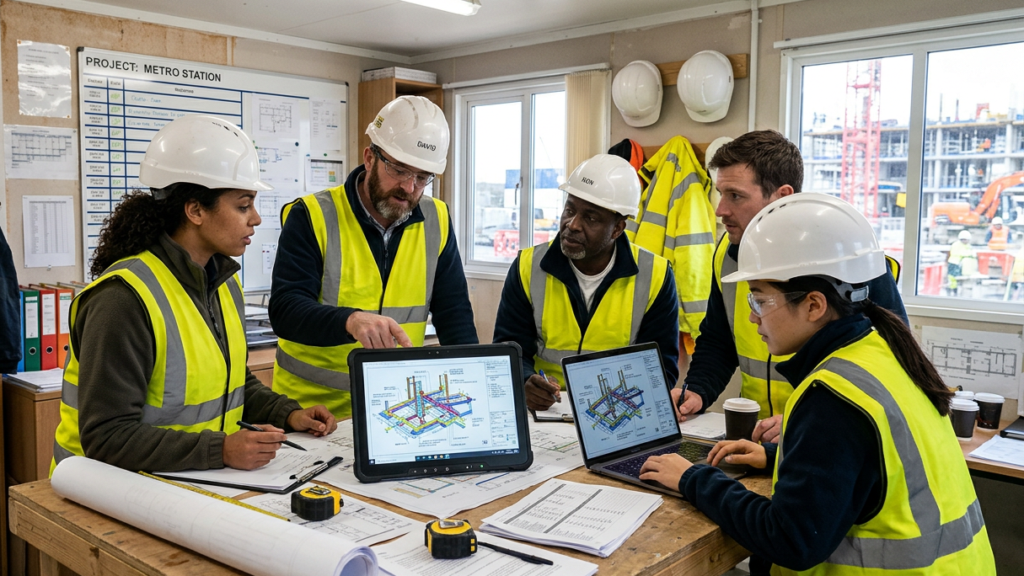
A modern common data environment (CDE) supports stronger construction risk management by:
- Providing a governed source of project information
- Maintaining version control across documents and drawings
- Supporting structured review and approval workflows
- Creating complete audit trails for decisions and communications
- Improving collaboration across owners, contractors and consultants
- Reducing manual processes and duplicated information
Connected digital platforms extend these benefits even further. When document management, field inspections, contract administration and analytics are linked, project teams gain greater visibility across the entire project lifecycle. This enables earlier identification of emerging risks and supports more informed, evidence-based decisions.
For broader risk control, Thinkproject connects CDE capabilities with contract management, QSHE, VDC, handover, asset management and analytics, helping organisations manage risk across the built asset lifecycle.
Make risk management a continuous project discipline

No construction project is free from risk, but a proactive approach to construction risk management helps organisations identify, assess and control risks before they affect cost, schedule, quality or safety. By treating risk management as a continuous process, project teams can make better decisions, improve collaboration and deliver more predictable outcomes.
As projects become more complex, connected digital platforms play an increasingly important role by bringing together project information, contract data and field records in a single, governed environment. With greater visibility and trusted information, organisations can strengthen risk control, reduce rework and improve project performance throughout the entire built asset lifecycle.
The Thinkproject Platform connects project documents, workflows, contract management, field processes and asset information within a governed environment. By creating a single source of truth across design, construction, handover and operations, organisations can improve visibility, strengthen collaboration and reduce risk throughout the asset lifecycle.
Explore how Thinkproject helps construction teams manage project information, improve governance and make more informed decisions across every stage of delivery.
Frequently asked questions
Construction risk management is the process of identifying, assessing, controlling and monitoring risks that could affect a construction project’s cost, schedule, quality, safety or compliance. The objective is to reduce uncertainty and improve project outcomes through proactive planning and continuous monitoring.
Common construction risks include health and safety incidents, financial uncertainty, contractual disputes, design errors, programme delays, supply chain disruption, quality issues, environmental risks, regulatory changes and poor information management.
A construction risk register is a structured document that records identified risks, their likelihood and impact, mitigation actions, responsible owners and review dates. It helps project teams monitor risks throughout the project lifecycle and supports consistent decision-making.
Digital information management helps ensure teams work from accurate, up-to-date project information. A governed Common Data Environment (CDE) improves document control, version management, collaboration and auditability, reducing the risk of errors caused by fragmented or outdated information.
Construction risks should be reviewed regularly throughout the project lifecycle. Reviews should take place at key project milestones, during progress meetings, following significant changes to scope or programme, and whenever new risks emerge. Continuous monitoring helps organisations respond quickly to changing project conditions.
More resources
-
Blog
Asset Management
Asset lifecycle management in construction: From planning to decommissioning
Read moreLearn how asset lifecycle management connects planning, construction, handover, operations and maintenance to improve built asset performance.
-
Blog
BIM
Browser-based BIM viewer performance: 10 factors that affect large IFC models
Read moreDiscover what impacts browser-based BIM viewer performance - from geometry and IFC file quality to client hardware and network. A technical guide for BIM teams.
-
Blog

BIM
8 best BIM collaboration software systems for construction teams
Read moreExplore the best BIM collaboration software systems, from CDEs and model coordination to issue tracking, document control, field collaboration, and handover.
-
Blog
CDE
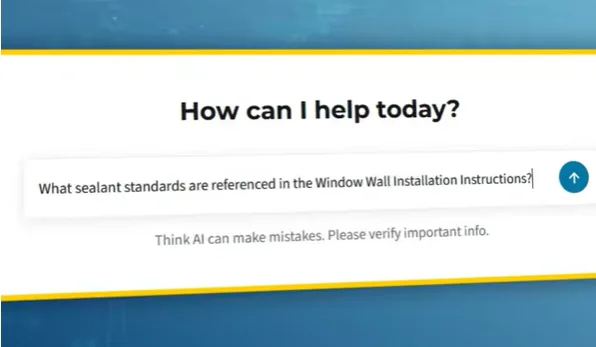
AI Search in NextGen CDE: How Thinkproject AI turns governed construction data into confirmed answers
Read moreDiscover how AI search in a NextGen CDE helps construction teams find current, approved project information while preserving permissions and control.
-
Blog

Digitalization
Construction business intelligence: Turning data into better decisions
Read moreLearn how construction business intelligence connects project data, improves reporting and supports better decisions across the asset lifecycle.
-
Blog

Contracts
Best construction contract management software: 11 features to look for
Read moreCompare the key features to look for in construction contract management software, from NEC, JCT and FIDIC workflows to audit trails and risk control.
-
Event
Built Asset Lifecycle Platform
Thinkproject Live London 2026
Register nowDiscover how AI and connected data are helping teams reduce risk, improve control, and make faster, smarter decisions across the project lifecycle.
-
Event

Built Asset Lifecycle Platform
Thinkproject Live Events 2026
Read moreJoin construction, infrastructure, and asset management leaders for a day focused on the future of project and asset delivery.
-
Blog
Contracts
JCT contract types: Choosing and managing the right contract
Read moreCompare the main JCT contract types, understand construction management contracts and learn how to choose and administer the right form.