
From data repository to active system: AI agents in CDEs
Common Data Environments (CDEs) play a central role in construction information management, helping teams share, review and approve project information. However, finding relevant documents, checking data quality and monitoring workflows can still require significant manual effort, particularly as project information grows in volume and complexity.
AI agents for CDE applications could help make these environments more active and responsive, supporting teams in interpreting information, identifying issues and carrying out defined tasks. This article explores how AI agents could work within a CDE, their potential impact on construction workflows and why trusted data and effective governance are essential to their adoption.
For asset owners and delivery teams, the opportunity goes beyond automating individual document tasks. It is about making governed project information easier to use across connected workflows, from design and construction through handover and into operations.
What are AI agents in a common data environment?
AI agents in a Common Data Environment are software systems that interpret project information, assess conditions and perform defined tasks towards a specific objective. Depending on their permissions, they could identify missing information, monitor workflows, recommend actions or initiate authorised processes.
Traditional CDEs already support information management through document registers, metadata, version control and configurable workflows. AI agents could extend these capabilities by interpreting information and determining appropriate next steps within established governance rules. For example, an agent could examine incoming documents, identify information relevant to an asset, classify records and prepare them for handover.
However, an AI agent does not replace the CDE’s existing information governance. It operates within the permissions, workflows and controls established by the organisation.
AI assistant vs. AI agent
The distinction between AI assistants and AI agents is important:
- An AI assistant typically responds to a direct request, such as finding a specification or summarising a document.
- An AI agent may perform several connected activities towards an objective, potentially working across information sources and workflows.
Rule-based workflow automation is different: it executes predefined actions when configured conditions are met, without necessarily using AI to interpret information or determine the next step.
Thinkproject’s NextGen CDE illustrates this development path, with its AI-assisted search capabilities, which have been demonstrated in the dedicated Innovation Series Webinar. The solution is also agentic-ready, providing a foundation for future agent-driven automation. These emerging capabilities build on the established role of the Common Data Environment as a governed source of project information.
How can AI agents work within a CDE?
AI agents could support construction teams across several stages of information management, from finding documents and checking data quality to monitoring workflows and preparing information for handover. By working with governed project data, they could reduce repetitive tasks and help teams identify issues earlier.
Some of these activities are already supported by existing CDE automation and AI-assisted search, while more advanced agent-driven workflows are still emerging.
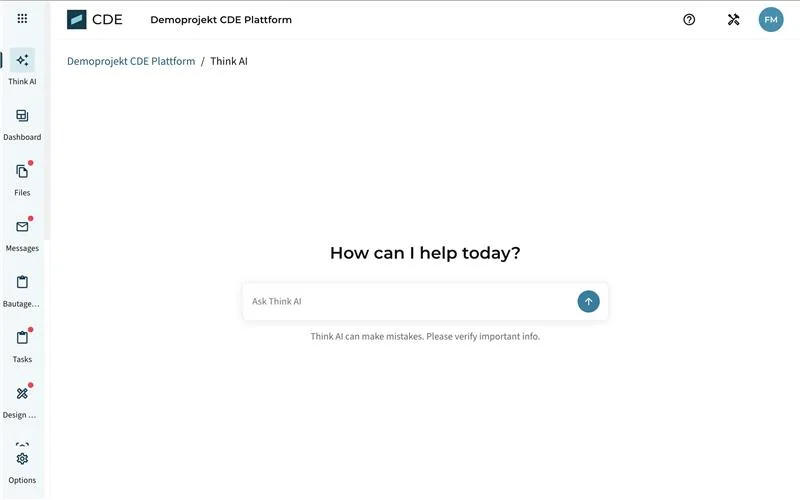
Find and interpret project information
Construction teams often search through large volumes of drawings, specifications and reports to find the information they need. Traditional CDE searches rely on document names, metadata or folder structures, making it time-consuming to locate specific details.
AI-assisted search simplifies this process by allowing users to ask questions in natural language and receive answers based on authorised project information. For example, an engineer could ask about a technical requirement rather than manually searching through a lengthy specification.
Thinkproject’s NextGen CDE already supports this approach. Users can retrieve information with source-document references, ask follow-up questions and revisit previous searches.
This means users can move from searching for a document to asking a question about the information in it, while retaining access to the underlying source.
Future AI agents could build on these capabilities by identifying relationships between documents and gathering information from multiple sources to support more complex tasks. As explored in our article on AI-assisted CDE search, access to trusted, permission-controlled information is essential for reliable results.
Check data quality and information standards
Reliable project information depends on consistent naming conventions, complete metadata and clearly defined requirements. Incorrectly classified documents or missing details can create additional work and cause problems during reviews, approvals and handover.
AI agents could help identify these issues by checking submissions against project requirements and highlighting discrepancies. For example, an agent could flag missing attributes, inconsistent classifications or absent supporting evidence.
Thinkproject’s NextGen CDE already automates several validation activities. During upload, it can apply configured validation and document-handling rules to check naming conventions, process metadata and flag information requiring attention.
These existing checks use configured rules rather than autonomous AI. Future agents could extend validation by interpreting more complex requirements and identifying inconsistencies across related documents. For organisations following ISO 19650 information management principles, this could strengthen information quality while keeping formal compliance decisions under human control.
But the value is not just document processing. Better information quality during project delivery supports more reliable downstream workflows, including handover and asset information management.
Monitor approvals and information workflows
Document reviews and approvals involve multiple stakeholders, responsibilities and deadlines. Although CDE workflows provide structure, information managers still spend time monitoring progress and following up on outstanding actions.
AI agents could make this process more proactive by assessing workflow information and identifying potential bottlenecks. For example, if a design submission remains under review beyond its agreed timeframe, an agent could flag the delay and prepare a notification for the responsible reviewer.
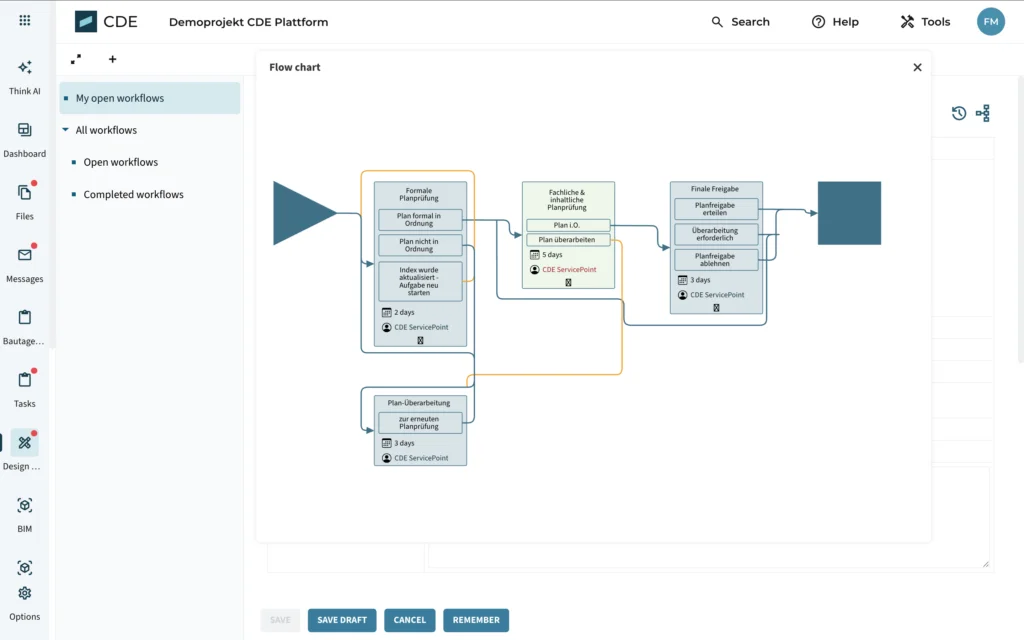
Thinkproject’s NextGen CDE already provides configurable review and approval workflows, assigned responsibilities, defined timeframes and audit trails. Its task-oriented homepage also helps users track outstanding activities.
Future agents could use this structured information to recognise emerging delays and recommend follow-up actions. This could reduce manual monitoring and help teams address issues earlier while maintaining accountability in construction document management.
For project managers and information managers, this results in clearer visibility of outstanding actions, responsibilities and potential delays without removing established approval controls.
Identify discrepancies before they become project issues
Construction information changes throughout design and delivery as drawings are revised, models are updated and technical decisions evolve. Maintaining consistency across related records can be challenging, particularly when multiple disciplines contribute information.
AI agents could identify discrepancies by comparing connected records and highlighting differences that need investigation. For example, an agent might detect that an equipment specification no longer matches its associated asset information, allowing teams to investigate before handover.
This becomes particularly valuable when project information is connected across a wider platform. A discrepancy identified in a specification may also affect a model reference, an approval process or the information required for asset handover.
Such cross-system checks would depend on the relevant integrations, data relationships and agent capabilities being available.
Route tasks and trigger the next action
Identifying an information issue often leads to several follow-up activities, from assigning responsibility to requesting missing documents or initiating another review. Coordinating these actions across multiple stakeholders can create unnecessary administrative work.
AI agents could streamline this process by interpreting workflow rules and preparing appropriate next steps. For example, an agent identifying missing asset documentation could recommend assigning a task to the responsible contractor or prepare a request for the required information.
Thinkproject’s NextGen CDE already automates routine activities, including distributing compliant documents and initiating predefined review and approval workflows. These capabilities use configured processes rather than autonomous AI.
Future agents could extend this functionality by supporting more context-sensitive decisions and potentially initiating authorised, low-risk actions. Formal approvals and changes to authoritative records would remain subject to human control, helping teams resolve issues more efficiently without compromising governance.
Connect information across project systems
Project information is often distributed across document management, BIM coordination, contractual and asset management systems. This fragmentation can make it difficult to understand how records relate to one another.
AI agents could help interpret these connections where governed integrations exist. For example, an agent could potentially bring together drawings, model references and handover documentation associated with a particular asset.
This is where Thinkproject’s Platform strategy becomes especially relevant. NextGen CDE governs project information, VDC provides model-based context, HANDOVER prepares validated information for operations, and ASSET HUB is designed to connect asset context across specialist applications and enterprise systems.
Within this connected ecosystem, future AI agents could potentially support activities that go beyond a single application, helping users understand information in the context of the asset, project and workflow to which it belongs.
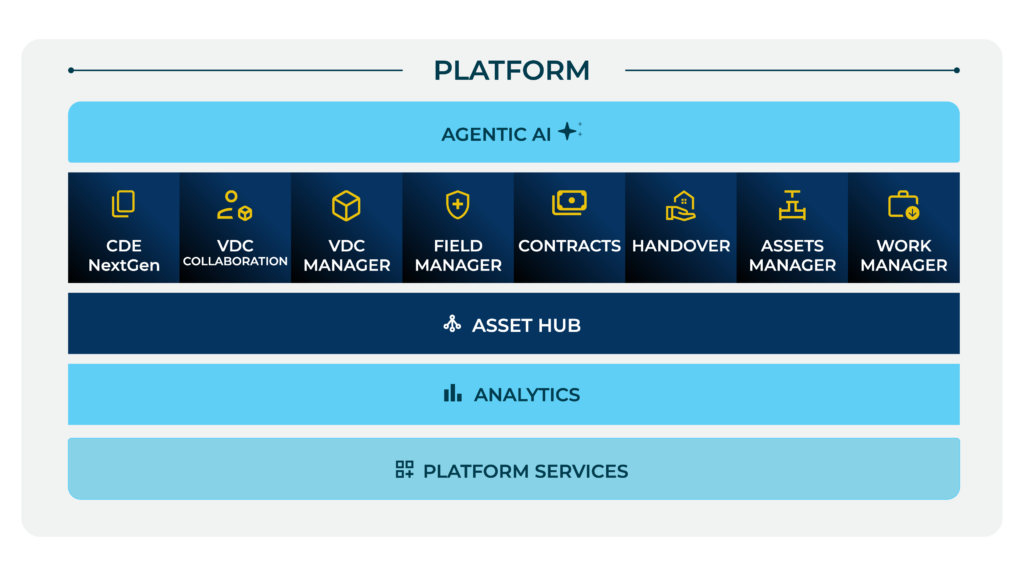
As organisations adopt more connected project delivery and BIM coordination workflows, these capabilities could help preserve information context and support a more efficient transition from construction into asset operations.
What impact could AI agents have on CDE workflows?
The potential impacts of AI in CDE include reduced administrative effort, improved information quality, earlier issue identification and more responsive workflow coordination. Their value will depend on how effectively they support existing information management processes.
- Improved productivity: AI agents could reduce the time spent searching for documents, reviewing repetitive information and preparing routine follow-up activities. This would allow information managers and BIM coordinators to focus more attention on complex issues.
- Earlier identification of delays: Agents could monitor outstanding reviews, missing submissions and workflow dependencies, helping teams investigate potential bottlenecks before they affect subsequent activities.
- Stronger data integrity: Automated checks and AI-assisted interpretation could help identify incomplete, inconsistent or potentially outdated information. Findings would still need to be assessed against authoritative project requirements.
- Better contextual understanding: By connecting relevant documents, models, workflows and asset information, agents could help teams understand the wider significance of individual records.
- More responsive execution: Where agent-driven automation is developed and authorised, certain routine follow-up activities could begin when predefined conditions are met.
- Improved handover preparation: Agents could help identify, classify and connect information needed for asset handover, reducing reliance on manual document collation.
- Better lifecycle continuity: By helping teams interpret governed information across connected applications, agent-driven workflows could support the transition from project delivery to handover and asset operations.
These are potential outcomes rather than guaranteed results. Organisations should evaluate AI against measurable improvements in information quality, processing time, workflow efficiency and operational readiness.
Why AI agents depend on good CDE data
AI agents require accurate, structured, accessible and governed information to produce reliable outputs and support appropriate actions. Without this foundation, they may retrieve outdated documents, misunderstand information relationships or recommend actions based on incomplete project context.
The quality of the information environment therefore determines how effectively organisations can adopt agentic AI. This is particularly important in construction, where information passes between multiple organisations and continues to change throughout the project lifecycle.
For Thinkproject, this is central to the platform strategy: meaningful AI depends on trusted, connected information, clear governance and the context behind every project and asset record.
Structured metadata and information requirements
Consistent metadata allows systems to identify documents, understand their purpose and relate them to specific projects, disciplines or assets. Document classifications, naming conventions and required attributes provide context that AI agents can use when interpreting information.
Thinkproject’s NextGen CDE supports configurable information structures, including an ISO 19650-aligned starting configuration that organisations can adapt to their own requirements. Our webinar demonstrated how metadata validation during upload helps maintain consistent information structures.
Controlled versions and approval status
Construction teams need to distinguish between information that is approved, under review or superseded.
An AI agent must understand these differences before using a document to support a recommendation. The latest uploaded file may not be the version authorised for a particular activity.
Thinkproject’s NextGen CDE maintains document revision histories, metadata and workflow records, providing the information needed to establish which records are appropriate for a given purpose. This governance becomes increasingly important when AI is used to interpret information across multiple documents.
This is why AI-assisted information management needs more than access to large volumes of files. It needs the governance and context that explain which information can be trusted and how it should be used.
Traceability and access permissions
AI-generated outputs should remain connected to their underlying sources. Users need to understand which documents informed an answer and whether the information is suitable for their intended purpose.
On NextGen CDE, the AI-assisted search provides source-document references and operates within existing CDE access permissions. The customer data is not used to train large language models and that CDE information is not exposed to public models through this functionality.
These safeguards are important foundations for responsible AI adoption. Future agents would require similarly controlled access, together with clear records of any recommendations or actions they produce.
Connected asset information
Information quality also depends on relationships between records. A document may describe a model element, which represents a physical asset that later requires inspection and maintenance.
For AI agents to interpret this information reliably, systems need consistent identifiers and governed connections between relevant records. This also explains why preparing data for AI should begin during project delivery, rather than waiting until information is required for handover.
Information ownership and accountability
Reliable information also requires clear responsibilities. Organisations need to define who maintains records, resolves discrepancies, approves changes and determines whether information meets agreed requirements.
AI agents may help identify issues, but they cannot replace these governance responsibilities.
For asset owners and infrastructure organisations, maintaining accountability is essential because information may continue to support operational decisions long after construction is complete.
What are the risks of using AI agents in a CDE?
AI agents introduce risks when their interpretations or actions are accepted without appropriate verification.
- One concern is incorrect information interpretation. AI systems can produce plausible but inaccurate outputs, particularly when records are incomplete, ambiguous or poorly structured.
- Another is inappropriate workflow execution. An agent operating without sufficient controls could recommend the wrong action, create unnecessary tasks or affect established responsibilities.
- Security and confidentiality also require careful consideration. Agents must respect project access permissions and organisational policies governing sensitive information.
- There is also a risk of reduced accountability if teams cannot identify the source information or the basis for an AI-supported recommendation.

These concerns make human-in-the-loop control particularly important. Under this approach, AI can assist with information discovery, validation and task preparation, while authorised professionals remain responsible for consequential decisions.
Organisations should establish clear permission boundaries, audit trails, testing procedures and escalation rules. It is also important to distinguish advisory AI from autonomous execution. These capabilities carry different risks and require different levels of oversight.
How can organisations prepare their CDE for AI agents?
Preparing a CDE for agentic AI should begin with information management maturity rather than purchasing an additional AI application. Organisations need to understand the quality of their existing information, how workflows operate and whether data can move reliably between systems.
A practical preparation approach includes six steps.
- Review information quality. Assess document naming, metadata completeness, revision control and recurring submission errors.
- Strengthen governance. Define information ownership, access permissions, approval responsibilities and requirements for authoritative records.
- Standardise workflows. Establish clear rules for submissions, reviews, validation, notifications and escalation.
- Connect relevant information. Improve relationships between documents, BIM models, asset records and other project information through supported integrations.
- Prioritise suitable use cases. Start with lower-risk activities such as information retrieval, identifying missing metadata or preparing handover documentation.
- Define AI controls and success measures. Establish human review requirements and evaluate outcomes such as time saved, exception rates and information completeness.
A phased approach allows organisations to build confidence before introducing more complex agent-supported activities.
It is also worth examining whether existing CDE functionality can address current problems. For example, configurable metadata validation and automated approval workflows may already reduce administrative effort without requiring AI agents.
What will the CDE look like in an agentic AI era?
The CDE is evolving from a document repository into a more active information management environment, combining governed data, AI-assisted discovery and connected workflows.
Thinkproject’s platform strategy reflects this direction, connecting NextGen CDE, HANDOVER and asset management solutions to maintain information continuity from construction through to operations. Planned AI capabilities could further support tasks such as identifying missing information, classifying documents and recommending workflow actions.
The long-term vision goes beyond a smarter CDE: a connected information ecosystem where trusted project and asset data enables AI-driven workflows and better decisions across the entire asset lifecycle.
Discover the future of connected construction information
Want to learn more about how CDEs are evolving? Watch Thinkproject’s on-demand webinar to explore how CDE nextgen and HANDOVER connect project information across the built asset lifecycle, with insights into AI-assisted capabilities and future agent-driven workflows.

FAQs about AI agents in common data environments
An AI agent in a Common Data Environment is a software system that can interpret project information and perform defined activities towards a specific objective. Potential applications include information classification, workflow monitoring, discrepancy identification and task preparation, subject to system capabilities and governance controls.
AI assistants generally respond to user requests, such as searching for a specification or summarising a document. AI agents can potentially perform multi-step tasks towards defined objectives. Thinkproject’s AI-assisted CDE search is an example of assistant functionality, while agent-driven handover information processing is a capability under development.
AI agents could support workflow automation by identifying conditions, preparing actions and potentially initiating authorised tasks. Existing CDE systems already provide rule-based automation for activities such as document validation and review routing. More advanced agent-driven execution depends on product capabilities, integrations and appropriate governance. The key distinction is between existing, configured workflow automation and future AI-driven processes that can interpret information and recommend or initiate context-sensitive actions.
AI agents are intended to support information managers and BIM managers by reducing repetitive work and improving access to relevant information. Professionals remain responsible for governance, technical interpretation, approvals and consequential project decisions. Human oversight remains essential.
A CDE needs structured metadata, controlled document versions, clear approval status, reliable information relationships and appropriate access permissions. Consistent information requirements, source traceability and defined ownership also help agents interpret information accurately and support trustworthy workflows.
More resources
Innovation Series

Built Asset Lifecycle Platform
Thinkproject Live and Recorded Webinars
Read moreLive and recorded webinars for teams that design, build, operate, and maintain the assets that shape our physical world.
-
Blog
Connected Data & Asset Intelligence
Construction data management: your documents are governed. Your project data isn’t.
Read moreLearn how construction data management helps teams organise, control and use reliable project information from design through handover and operations.
-
Blog

Connected Data & Asset Intelligence
From projects to intelligent assets: 8 takeaways from Thinkproject Live London 2026
Read moreExplore 8 takeaways from Thinkproject Live London 2026: on connectedconstruction, asset intelligence, better decisions, AI adoption and more.
-
Blog
BIM
BIM collaboration: How connected project teams work better together
Read moreSee how BIM improves construction collaboration through shared models, clash detection, issue tracking, CDE workflows and connected project information.
-
Blog

Asset Management
From delivery to lasting performance: four governance priorities for Spain’s asset owners
Read moreDiscover four asset governance priorities that help Spain’s asset owners improve information reliability, flexibility, decision speed and ROI.
-
Blog

Built Asset Lifecycle Platform
Construction project life cycle: 6 phases from concept to handover
Read moreUnderstand the construction project life cycle, from feasibility and design to procurement, construction, commissioning and handover.
-
Blog

Field Management
Thinkproject HANDOVER: Turn project information into operations-ready asset data
Read moreDiscover how Thinkproject HANDOVER helps asset owners and contractors reduce information gaps and deliver validated asset data from construction into operations.
-
Event

Built Asset Lifecycle Platform
Thinkproject Live London 2026
Register your interest for 2027Discover how AI and connected data are helping teams reduce risk, improve control, and make faster, smarter decisions across the project lifecycle.
-
Event

Built Asset Lifecycle Platform
Thinkproject Live Events 2026
Read moreJoin construction, infrastructure, and asset management leaders for a day focused on the future of project and asset delivery.